Empowering your customers to direct their experience will have a positive effect on their perception of your services. Better visibility, better access, and more relevant data ensure clients are satisfied with every step of the customer journey. Bezlio delivers a superior tie-in with existing Epicor ERP systems to empower customers, reduce resource costs, and improve ROI. Read on for more info on our strategic partner, Bezlio.
Self Service Portals
Among the many features Bezlio self-service portals provide, order visibility, shipping, and order detail tools rank among the most critical in the eyes of the customer. Here’s how Bezlio addresses these needs to deliver a superior service portal and customer experience.
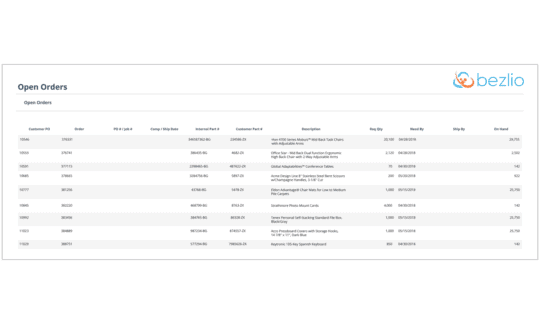
Open Order Access
By allowing customers to view their full queue of open orders that are ready for processing they can address those that are more time-sensitive, make better forecasting, and drill down into further details on an as-needed basis.
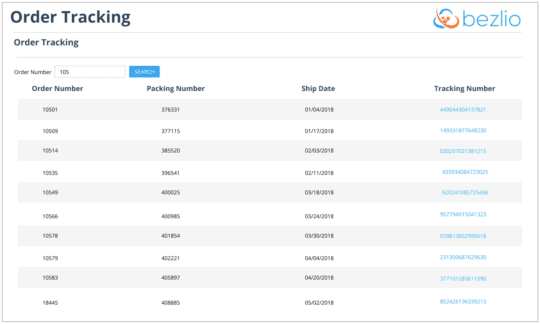
Order Tracking
With a simple and self-explanatory approach to giving customers further visibility into the ordering process, your customers gain better forecasting and turnaround time on orders. This empowers them to deliver on their obligations with better accuracy. As a result, their trust in your dependability increases.
Order History
Providing full visibility into order history allows customers to recreate previous purchases with ease, download and print the necessary details as needed, and maintain cleaner data regarding invoicing, supply on hand, and spending over given periods.
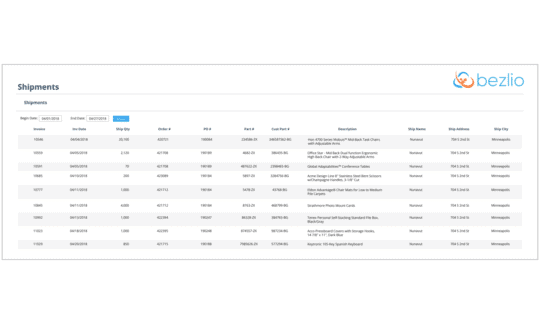
Shipment Tracking
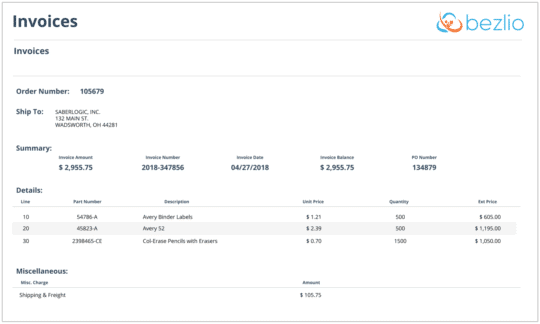
Shipping visibility gives customers access to the full field of details regarding every order, including invoice numbers, dates, quantities, order numbers, PO numbers, part numbers, and much more. Good for both in-process and historical data, shipping visibility is one component of Bezlio’s services everyone agrees is essential.
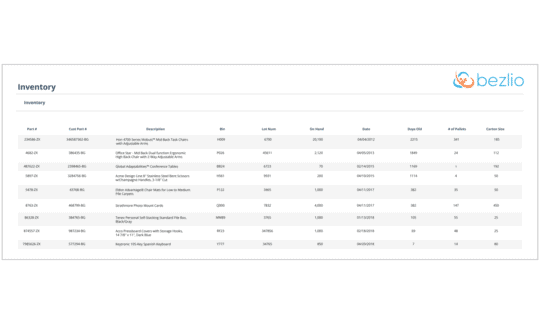
Parts And Inventory Lookup
General and custom parts look-up facilitates real-time inventory visibility to ensure your customers can get the parts and products they need to be delivered on time and as expected.
Invoice Archives
Convenience invoice sorting and search allows customers to find their invoices by order number and to share essential invoice details with the click of a mouse button.
Autonomous Order Entry
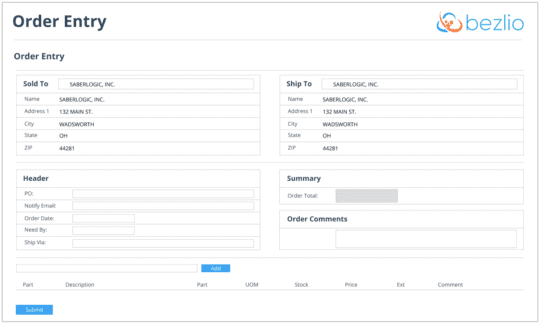
Going one step further than reviewing important order and inventory details, the ability to place orders on their own, without the tedious set-up associated with complicated e-commerce platforms.
AboutBezlio
Bezlio is a US-based company with 15 years of experience in customizing and optimizing ERP (enterprise resource management) systems and manipulating data. Specializing in mobile, cloud-based integrations, Bezlio offers many supplemental tool integrations for existing Epicor systems, such as mobile crystal reports, Amazon Seller integration, Salesforce + ERP, tableau write-back, and the recently added self-service customer portals.
Encompass Solutions is a business and software consulting firm specializing in ERP systems, EDI, and Managed Services support for Manufacturers and Distributors. Serving small and medium-sized businesses since 2001, Encompass modernizes operations and automates processes for hundreds of customers across the globe. Whether undertaking full-scale implementation, integration, or renovation of existing systems, Encompass provides a specialized approach to every client’s needs. By identifying customer requirements and addressing them with the right solutions, we ensure our clients are equipped to match the pace of the Industry.
Right now, employment in the US is the highest it’s been in over a decade. That has put a lot of businesses in a tough position when hiring talented employees. More and more businesses are running into the same problem: lack of availability of capable manpower. With so much competition, your business may want to consider going down a more progressive route.
By implementing automated processes made possible with ERP software, your business can avoid the resource-intensive undertaking of searching for, hiring, and onboarding new talent in a competitive labor market. Getting rid of the mundane and repetitive tasks on your back-end will free up your workforce to take on more customer-focused tasks, ensure your business is positioned to adapt to a sudden change in your business environment, and improve your bottom line without sacrificing headcount or quality customer experiences.
Addressing Labor Market Constraints
While low unemployment is great for job-seekers, it puts businesses in a tough position when hiring new talent to help their operations expand. Couple that with employees having more bargaining power in the workplace and it’s clear that businesses not only need to improve their benefits but their environment, as well. One of the easiest ways to address the trend is to automate processes. This will free up your employees to take on more creatively demanding and fulfilling roles within the workplace. This not only allows the employee to take on more significant tasks within the organization, but also grow professionally and receive compensation worthy of their increased responsibility and skill set. As a result, their time is more valuable and the work they produce for the company is valued more highly in the eyes of customers.
Combining Process Automation With ERP
One of the biggest buzzwords to come out of Industry 4.0 is Robotics Process Automation (RPA). However, the misleading name is enough to turn off even those who can benefit from it the most. RPA doesn’t involve any robots or mechanical components. Not only this, but it applies to just about any business that deals with ordering, invoicing, and data entry.
Let’s break it down by definition:
Robotic – an entity being programmed by a computer to complete complex tasks. In this case, the term refers to mimicking human actions.
Process – A sequence of steps leading to a meaningful activity or task.
Automation – when a task happens automatically, i.e. without human intervention.
RPA is a business process automation technology that automates tasks through the interface a company uses to enter data in the back-end of their operations. In short, RPA initially watches a user perform a task in the GUI, then automates that task and performs it autonomously. One common application can be found in identifying important attachments in emails, like an invoice, extracting that data, and then entering it into the company bookkeeping system. This all happens automatically and in a fraction of the time, it takes a human worker to complete manually.
The Impact of RPA On Employment
While it’s no secret that many workers are skeptical of automation and fear it can lead to layoffs, the incorporation of such technology has had the opposite effect according to a study conducted by the London School of Economics. The study found that rather than a decrease in the workforce, employees were able to achieve greater productivity and work completed with the same number of people.
The same study also found that RPA technology enables repatriation of processes in the workplace, allowing companies to bring processes back to their home soil, rather than outsourcing business processes to cheaper labor markets abroad.
The Impact of RPA on Employees
A company’s greatest resource is its employees and anything a business can do to retain top talent is in its best interest. RPA directly contributes to the benefit of employees by implementing practices that reduce the stress of a cluttered and over-managed environment. Here are a few examples:
Reduction in human error – When RPA takes over the mundane and tedious tasks involving data entry, there are far fewer instances of human error leading to blockers and errors on the paperwork that must then be re-evaluated and re-submitted. With the risk of human error substantially diminished, your employees spend less time going over the same data they’ve already entered and less time thinking about what might have gone wrong after the fact. A more precise and automated workflow allows your employees to spend more time fretting and overdelivering the best service to your clients.
Employee Empowerment – One of the biggest challenges in retaining top talent is providing these individuals and teams with the ability to share innovative ideas and creative solutions to business challenges, have their voices heard, and directly impact the future of their company. They want buy-in and the ability to pursue their full potential within the company. Give them the opportunity by getting rid of the tedious tasks that can suck up most of their day with an automated workflow process.
Organization Of Your Organization – When your workflow and document management are automated, there are far fewer instances of lost documents or searching through the system for the latest iteration. The organization is one of the many byproducts of RPA. When employees aren’t spending the time to track down documents between departments, more time is made available for employees to take a measured approach to more critical tasks with more time to collect, plan, and strategize, or fit in a personalized call to a new customer or prospect you’ve been working on.
Internal Communication Improves – When the opportunity for employees to lose documents or impact another worker’s tasks is removed from the equation, relationships between coworkers improve and productive communication becomes the norm. Cleaner data and better access to their colleagues ensure that your employees have what they need to do their jobs correctly and well. Workflow automation lends itself to effective monitoring of tasks as well, so looming deadlines and tasks past due don’t contribute to office stress levels.
With improved confidence and a new sense of ownership resulting from RPA and an effective ERP software solution, both employees and businesses benefit. The result is a better service, better product, and better working environment, which pleases everyone from the management to the employee to the customer.
Encompass Solutions, Inc. is an ERP consulting firm, an Epicor Platinum Partner, and NetSuite Solution Provider that offers professional services in business consulting, project management, IT support, and software implementation. Whether undertaking full-scale implementation, integration, and renovation of existing systems or addressing emerging challenges in corporate and operational growth, Encompass provides a specialized approach to every client’s needs. As experts in identifying customer requirements and addressing them with the right solutions, we ensure our clients are equipped to match the pace of the Industry.
It’s no secret that the manufacturing landscape is changing constantly and new technologies are emerging faster than ever. It is for these reasons that identifying which technologies will give your enterprise a competitive edge and allow it to weather the storm of disruption is essential. Adopting a unified ERP system to more efficiently connect and organize your operations is one such advantage. Here’s a list of 10 things you can do to ensure your ERP implementation is a success once you’ve identified which solution is right for your enterprise.
1. Pick The Right Partner For The Job: ERP Consultants, Vendors, and Partners
Who you enlist to assist with your ERP implementation is a crucial component of ensuring your success, if not the most important factor contributing to the outcome project.
Don’t add yours to the long line of inefficient and outright failed ERP implementations by doing your due diligence and identifying a vendor, partner, ERP consulting firm, or other organization that speaks to your needs and connects with your organization, its goals, and desired outcomes. You and your teams will likely be working with these ERP experts for months on end, so it’s important to connect not just on a professional level, but a personal one too. After all, if you’re collaborating with someone you can’t stand, there is little chance the project will survive such a strained working relationship.
Trust your partner to know how to manage the project since it’s likely they’ve completed several implementations across an array of industries. It may mean giving up some control you’re used to maintain, but the success of your project trumps comfort, without question.
2. Pick The Right Solution For Your Situation: Not All ERP Solutions Are Built Alike
There are ERP platforms that have been around for decades and ERP solutions that were developed as recently as last year. They all offer different values for their price. Some sacrifice capability for ease of use, while others sacrifice emphasis on one enterprise need at the expense of another. Whether you want an ERP solution that is cloud-based, hosted, on-premise or one that can be all three, options exist to address your enterprise’s needs. That doesn’t mean the search for the right fit will be easy.
Are you shopping for an ERP solution geared closer to process manufacturing, discrete manufacturing, or a service you provide? It’s better to measure twice and cut once. Don’t’ waste precious resources, like time, money, and labor, on a solution that won’t address your most critical of needs. Contact ERP consultants and vendors, arrange for demos of each solution and meet with your teams to understand what they’ll need out of the final product.
3. Plan For The Future: Going Beyond Go-Live
Your success doesn’t stop once things are up and running. How will your enterprise utilize your new ERP solution for the next 5 or 10 years? Upgrades, turnover, customizations as you enter new markets, and so many more factors await as you move forward.
You need a solution that grows with your business’ trajectory, which makes it even more critical to select a solution that can accommodate that new warehouse overseas or subsidiaries on the horizon. Changing regulations and compliance requirements at local, state, national, and international levels may be something you need to consider.
Going into your selection process with a roadmap of where the organization is going over the next decade will ensure you aren’t painted into an expensive corner. Plan as far as you can to give your partners the clearest picture of your intended journey as possible.
4. Staff Buy-in: On-Boarding Makes The Difference
Let’s put this out there first: nothing ensures a business’ success more than its employees. That said, your staff needs to be on board with this transition or it’ll be destined to fail before it starts. Naturally, change, especially significant change can be fear-inducing. However, with the right approach, your staff can come to embrace the coming change. Address their apprehensions, and be prepared to give concrete answers to how the new system will address employee needs and make their jobs both easier and more efficient. Getting your staff to understand why this change is coming is integral in getting them on board with how you go about implementing it.
5. Sideline The Bureaucracy: Streamline Implementation
Bureaucracy is notorious for slowing down even the most efficient processes. EPR consultants and integrators are good at their jobs when they’re allowed to operate. By getting the necessary parties involved from inception, you can avoid blockers to critical processes during implementation. This may depend on how many layers of management your organization had in place, but by clearing the channel to enable the ERP consultants to do their job without impediment, you can avoid bottlenecks and wasting precious resources in the process.
6. Establish Order: Project Roles And Responsibilities
When it comes to both in-house and external resources, make sure everyone has a clear understanding of their role and responsibilities during your ERP implementation process. Your partnered ERP consultant will walk you through the process and give recommendations on how best to delegate the workload during implementation. Ensure that you and your team know what’s going on at every stage to avoid bottlenecks and unintended setbacks.
7. An Opportunity To Redefine Your Business Processes
Your ERP consultants will likely conduct a business process review before beginning your ERP implementation. This is a critical time for your business to reevaluate how processes are carried out. While you may be tempted to replicate old ways of doing things on a new ERP platform, the new system enables your teams to make more efficient use of the tools at their disposal. Go back to the beginning and determine whether your organization should change the way they do things from the onset. Keep in mind, that many ERP software solutions come built-in with the best practices of hundreds if not thousands of businesses in related industries.
8. Emphasize Clean Data
Old SKUs, incomplete, and just plain bad customer data don’t need to follow you into a new era for your business. make an impact with a new start that doesn’t leave room for shoddy work. Ensuring your recording and data practices are clean and clear from the start is the best way to ensure the right approach to record-keeping and management is in your future.
9. Don’t Cut Corners On Training
Like onboarding, your team should be in it to win it when it comes to your ERP implementation. That means they need to know the software inside and out when it comes time to use the platform. A quality ERP consultant will get your staff trained in all the right tools needed for their given role. Instill confidence in your team by giving them the best training that money can buy, your business with prosper and your staff buy-in will increase with your investment.
10. Don’t Cut Ties After Go Live
When it comes time to use the new ERP solution on your own, chances are there will be bumps in the road as you move forward. This is where your team’s training is proven and your reevaluated business processes are put to the test. Consider bringing on an ERP consultant that offers managed services and support beyond ERP implementation. Maintaining a solid professional relationship with partners can save your business a lot of unnecessary grief and precious resources in the long run. On the other end of a successful go-live, when your business hits the ground running and has a bright future ahead a good partner can enable your enterprise to take advantage of rapid development and position for expansion.
Encompass Solutions, Inc. is an ERP consulting firm and Epicor Gold Partner that offers professional services in business consulting, project management, and software implementation. Whether undertaking full-scale implementation, integration, and renovation of existing systems or addressing emerging challenges in corporate and operational growth, Encompass provides a specialized approach to every client’s needs. As experts in identifying customer requirements and addressing them with the right solutions, we ensure our clients are equipped to match the pace of the Industry.
The Industrial Internet of Things (IIoT) has flooded manufacturers with information like never before with valuable data from every aspect of operations. However, having data is only part of the solution. You need to be able to make sense of that data in your possession. Experiencing only a portion of the bigger picture can leave your business shortchanged on vital data necessary to make informed decisions on the future of your organization. ERP solutions, whether appealing to process manufacturing or discrete manufacturing operations, provide a way for businesses to make sense of the data new technology is revealing. Here are some ways you can leverage modern tech and ERP to optimize your operations.
Modern Maintenance: Prediction Preventing Predicaments with IIoT Connectivity
Utilizing modern sensing and machine learning capabilities, a true prediction is possible when it comes to maintaining your manufacturing equipment on the factory floor.
Everything from vibration, voltage, temperature, and other performance aberrations feed into analytical tools and are visualized by intelligent ERP solutions, to be translated as a set of warnings and alerts for the right set of eyes to evaluate and make a call on what action to take.
These innovative tools have proven their efficacy in reducing the instances of incidents, accidents, and breakdowns significantly. So much so, that no one can afford not to consider implementing these tools into their operations shortly.
Automated systems can order replacement parts if none are on-site and schedule the replacement or repair at a point resulting in minimum downtime when it comes to production.
You might be asking: well, how does this new take on maintenance affect my bottom line? Have you ever had a part break on a critical piece of equipment? What procedures are in place to replace or repair broken machinery? Intelligent and connected devices throughout the factory can set critical data point that indicates when a part is reaching end-of-life. Automated systems can order replacement parts if none are on-site and schedule the replacement or repair at a point resulting in minimum downtime when it comes to production.
That’s one example. What if an abnormally humid summer is leading to excessive heat in the workspace as well as moisture? Maybe a crucial machine is shutting down intermittently, requiring a manual restart in each case that can take a significant amount of time. You may not have known it was faulty wiring on a portion of your factory without the insight your connected devices provide. It all boils down to getting the full picture and assuming full control. A robust ERP coupled with the IIoT in a connected factory can deliver exactly that for greater efficiency.
Mastering Agile Operations For Your Enterprise with IIoT Connectivity
With an increasingly global reach for many companies, remaining connected to bases of operation near and far is of critical importance when it comes to remaining efficient.
Properly segmenting data sets to be fed to the appropriate overseers is just one more invaluable capability of a connected enterprise.
For decades, the idea of centralized control has prevailed in energy, resources, and telecommunications industries. This philosophy is just as easily leveraged in optimizing performance in tandem with the IIoT. When it comes to manning the helm digitally, for instance on an offshore oil platform, the keyed-in, land-based operations center can communicate with their off-shore counterparts and even manipulate controls remotely with an interconnected series of software and instruments.
However, all the data being fed into a central hub from global operations can be too much for one pair of eyes. Properly segmenting data sets to be fed to the appropriate overseers is just one more invaluable capability of a connected enterprise.
Cooperative Communication And Collaboration With ERP And IIoT Connectivity
Organizing your internal operations is just as important as external components. With IIoT and ERP, that means putting the right people in the right space with the right information at their disposal.
Operating an enterprise comprised of siloed departments utilizing disparate systems is one of the biggest causes of problems in operations and one of the best reasons to switch to a unified ERP solution. These digital hairballs cause hiccups, miscalculations, bottlenecks, and so many more problems that enterprises refusing to act before it’s too late find themselves gone the way of the dodo before long. Putting everyone on the same page with a clear channel of communication and access to the data they need is essential to organizational success.
A robust ERP solution works to empower small teams at just about any scale and with the same tools global conglomerates utilize to place, ship, and trace orders, manage and store inventory, invoice, and store user data.
Not positioned for global expansion just yet? The same tools can be leveraged to more efficiently organize local teams and their work. In this case, organize your teams so that related roles are close to each other and don’t have to go across the room, hall, or floor to get to the person or people they need to speak with to get the job done right and right now. A robust ERP solution works to empower small teams at just about any scale and with the same tools global conglomerates utilize to place, ship, and trace orders, manage and store inventory, invoice, and store user data.
One Buzzword To Rule Them All: AI
While the term has been tossed around more than a golf ball in a dryer, AI is inseparable from any conversation regarding Industry 4.0 and the modern manufacturing process. It relates to machine learning and offers numerous opportunities to refine processes using technology that can not only tell you why what was done was done but also the rules followed to reach the solution. AI is connected to machine learning in the sense that all AI is machine learning, but not all machine learning is AI, but Don’t let that throw you through a loop. Let’s break it down.
Example of IIoT
An everyday example of IIoT and machine learning involves something just about everyone uses at work, home, and at play: Email. As a means of communication, it is one way we all stay in touch through every aspect of our daily life, from reaching out to loved ones, co-workers, friends, and services we hold valuable. Services like Google and Microsoft’s Outlook use powerful machine learning to identify core components of these messages and serve them to us with a high degree of accuracy when it comes to relevant content. It is estimated that Google’s machine learning algorithms are capable of filtering 99.9% of spam emails from our inboxes. Beyond spam filtering, categorizing importance is another feat that machine learning tackles skillfully. By incorporating who we communicate with most, be it a person or a service, machine learning delivers messages of importance to ensure vital communications don’t have an opportunity to slip through the cracks. These technologies have been around for years now, but the latest from Google has been a time saver for many. Smart Replies enable a lightning-fast response to emails through the use of machine learning. By “reading” text for certain keywords and phrases, Google’s machine learning algorithms can generate a series of smart replies to send with the tap of a finger or click of a mouse button that speak directly to your conversation’s content.
AI is inseparable from any conversation regarding industry 4.0 and the modern manufacturing process.
As for AI, recent discussions among groups and individuals have focused on Facebook. Both timeline feed and facial recognition AI have earned the social media giant the lion’s share of attention. An AI that omits certain bits of content in favor of others to deliver a more personalized experience has earned the company both accolades and ire. Facebook employs facial recognition, a powerful technology used to tag friends in photos posted on user profiles. However, the practice has been a contentious one that results from concerns over the collection of non-user data. Amazon’s Rekognition is a similar deep learning-based image and video analysis tool that the company says can detect, track, and analyze faces for several applications. However, its capabilities don’t end there, the software can also “identify objects, people, text, scenes, and activities, as well as detect any inappropriate content” according to Amazon.
While on the subject of Amazon, further everyday examples of AI emerge with AI-powered assistants, like Alexa, which accepts voice commands to create to-do lists, order items online, set reminders, and answer questions (via internet searches). Microsoft and Google also have iterations of AI assistants with Cortana and Google Assistant, respectively.
How AI And Machine Learning Fit Into An ERP Solution
The short answer is that they don’t. There is no direct communication between machine learning and ERP software. The two mechanisms exist as separate but necessary components of running a successful modern manufacturing enterprise. While machine learning can lend insight into how machines perform and how processes can be improved, proper ERP solutions provide the tools to communicate between departments, assign tasks to the right labor pools, and ensure the raw materials are there for the automated factory and its modern machinery to utilize. The unified system speaks to every department and presents the necessary data to make informed decisions for today, tomorrow, and far into the future.
Encompass Solutions, Inc. is an ERP consulting firm and Epicor Platinum Partner that offers professional services in business consulting, project management, and software implementation. Whether undertaking full-scale implementation, integration, and renovation of existing systems or addressing emerging challenges in corporate and operational growth, Encompass provides a specialized approach to every client’s needs. As experts in identifying customer requirements and addressing them with the right solutions, we ensure our clients are equipped to match the pace of the Industry.
The effects of emerging technology on business are felt faster and stronger than ever before in just about every industry. Most enterprises know they need modern tech to remain competitive, but do they know which technologies are the right focus for their business? Do you?
Below is a compilation of recently released findings surrounding the emerging technology. Find out why enterprises are integrating new technology, what sectors of their business they are most interested in growing, and what you can do in-house to modernize operations and scale at the pace of the industry.
Encompass Solutions, Inc. is an ERP consulting firm and Epicor Platinum Partner that offers professional services in business consulting, project management, and software implementation. Whether undertaking full-scale implementation, integration, and renovation of existing systems or addressing emerging challenges in corporate and operational growth, Encompass provides a specialized approach to every client’s needs. As experts in identifying customer requirements and addressing them with the right solutions, we ensure our clients are equipped to match the pace of the Industry.
A concept coined by Douglas Adams in his famous science-fiction novel, The Hitchhiker’s Guide To The Galaxy, the Someone else’s problem (SEP) Field masks objects and concepts. According to Adams:
An SEP is something we can’t see, or don’t see, or our brain doesn’t let us see, because we think that it’s somebody else’s problem…. The brain just edits it out, it’s like a blind spot. If you look at it directly you won’t see it unless you know precisely what it is. Your only hope is to catch it by surprise out of the corner of your eye.
In the field of social psychology, SEP goes by another name: the bystander effect. The phenomenon revolves around the concept that an individual is less likely to help someone in need or solve an existing problem in direct correlation with how many other people are present. In this case, the larger the number of bystanders, the tendency for the individual is to believe someone else has taken the agency to get things under control. The individual is, therefore, less likely to lend aid.
Someone Else’s Problem is a dangerous concept to underestimate or allow to become established as the status quo.
Other Factors Contributing To SEP
Some other concepts that come into play are the ambiguity of the problem at hand, group cohesion, or how close the social ties are between members of a group, and the diffusion of responsibility. That last concept is perhaps the most significant of the three, whereby the individual in question may believe the responsibility lies solely on other group members or that those individuals are assumed to have already addressed the problem.
The Harm Of SEP In Business
When it comes to business, the concept of SEP can emerge with significantly detrimental results. When it comes to the operations of an enterprise, Someone Else’s Problem is a dangerous concept to underestimate or allow to become established as the status quo.
Playing games of tag on tasks within a department or between departments can choke a business’ efficiency and mishandle resources when they can be put to more efficient use. For example, try to assign a list of tasks for your team to tackle as a whole and a list of tasks for each member. Team members will consistently take on the individual tasks first and consider the broader tasks as secondary priorities.
What if one, or several, of the team tasks, is a blocker for one, or several individuals’ tasks? who takes the initiative to resolve the issue(s)? Who in your organization has the visibility and understanding to prioritize and delegate essential tasks? Being able to prioritize accordingly and assume ownership is essential in keeping the business functioning at peak performance. The problem is a common one and, fortunately, the solution an accessible one.
Keeping SEP At Bay
The good news is SEP doesn’t have to be a plague upon your business. According to social psychological research, the most effective solution emerges in the reinforcement of teamwork and forming of strong bonds between coworkers. Business investment in the employee also tends to lead to their reciprocated investment in the company. Issues that can be detrimental to the business are viewed as detrimental to the individual by association. In this way, the issue isn’t kicked further down the road or ignored altogether as SEP, because, while not everyone may have the ability to address the problem, they are invested enough to acknowledge it needs to be addressed, resolved and learned from.
Once your team is functioning together and understands working towards the success of the business is an investment in their success, you can focus on reinforcing strategies for collaborative problem-solving. Quality training along with clear workflows and processes play important roles in keeping SEP at bay. A quality ERP solution can also provide the essential visibility and task management capabilities a business needs to avoid the pitfalls of SEP peril.
Having the right tools on hand, a procedural plan of action, and an answer to ” It’s Someone Else’s Problem” is the best way to keep your business SEP-free before the phenomenon can take root within your workforce.
Encompass Solutions, Inc. is an ERP consulting firm and Epicor Gold Partner that offers professional services in business consulting, project management, and software implementation. Whether undertaking full-scale implementation, integration, and renovation of existing systems or addressing emerging challenges in corporate and operational growth, Encompass provides a specialized approach to every client’s needs. As experts in identifying customer requirements and addressing them with the right solutions, we ensure our clients are equipped to match the pace of the Industry.
Encompass Solutions recently sat down with Metaphase Technologies President Kevin High to discuss the company’s current Epicor ERP implementation, manufacturing custom vision and lighting solutions, and the future of Metaphase. Here’s what Kevin had to say about his company and where he’ll be taking it with the advanced capabilities Encompass Solutions and Epicor ERP will provide.
Q: Can you describe what Metaphase does and what makes the company unique?
Our mission is to be the leading manufacturer of high-quality, high-performance, custom and standard machine vision LED lighting solutions. Metaphase Technologies is a custom job shop with over 7,000 active products and new ones developed every week. We have in-house resources, including engineering, manufacturing, sales, and service, all under one roof. We customize solutions to fit the end-user’s needs and provide application expertise to help determine the ideal solution.
Q: What are some everyday challenges Metaphase faces in business? Anything specific to vision systems and lighting that other manufacturers might not face?
As a company, some of the common challenges we face on a day-to-day basis include tracking all active projects, custom light specifications, and evaluation units we send to customers. Since we lack continuity of data platforms, it can also be challenging to track where we are in the sales cycle. Lastly, our products are an integral part of our customers’ applications, which means we have to continue designing around component obsolescence. Information acquisition is often a time-consuming challenge. It is challenging to be able to view our inventory levels, provide prompt responses, and have short lead times.
Q: What is your business hoping to accomplish with Epicor ERP software that you couldn’t previously?
Our expectations in working with Epicor are to learn efficiency in a custom job-shop environment, from top to bottom. What we are looking for is a more streamlined integration from start to finish. When our Sales Managers are in the field, we want them to be able to deliver quick and accurate information to the customers. Our goal with our next software implementation is to have a consistency of data across all departments, including BOM accuracy, to ultimately improve quality and lead times, as well as, efficiency in tracking process flows from start to finish.
Q: How are you taking advantage of the strengths and benefits of production located in North America vs. production overseas?
Being a manufacturing company in North America is beneficial for both Metaphase and our domestic customers. Our Sales team maintains a healthy relationship with customers in the USA because of the accessibility and ease of communication. Our time-to-delivery is also decreased since we are not waiting on parts manufactured internationally.
Q: At what point did you know you would need to implement an ERP solution for your business?
In 2014, we knew that we had to implement ERP software just to keep up with in-house processes, it was becoming resource intensive to find answers; paper trail audits are very resource intensive and could take days to track down information on a product shipped in previous years. Metaphase has been through the implementation of software that didn’t appropriately fit the needs of our unique company. In December 2017, we knew we wanted to start looking and exploring different ERP options because our current ERP system is inadequate to handle the custom job-shop flow our company has. We needed a better solution.
Q: Can you describe your ERP selection process?
We began our search by interviewing multiple vendors and identifying certain requirements. We evaluated live demonstrations of the software and eventually narrowed it down to two software companies. Proposals of the implementation process, as well as the financials, followed the second demonstration of the software systems. An internal discussion was needed to evaluate the risks and rewards of each and we were able to make a decision.
Q: What key component(s) of Epicor got you interested?
Epicor had not been a software we were looking into originally but a chance meeting with Sonia, President of Encompass Solutions, at the A3 convention had put them on our radar. A good repour and quality customer care from the President had been reassuring and important to us.
Q: What are some of your apprehensions regarding the implementation of a new ERP system and how did Encompass allay those apprehensions and give your company the confidence to bring us on?
There will always be uncertainties about implementing a new ERP system since there is always a chance the system will not meet our expectations. Some apprehensions we have include cost and resource allocation, not being able to complete implementation within the projected time frame, and also the transfer of data from our current ERP into Epicor. The quality of training and technical support is also a concern that we, along with many other companies, have going into an ERP implementation. Despite the apprehensions we have, Encompass has been guiding us through the process up to this point. The face-to-face communication with Sonia and Lynn has given us the confidence that they are willing to work with us throughout any issues that may occur during the implementation. The live demonstration of the software by Jeff was smooth and displayed his knowledge of the product well. The detailed proposal documentation that included the implementation process and timeline set expectations for not only Epicor/Encompass but also Metaphase. The level of detail in the documentation made us more confident that Encompass has the experience to run a smooth implementation/ERP transition.
Q: What do you expect will improve as a result of implementation?
After the Epicor implementation, we expect that our process flows within our organization will improve. The user-friendly interface will allow for more timely and accurate information to flow through the system. Being able to help the Sales team save time with easy CRM management and mobile capabilities, we expect them to have more time to do more selling!
Q: What do your employees think about the transition?
We notified our employees about our decision to move forward with Epicor and apprehension was expected. A majority of them are concerned about having a repeat of our previous ERP implementation and how many committed resources will be needed to make this work. But there is also some excitement about the possibilities this software system has and what it can do for us.
For more than two decades, Metaphase Technologies has been developing products that advance “The Quality of Light” through the engineering and manufacture of uniform diffuse high brightness and ultra brightness LED illuminators. Metaphase’s illuminators are specially designed for applications in machine vision, military, and specialty lighting. Metaphase boasts expertise in engineering flexible lighting solutions for ease of integration into vision systems design. The company’s LED illuminators are currently utilized in thousands of applications throughout the world, including vision-guided robotics, automation systems, line scan inspection units, and many others across the machine vision industry.
As the first to standardize built-in constant current drivers, Metaphase continues to synergize cutting-edge machine vision LED lighting & control technologies to simplify innovation and increase customer return on investment.
Encompass Solutions, Inc. is an ERP consulting firm, NetSuite Solution Provider, Suite Success Partner, and Epicor Gold Partner that offers professional services in business consulting, project management, and software implementation. Whether undertaking full-scale implementation, integration, and renovation of existing systems or addressing emerging challenges in corporate and operational growth, Encompass provides a specialized approach to every client’s needs. As experts in identifying customer requirements and addressing them with the right solutions, we ensure our clients are equipped to match the pace of the Industry.
Peer Insight―Network with fellow professionals, discuss common challenges and share solutions while enjoying all that Nashville has to offer
Expert Insight―Hear from Epicor executives regarding what lies ahead and schedule meetings with Epicor experts
Education ROI―Extended education sessions offer a deep dive into the business software you’re using today
You can view the full agenda here, including extended education sessions and hands-on labs. The events begin next week and we couldn’t be more excited!
Join Encompass For A Customer Appreciation Event At Epicor Insights 2018
We are looking forward to seeing you all at Insights. This is a great chance for all of our customers to both meet each other and exchange war stories, but also for you to get a chance for some face-time with your Encompass team ― this year there will be representation at both an Executive and Operations level, as well as the account management team ― Sonia and Dave both look forward to meeting new customers and spending time with those of you who have done business with Encompass for years.
Our team will be available throughout the event for meetings to discuss how we might support your organization in those endeavors. After a long day of training please join us for food and drink while surrounded by natural splendor beneath a soaring glass atrium in the Delta Pavilion Gazebo!
Encompass Solutions’ strategic partner Bezlio has added further enhancements to its mobile dashboard and user interface capabilities within ERP software. The latest feature comes in the form of streamlined and intuitive customer service portals that enhance the overall experience when it comes to providing documentation and service to clients at all hours. An effective ERP solution, with the latest in customer-focused tools, can help differentiate your business from competitors and stand out in a crowded marketplace.
ERP Integrated Self-Service Portals
Customers want access to their essential documents, invoices, and purchase orders, and not just during office hours. Customer portals have fast become a crucial component of the customer experience. As a result, their availability has risen to the top of expected features in any business environment. And why shouldn’t they be?
Bezlio has delivered an attractive and seamlessly integrated answer to customer demand with a customer service portal that can be easily incorporated into an existing EPR system and accessed via desktop or mobile device. Within the ERP integrated self-service portals, customers can:
Open orders
Review order history
Track orders
Review shipping records
Access inventory in real-time
Access invoices
These powerful capabilities are the new normal when it comes to the customers’ experience and businesses must keep up to satisfy an increasingly discerning audience of current and prospective clients. However, reading and displaying data is just the beginning.
An Open Channel Of Communication
Now more than ever, Customers want an open channel of communication available for when questions are asked and answers are needed, on-the-fly. Two-way communication within the customer portal ensures that your customers are empowered to write data and complete transactions directly to your source application. Cut out the complication of modern e-commerce systems and let your customers place orders on their time with the Order Entry functionality of Bezlio’s customer self-service portal.
Security Is Key
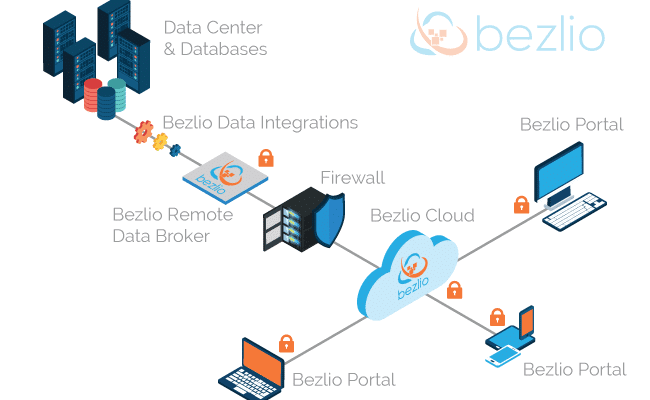
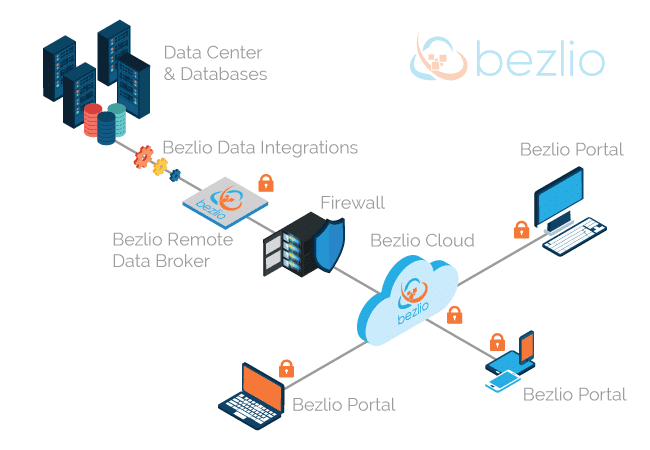
As with all digital information exchanges, security is of the utmost importance. Bezlio’s approach ensures you never synchronize a single byte to the cloud, and receive the benefit of top-level encryption and security measures to protect your business and your associated data.
The Gauntlet of Bezlio Security Measures Keeping Your Data Safe.
How To Implement The Bezlio Self-Service Center
So, you know you need a functional ERP integrated self-service portal, but don’t know where to begin with integration. Fortunately, the process is made simple and enterprises will only need to follow a few simple steps before they are up and running with this powerful integration from Bezlio.
Initially, the data agent from Bezlio will need to be installed inside of an enterprise’s firewall, be it through Bezlio, a partner, or an ambitious enterprise with a crack IT squad. The agent will be configured to communicate with the sources of data within the enterprise ERP, which can be assigned permissions based on the data to be shared. After that, queries to pull the data are linked up with Bezlio. These can be existing queries or built from scratch to fit a particular purpose within your enterprise. Once the backend is set up, templates and custom HTML/CSS/JavaScript can be utilized to create an attractive interface on the customer-facing end. Once things are set up, all that’s left is to bring your customers into the fold and show them the new and powerful tools at their fingertips. The benefits of more satisfied customers and enhanced ROI are now yours to enjoy.
AboutBezlio
Bezlio is a US-based company with 15 years of experience in customizing and optimizing ERP (enterprise resource management) systems and manipulating data. Specializing in mobile, cloud-based integrations, Bezlio offers many supplemental tool integrations for existing Epicor systems, such as mobile crystal reports, Amazon Seller integration, Salesforce + ERP, tableau write-back, and the recently added self-service customer portals.
Encompass Solutions is a business and software consulting firm specializing in ERP systems, EDI, and Managed Services support for Manufacturers and Distributors. Serving small and medium-sized businesses since 2001, Encompass modernizes operations and automates processes for hundreds of customers across the globe. Whether undertaking full-scale implementation, integration, and renovation of existing systems, Encompass provides a specialized approach to every client’s needs. By identifying customer requirements and addressing them with the right solutions, we ensure our clients are equipped to match the pace of the Industry.
We are pleased to announce that legendary NFL quarterback, Peyton Manning, will be joining us as the Epicor Insights 2018 guest keynote speaker.
(Photo by Bobby Ellis/Getty Images)
Peyton Manning, the NFL’s only five-time Most Valuable Player and a 14-time Pro Bowl selection, has earned his place among the greatest quarterbacks in league history as a leader in nearly every statistical passing category. During the 2015/2016 season, Manning led the Denver Broncos to a 24-10 win over the Carolina Panthers in Super Bowl 50, making him the first starting quarterback in NFL history to win a Super Bowl with two different teams.
Manning has continued his efforts off the field and was honored as the recipient of the Byron “Whizzer” White Humanitarian Award and the NFL’s Walter Payton Man of the Year in 2005, the Bart Starr Award in 2015, and the Lincoln Medal in 2017.
Manning serves as a member of the American Red Cross National Celebrity Cabinet and The Pat Summit Foundation Advisory Board. He and his wife, Ashley, established the PeyBack Foundation in 1999 to promote the future success of disadvantaged youth by assisting programs that provide leadership and growth opportunities for children at risk. The payback Foundation has provided more than $13 million of impact to at-risk youth through its grants and programs since its inception.
Register today so you can secure your spot for Peyton Manning’s keynote!
Join Encompass For A Customer Appreciation Event At Insights 2018
We are looking forward to seeing you all at Insights. the good news doesn’t end with the announcement of the Epicor Insights 2018 guest keynote speaker, either. This is a great chance for all of our customers to both meet each other, and exchange war stories, but also for you to get a chance for some face-time with your Encompass team – this year there will be representation at both an Executive and Operations level, as well as the account management team – Sonia and Dave both look forward to meeting new customers and spending time with those of you who have done business with Encompass for years.
Our team will be available throughout the event for meetings to discuss how we might support your organization in those endeavors. After a long day of training please join us for food and drink while surrounded by natural splendor beneath a soaring glass atrium in the Delta Pavilion Gazebo, Wednesday, May 23, 2018, from 5:00 PM – 7:00 PM!
Encompass Solutions, Inc. is an ERP consulting firm and Epicor Platinum Partner that offers professional services in business consulting, project management, and software implementation. Whether undertaking full-scale implementation, integration, and renovation of existing systems or addressing emerging challenges in corporate and operational growth, Encompass provides a specialized approach to every client’s needs. As experts in identifying customer requirements and addressing them with the right solutions, we ensure our clients are equipped to match the pace of the Industry.