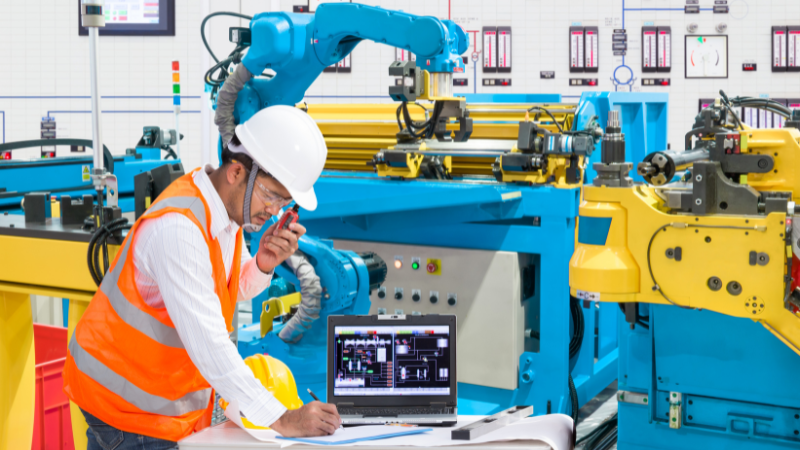
Artificial intelligence (AI) is a broad term attached to various Enterprise Resource Planning (ERP) services for manufacturing automation. These AI-powered ERP solutions aim to enhance efficiency, streamline processes, and provide valuable insights for manufacturing operations. By leveraging machine learning algorithms and predictive analytics, AI-enhanced ERP systems can anticipate potential issues, optimize resource allocation, and automate routine tasks. Integrating AI in ERP technology empowers manufacturers to make data-driven decisions faster, adapt to market changes more effectively, and maintain a competitive edge in an increasingly digital industry landscape.  Having introduced AI’s role in manufacturing automation, let’s delve deeper into its integration with ERP systems such as Epicor Kinetic. 

AI in ERP

AI is a predictive computer model that enables programs to contextualize questions or tasks and generate responses based on trained data. Enterprise Resource Planning (ERP) systems, such as Epicor Kinetic, provide customizable, robust software solutions to track information for manufacturing services, financial systems, and efficiency studies. When integrated with ERP systems, AI broadens the scope, improves accuracy, and enhances the efficiency of individual tools offered.  

This connection between AI and ERP creates a powerful platform for businesses to optimize their operations and make data-driven decisions in real-time. This connection of technologies allows companies to automate complex processes, forecast trends more accurately, and adapt swiftly to changing market conditions, giving them a significant competitive advantage.  

How AI is used in Manufacturing

AI is utilized in various tools that automate manufacturing and enhance data accuracy. It sorts through numerous suppliers using specific parameters to find optimal matches and initiate orders. AI analyzes historical data on submitted orders and inventory requirements to provide predictive insights for company preparedness. Additionally, it improves data collection quality for studying production efficiency and status.   

These AI-driven capabilities enable manufacturers to make more informed decisions, optimize their supply chains, and respond swiftly to market changes. Furthermore, AI integration in manufacturing processes can lead to significant cost reductions and improved product quality by identifying inefficiencies and predicting maintenance needs before equipment failures occur.  

Common Myths Surrounding AI

While AI is developing rapidly and powerfully, its output types and scope remain limited. Accurate, targeted AI models require abundant clean, high-quality data. Many companies overestimate their data resources, lacking the volume or quality needed for effective model training. Contrary to common belief, AI doesn’t create information or expand its understanding independently. It requires extensive data because it predicts actions solely based on its accessible information history. Consequently, the more quality data fed to the model, the more accurately it can predict optimal responses.   

Lastly, due to AI’s novelty, businesses seeking customized solutions face a scarcity of quality information and expert assistance. This challenge underscores the importance of partnering with experienced AI consultants who can guide companies through the complexities of data preparation, model selection, and implementation to maximize the benefits of AI integration.  

How AI Can Automate Your Business

Although there are many conflicts and misunderstandings surrounding AI, when used correctly, the added functionality of a trained model is compelling at bringing automation to your business. Products like Epicor Grow and Prism provide models that can interact with suppliers, offer predictive analysis for inventory and production, and provide insights into potential efficiency improvements. Sorting through the vast array of different products, performing a study to determine what needs to be implemented, and executing the physical implementation steps can be a complex undertaking for a busy company.   

As an Epicor premier partner in this field, Encompass Solutions can provide the expertise needed for Automation Audits to understand better your specific needs, as well as continued support through the implementation process to ensure long-term adoption is successful.

How Encompass Solutions Can Be a Part of Your Journey

Encompass Solutions understands how manufacturing automation provides companies with the know-how and services to implement ever-evolving AI tools that enhance productivity.  

  • Expert Guidance: Leading companies through each stage of the ERP implementation process with expertise and best practices. 
  • Customization: Offering direct customization of Epicor’s AI solutions to meet each company’s unique specifications and requirements. 
  • Training: Providing comprehensive training to equip staff with the necessary skills to fully leverage AI functions and capabilities. 
  • Ongoing Consulting: Delivering continuous support and service to address any post-deployment issues or challenges promptly.

Integrating AI in ERP systems represents a powerful opportunity for manufacturing businesses to revolutionize their operations. While the implementation of AI technology comes with its challenges, the potential benefits of efficiency, accuracy, and decision-making capabilities are substantial. Partnering with an experienced consultant like Encompass Solutions can help navigate the complexities of AI adoption, ensuring a smooth transition and maximizing the return on investment. As AI continues to evolve, businesses that embrace this technology will be well-positioned to thrive in an increasingly competitive and digital manufacturing landscape. For more information on how Encompass Solutions can help automation your AI and ERP journey, visit www.oldencompass.sevenagesdesign.com


Accounting might not be a favorite topic, but it’s essential for your team and business. The days of relying on spreadsheets are behind us, and many small to medium-sized companies use QuickBooks, a popular accounting program. However, as your business grows, you may outgrow QuickBooks. When should you switch to a more robust solution like Enterprise Resource Planning (ERP) software? This ERP vs. QuickBooks comparison will help you understand the best option to keep your business moving forward.

What is QuickBooks?

QuickBooks is a widely used accounting solution ideal for sole proprietors and small to medium-sized companies, including some manufacturing operations. It offers invoicing, payroll, financial reporting, and basic accounting capabilities. However, it focuses solely on accounting. If you need software for other functions, such as production planning, you’ll need separate solutions that may not integrate well.

QuickBooks works well for small companies with a user limit of 40. It helps businesses keep track of finances, handle taxes, and plan for the future.

What is ERP Software?

Enterprise Resource Planning (ERP) software, like Epicor, is a comprehensive solution that, although more expensive, becomes cost-effective as your company grows. It is designed for larger teams and complex operations, scaling with your success. ERP software handles multiple locations, currencies, and extensive customization options, and integrates various business functions, including manufacturing processes, supply chain, and customer relationship management.

ERP systems manage all your complex operations, reducing errors and redundancy compared to using multiple systems.

When Should You Consider Switching?

QuickBooks is a good solution for smaller businesses, but as you grow, you might need more robust support. Here are signs that indicate it’s time to consider switching to ERP software:

  • You are approaching or have hit the 40-user cap, and scaling QuickBooks further becomes expensive.
  • You use multiple software platforms to manage different parts of your business, leading to mounting errors and inefficiencies.
  • QuickBooks inventory management can no longer keep up with your needs.
  • Employees spend too much time transferring and re-entering data.
  • Data tracking issues arise because information is scattered across different systems.
  • Inventory problems lead to customer service issues.
  • Demand forecasting relies heavily on guesswork.
  • You engage in made-to-order and discrete manufacturing.

Outgrowing QuickBooks can be subtle, but addressing these issues early saves money and boosts employee morale.

What Does ERP Software Offer?

ERP software is customizable to meet your team’s needs, with modular functionality allowing you to add or remove features as necessary. An ERP consultant, like Encompass Solutions, can help navigate your specific needs and implement a tailored solution. ERP software offers:

  • Accounting in multiple currencies, languages, and locations.
  • Cloud-based solutions for accessible business data.
  • Integration of finance, supply chain, and customer relationship management.
  • Real-time data visibility across your organization.
  • Advanced tools for production planning and scheduling.
  • Real-time inventory management for raw materials, works-in-progress, and finished goods.
  • Demand forecasting without guesswork.

ERP software consolidates multiple functions into one platform, simplifying IT management and reducing the need for multiple integrations.

Will You Outgrow Your ERP?

No, ERP platforms are scalable. You can add features and users as needed, with costs increasing reasonably. A consultant can help future-proof your ERP, ensuring it evolves with your company.

ERP systems are tailored to your needs, whether managing international contractors, supply chains, or peak production periods. They allow for growth without losing data, minimizing the risk of human error during migrations.

Can an ERP Integrate with Existing Systems?

Yes, ERPs can integrate with your existing software, allowing smooth data transfer. They are often cloud-based, compatible with various devices, and support remote work.

What If I Like QuickBooks?

In regards to ERP vs. QuickBooks, QuickBooks is excellent for smaller businesses and is user-friendly. If your business remains small, it might suffice. However, growing businesses with expanding teams and formal manufacturing processes may need more comprehensive features.

How to Choose the Right ERP System?

Choosing the right ERP involves assessing your needs, evaluating vendors, and considering your budget. Encompass Solutions can help with ERP solutions designed to streamline manufacturing processes, support growth, and integrate cross-functional teams.

We assist in selecting, negotiating, and supporting the right ERP system for your team. Our custom development services ensure your ERP system is a perfect match, keeping you ahead in your industry.

If QuickBooks no longer meets your growing business needs, contact Encompass Solutions. As an Epicor partner, we provide ERP solutions tailored to made-to-order and mixed-mode manufacturing companies, ensuring your business thrives with advanced support and integration.

Ready to take the next step? Contact us today to schedule a consultation by filling out a form and discovering how our ERP solutions can transform your business. Understanding ERP vs. QuickBooks is crucial for making the right decision for your company’s future.


In today’s fast-paced business landscape, organizations constantly search for ways to optimize their operations and gain a competitive advantage. One particular area that often presents challenges is supply chain management. The smooth flow of goods and information from suppliers to customers is critical for the success of any company. This is where the power of Enterprise Resource Planning (ERP) comes into play. ERP systems provide a comprehensive solution for streamlining supply chain management by integrating various processes and departments into one centralized platform. From procurement and inventory management to production planning and customer relationship management, ERP empowers businesses to make informed decisions, cut costs, and enhance overall efficiency. In this article, we will explore the potential of ERP in revolutionizing supply chain management and how it can help businesses stay ahead in today’s competitive marketplace.

What is ERP?

At its core, ERP is a software system that integrates various processes and departments into one centralized platform. It allows companies to manage and automate a wide range of business activities, including finance, human resources, procurement, inventory management, production planning, and customer relationship management. By providing a holistic view of the organization’s operations, ERP enables businesses to make informed decisions, reduce costs, and improve overall efficiency.

Benefits of Using ERP in Supply Chain Management

Implementing an ERP system for supply chain management offers numerous benefits. First, it enables real-time visibility into the entire supply chain. With a single source of truth, businesses can track inventory levels, monitor production processes, and identify potential bottlenecks or delays. This visibility allows for better planning and forecasting, ensuring the right products are available at the right time.

Secondly, ERP systems facilitate better collaboration and communication between different departments and stakeholders involved in the supply chain. By breaking down silos and enabling seamless information sharing, teams can work together more efficiently, resulting in faster decision-making and improved customer service.

Additionally, ERP streamlines critical supply chain processes such as procurement and inventory management. With automated workflows and integrated tools, businesses can optimize their purchasing activities, reduce lead times, and minimize stockouts or excess inventory. This not only saves costs but also improves overall supply chain performance.

Streamlining the Supply Chain with ERP

ERP systems play a vital role in streamlining the supply chain. One way they achieve this is through demand planning and forecasting. By analyzing historical data and market trends, ERP software can accurately predict demand and help businesses align their production and inventory levels accordingly. This proactive approach ensures that products are available when customers need them, reducing lead times and enhancing customer satisfaction.

Another key aspect of supply chain management that ERP addresses is order fulfillment. With integrated order management functionality, businesses can automate and streamline the order-to-cash process. ERP systems ensure smooth and efficient order fulfillment, from capturing customer orders to managing shipping and invoicing, reducing errors and delays.

Furthermore, ERP allows for effective inventory management. By providing real-time visibility into inventory levels, ERP systems help businesses optimize their stock levels, minimize carrying costs, and prevent stockouts or overstocking. This level of control ensures that the right products are available at the right time, reducing lead times and improving customer satisfaction.

Key Features of ERP for Supply Chain Management

To effectively streamline supply chain management, ERP systems offer a range of key features. These include:

Demand Planning and Forecasting

ERP software leverages historical data and market insights to accurately predict demand, enabling businesses to optimize their production and inventory levels.

Order Management

Integrated order management functionality allows businesses to automate and streamline the entire order-to-cash process, reducing errors and delays.

Inventory Management

Real-time visibility into inventory levels helps businesses optimize stock levels, minimize carrying costs, and prevent stockouts or overstocking.

Supplier Management

ERP systems enable businesses to effectively manage their supplier relationships, ensuring timely deliveries and maintaining high product quality.

Warehouse Management

ERP systems improve efficiency, reduce errors, and optimize storage and picking processes by automating warehouse operations.

Transportation Management

Integrated transportation management functionality allows businesses to optimize shipping routes, reduce costs, and improve delivery times.

Implementing ERP for Supply Chain Management

Implementing an ERP system for supply chain management is a complex undertaking that requires careful planning and execution. It involves several steps, including:

  1. Needs Assessment: Identify the specific requirements and goals of the organization to determine the right ERP solution.
  2. Vendor Selection: Research and evaluate different ERP vendors based on factors such as functionality, scalability, ease of use, and customer support.
  3. System Customization: Customize the ERP system to align with the organization’s unique supply chain processes and requirements.
  4. Data Migration: Transfer existing data from legacy systems to the new ERP system, ensuring data integrity and accuracy.
  5. User Training: Provide comprehensive training to employees to ensure they can effectively use and maximize the benefits of the ERP system.
  6. Testing and Deployment: Thoroughly test the ERP system before deploying it across the organization, ensuring a smooth transition and minimal disruption to operations.

Challenges and Considerations When Implementing ERP

While implementing an ERP system can bring significant benefits, it also comes with its fair share of challenges. Some common challenges and considerations include:

  • Cost: ERP implementation can be expensive, including upfront costs for software licenses, hardware infrastructure, customization, and ongoing maintenance and support.
  • Change Management: Introducing a new system can disrupt existing workflows and require employees to adapt to new processes. Effective change management strategies are essential to ensure a smooth transition.
  • Data Integrity: Migrating data from legacy systems to the new ERP system requires careful planning to ensure data integrity and accuracy.
  • Scalability: As businesses grow and evolve, the ERP system needs to be scalable to accommodate increased data volumes, users, and functionality.
  • User Adoption: Ensuring user buy-in and providing comprehensive training is crucial for successful implementation.

Best Practices for Optimizing Supply Chain Management with ERP

To maximize the benefits of ERP in supply chain management, businesses should follow these best practices:

  1. Define clear goals and objectives: Clearly define the desired outcomes and objectives of implementing an ERP system for supply chain management.
  2. Involve key stakeholders: Involve key stakeholders from different departments and levels of the organization to ensure their needs and requirements are considered throughout the implementation process.
  3. Ensure data accuracy and integrity: Invest time and resources in data cleansing and migration to ensure accurate and reliable data in the ERP system.
  4. Provide comprehensive training: Train employees on how to effectively use the ERP system and its specific features for supply chain management.
  5. Continuously monitor and improve: Regularly monitor key performance indicators and metrics to identify areas for improvement and optimize supply chain processes.

Conclusion

In today’s competitive marketplace, streamlining supply chain management is essential for businesses to stay ahead. ERP systems offer a comprehensive solution for integrating and optimizing supply chain processes, enabling real-time visibility, better collaboration, and improved efficiency. By leveraging key features such as demand planning, order management, and inventory management, businesses can unlock the full power of ERP in revolutionizing their supply chain. However, implementing ERP for supply chain management comes with challenges and considerations that need to be carefully addressed. By following best practices and learning from successful case studies, businesses can successfully harness the power of ERP to streamline their supply chain and gain a competitive edge in the market.

ERP streamlines supply chain management by integrating processes and departments, automating activities, and providing real-time visibility. It optimizes procurement, inventory, and order fulfillment, reducing lead times and ensuring product availability. However, implementing ERP has challenges like cost, change management, and data integrity. Best practices and involving key stakeholders help businesses harness ERP’s power to stay competitive.

If you’re ready to unlock the true potential of ERP in revolutionizing your supply chain management, contact us today for a consultation and take the first step towards operational excellence. You can learn more about Encompass Solutions by visiting our website or contacting us as sales@oldencompass.sevenagesdesign.com.


To succeed in Make-to-Order (MTO) and Engineer-to-Order (MTO) manufacturing, you must meet your clients’ diverse needs efficiently and quickly. Today’s customers are increasingly sophisticated, demanding more personalized and configurable products. Consequently, every savvy manufacturer strives to implement innovative processes that beat the obstacles of mass customization. The right technologies can help you address your business and client’s needs and gain a competitive edge. In this pursuit for excellence, an aggressively proficient tool can come in handy. You need a production scheduling solution that can handle special job requirements, visibility, and inventory control. This is where Enterprise Resource Planning (ERP) software comes in.

This detailed guide will take you through the basics of this revolutionary software, including how it works and how manufacturers can use it to enhance their MTO and ETO robotics components.

The Need for ERP for Robotic Manufacturers

In the current era of the human-centric Industry 5.0, manufacturers are getting the most out of automation to drive efficiency. Companies nowadays make even more significant productivity gains by combining manufacturing automation with advanced technologies like robotics.

Generally, every modern manufacturer strives to achieve sustained business growth and increased revenue. Common strategies include:

  • Producing high-value products.
  • Establishing a loyal clientele.
  • Navigating the disruptions typical of today’s dynamic global markets.

But juggling all these simultaneously isn’t as cut and dried. The solution lies in acquiring basic comprehension of the most accessible and potentially impactful automation aspects. Fortunately, you can seek refuge in a reliable ERP solution.

The Benefits of ERP Solutions

At its core, Enterprise Resource Planning or ERP tools comprise integrated business management processes and tools you can use to oversee your company’s data.

The tool manages your daily operations like procurement, supply chain operations, accounting, compliance and risk management, and project management. Moreover, you can connect it to your machines for better insight into your worker’s and equipment’s performance.

This purpose-built manufacturing tool offers numerous capabilities and features geared towards a competitive advantage. Companies already getting the most out of these tools report the following benefits.

Visibility And Projection Flexibility

These tools offer around-the-clock visibility into your entire manufacturing process and product scope. They save each project’s data, enabling product prediction while allowing you to make appropriate adjustments to your strategy and on-the-fly changes to the company’s supply chain.

Improved Lead Times And Less Waste

This human-centered technology ensures optimal productivity by simplifying processes. The ability to leverage data from previous projects can significantly reduce waste as you’ll be implementing lean strategies.

It Aids In Project Management

ERP’s integrated project management facilitates phase planning and budget creation, storing your data in one location. This includes variance chance orders, task management, invoices, sales orders, purchasing, project-based scheduling, and manufacturing job views.

Advanced Analytics

These tools offer around-the-clock access to real-time production data. They record and review your product’s entire lifecycle, including project purchase records and audit trails. So you can always be sure of backed metrics to aid your decision-making – even if you have to decide on the go.

Aids Scheduling And Planning

ERP solutions inform you of each order’s real-time status, providing superior operational oversights to help you address problems, meet deadlines, tweak workflows, track capabilities, and boost collaboration using the social networking tool. By including manufacturing-focused tools in scheduling and planning, you’ll streamline your process to ensure clients receive the highest quality products on time.

Compliance

By automating your compliance process, you can be sure that you’re always on the right side of the law. The software also provides a comprehensive compliance standards trail for delivery, sourcing, production, and design stages.

Seamless Communication

Besides being a proven streamlining framework for business processes, this tool enables seamless product information communication with complete workflows. This includes client sign-off at all the vital stages, from concept design to provide the final estimate.

Serialization 

Most tools fail to address the crucial aspect of manufacturing: serializing finished products and their components. But an ERP tool will keep you ahead by taking care of serialization, returns, and warranties.

How ERP Software Works

In the most basic sense, Enterprise Resource Planning software simplifies business processes by decentralizing your information database and automating routine tasks. It meets complex needs by supplying the right tools to refine operations, obtain actionable insights, and maintain great partner and client relationships.

ERP streamlines processes to meet demand without increasing costs or sacrificing quality, improving your business performance.

Typically, small and medium-sized entities aren’t self-sufficient. So they rely on external suppliers to support operations. But what happens if your sole source of manufacturing components goes belly up or fails to deliver the vital parts? Your operations will probably come to a halt, and you’ll fail to yield on your orders.

Managing your supplier relationships and maintaining a network of reliable collaborations is crucial. This is your best way to maintain the consistency and quality your client depends on. ERP software provides great supplier relationship tools for this job. It automates vast supply chain processes and empowers manufacturers to make informed decisions and get an edge in the competitive landscape.

The system can serve as your single source of truth or repository for all records, helping you preserve accuracy, fix redundant data entry, and streamline workflows. It supersedes supplier relationship management capabilities to offer a complete suite of supply chain management tools, including the following:

  • Purchase Management
  • Manifesting and Freight Management
  • Advanced Material Management
  • Warehouse Management
  • Supplier Relationship Management
  • Supplier Connect
  • Shipping and Receiving
  • Inventory Management
  • Handhelds

Enhance Your Supplier Relationships and Supply Chain Management

At Encompass Solutions, we understand the role of automation and robotics in manufacturing. Thus, we provide the right solutions to help you excel and scale your processes to meet the demands of today’s growing market.

With years of experience serving manufacturing companies, we understand the industry and all underlying factors that drive Automation tooling and robotics. Moreover, we know how an ERP solution can address your labor and supply chain issues to drive efficiency and enable growth. So you can count on us for valuable insights.

All that said, don’t hesitate to download our Epicor Kinetic Catalogue for Manufacturing. It’s absolutely free!


Recently, we’ve been receiving many questions on Epicor’s Lifecycle Policy. This blog will outline the currently supported versions of the Epicor ERP system, the difference between Active and Sustaining support, and the upgrade options available.

Release Lifecycle

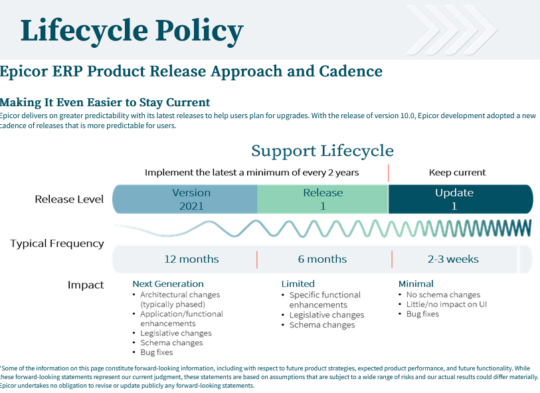
Like other software packages, Epicor Kinetic requires frequent patching. These can be for cosmetic (Updates), functional enhancements (Releases), or wholesale architecture changes (Version). Regular patching is necessary to keep the software running smoothly or plug security holes to keep you and your data safe. Epicor’s cadence is defined and outlined in the graphic below of how often you can expect updates, releases, and versions from Epicor. 

Support Lifecycle

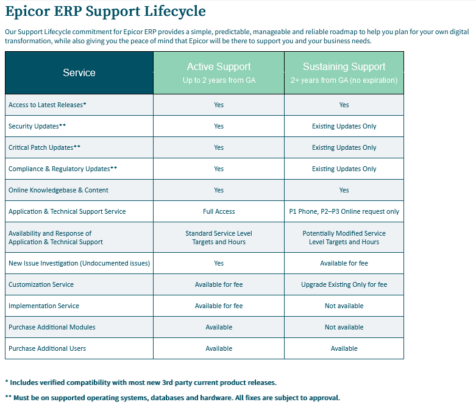
Support is an essential part of any software package, and when things are running smoothly, you seldom need it. However, when issues arise and you need support, having an active support contract is the difference between being down for a short period versus an extended outage. The chart below shows what you can expect from a support contract. 

Active support gives you full access to Epicor phone support, security updates, and new issue investigation, to name a few. Sustaining support gives limited phone support, access to the latest release, and an online knowledge base. While you will no longer be able to purchase new modules under Sustaining support, you can purchase additional users for your version.

Review the comprehensive FAQs for Epicor’s support lifecycle. You will need a valid Epicor EpicWeb ID to review the guide. 

Product Lifecycle

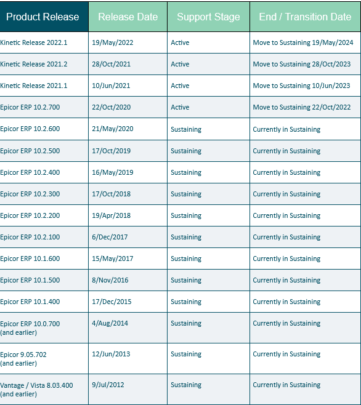
All good things must come to an end. Or so the saying goes, right? The good news is Epicor software supports versions back to Version 8.03.400 and earlier under their Sustaining support model. Below is a chart outlining the transition date for each version of Epicor Kinetic ERP. If you are on the Epicor Public Cloud model, you never have to worry about being out of Active support – more on this option below.

What are the Options?

Your options are straightforward. On-premise customers have two options:

  1. On-premise upgrade: As long as you have an active maintenance contract with Epicor, you are entitled to the latest version of the Epicor Kinetic versions. This version can be installed in your server farm, a hosted server farm, or your cloud subscription (i.e. Azure, AWS, Google, etc.)
  2. Migration to Epicor SAAS Cloud: You can migrate your on-premise database up to the Epicor public cloud. Doing so provides a future of hassle-free upgrades and allows you to get back to running your business.

No matter which option you choose you will need to do something if you are on Epicor ERP 10.2 or earlier. To have a conversation about upgrading your Epicor software, email info@oldencompass.sevenagesdesign.com.


The financial challenges that businesses face can be difficult to overcome without the right person at the helm. A fractional CFO or similarly-qualified financial consultant may deliver the results and value to help your organization succeed. Maybe a full-time financial leader does not make sense for your business or you need support while searching for the right individual. In any case, a fractional CFO or similarly qualified financial consultant may deliver the results and value required to help your organization succeed in a fiscally-healthy, responsible, and sustainable way.

What a Fractional CFO Does for Your Business

While a highly organized person may be able to step into an operational leadership position or a persistent and detail-oriented person can excel in marketing and sales, financial leadership is a unique skill set.

Optimizing cash flow, maximizing growth and profitability, and ensuring the financial stability of an organization are just some of the essential services a fractional CFO can provide. However, a full-time CFO can be tough to justify in terms of cost or it may be difficult to find the right individual to not only make the best financial decisions for your company but also has deep knowledge of and experience in your particular industry.

Whatever the reason a full-time CFO may not make sense for you at this point, Encompass has consultants to provide the experience and expertise you need at a fraction of the cost of an in-house CFO.

Specialty Financial Consulting Services

As a provider of financial leadership consulting, Encompass consultants can strategic expertise to help you better understand and outline your financial goals, ensure your business stays on course to achieve those goals, and excel in a competitive industry.

Partnering with Encompass ensures your business will have a qualified representative leading your financial department to satisfy the most essential functions of a financial department. These services include but are not limited to:

  • Financial Strategy, Planning, and Management
  • Financial Analysis, Planning, and Forecasting
  • Financial Regulation and Compliance
  • Accounting, General Ledger, Administration, and Operations
  • Financial Management > Financial Relations and Policies
  • Cash Management – Cash Flow Analysis/Financial Position Analysis
  • Automation and Process Improvement
  • Financial Technology and Solution Evaluation
  • Financial Strategy Alignment in preparation for, as part of, or following ERP implementation
  • Report Development beyond the initial Balance Sheet and Income Statement created in XLConnect
  • Booking Journal Entries as needed to record Reconciliation differences or reclassifications
  • Financial Statement preparation and review
  • Discussions regarding General Accepted Accounting Principals (GAAP)
  • Month and Year End processes
  • Clean up old and new accounting issues
  • Account reconciliations and analysis

A modern business requires modern tools to maintain a competitive edge. An ERP solution or other business management system will empower your business to address the needs of financial strategy and stability. Our financial professionals work within these systems daily to ensure our client’s financial goals are aligned with their internal processes, and regulations, satisfy the financial compliance requirements of all jurisdictions in which they conduct business, and are liable for financial reporting and payments to which they are subject.

Partner with an Encompass Fractional CFO or Financial Consultant

If you are ready to have a conversation about the financial leadership needs of your business, we’re standing by to help.

Contact us today to learn how Encompass can help position your financial activities and policies on the path to success.

You can download the financial services summary in a sharable format (PDF) below.

Fractional CFO Services


About Encompass Solutions

Encompass Solutions is a business and software consulting firm that specializes in ERP systems, EDI, and Managed Services support for Manufacturers. Serving small and medium-sized businesses since 2001, Encompass modernizes operations and automates processes for hundreds of customers across the globe. Whether undertaking full-scale implementation, integration, or renovation of existing systems, Encompass provides a specialized approach to every client’s needs. By identifying customer requirements and addressing them with the right solutions, we ensure our clients are equipped to match the pace of the Industry.


Watch this short video (5:45) to improve your relationship with your customers with automated templates triggered by certain conditions. Use SMS, automated phone calls, or e-mails as you prefer.


About Encompass Solutions

Encompass Solutions is a business and software consulting firm that specializes in ERP systems, EDI, and Managed Services support for Manufacturers. Serving small and medium-sized businesses since 2001, Encompass modernizes operations and automates processes for hundreds of customers across the globe. Whether undertaking full-scale implementation, integration, or renovation of existing systems, Encompass provides a specialized approach to every client’s needs. By identifying customer requirements and addressing them with the right solutions, we ensure our clients are equipped to match the pace of the Industry.


Four key technologies promise to drive digital transformation over the next five years. They are expected to shape small- and medium-sized business investment strategies and priorities across industry sectors.

Technology is driving digital transformation and creating a futurescape where artificial intelligence (AI), the Industrial Internet of Things (IIoT), automation, and blockchain are converging in what some futurists call the fourth industrial revolution or Industry 4.0.

Digital transformation marks a radical rethinking of how organizations use technology, people, and processes to fundamentally change business performance. In the next five years, key technologies— including AI, IoT, automation, and blockchain—promise to better enable how companies use data-driven insights to improve operations and boost ROI.


About Encompass Solutions

Encompass Solutions is a business and software consulting firm that specializes in ERP systems, EDI, and Managed Services support for Manufacturers. Serving small and medium-sized businesses since 2001, Encompass modernizes operations and automates processes for hundreds of customers across the globe. Whether undertaking full-scale implementation, integration, or renovation of existing systems, Encompass provides a specialized approach to every client’s needs. By identifying customer requirements and addressing them with the right solutions, we ensure our clients are equipped to match the pace of the Industry.


2020 saw a surge in remote work with companies experiencing shutdowns and business disruptions. But thanks to Industry 4.0 and smart factory technologies, many resilient businesses were able to adapt. Manufacturer Hytera reassigned a few of its production lines to produce disposable face masks. Baoshan Iron and Steel kept its facility in Shanghai running with automated production. According to a news report, “The two major product lines in Baoshan are fully unmanned. Each line needs two to three workers for inspections.”

Companies have had to reevaluate their operations to meet social distancing requirements. They created virtual workspaces and leveraged new skills for their employees, Gartner reports. Hytera and Baoshan maintained production with new health guidelines to keep employees safe. With the sudden global changes, many businesses expected a change in production. Close to 80% of U.S. companies surveyed by the National Association of Manufacturers anticipated a financial impact. More than half anticipated a change in operations.


About Encompass Solutions

Encompass Solutions is a business and software consulting firm that specializes in ERP systems, EDI, and Managed Services support for Manufacturers. Serving small and medium-sized businesses since 2001, Encompass modernizes operations and automates processes for hundreds of customers across the globe. Whether undertaking full-scale implementation, integration, or renovation of existing systems, Encompass provides a specialized approach to every client’s needs. By identifying customer requirements and addressing them with the right solutions, we ensure our clients are equipped to match the pace of the Industry.


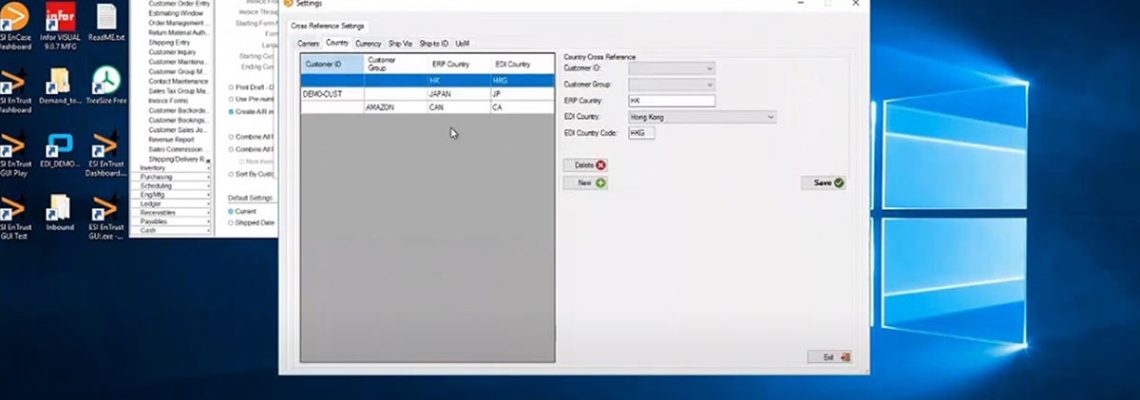
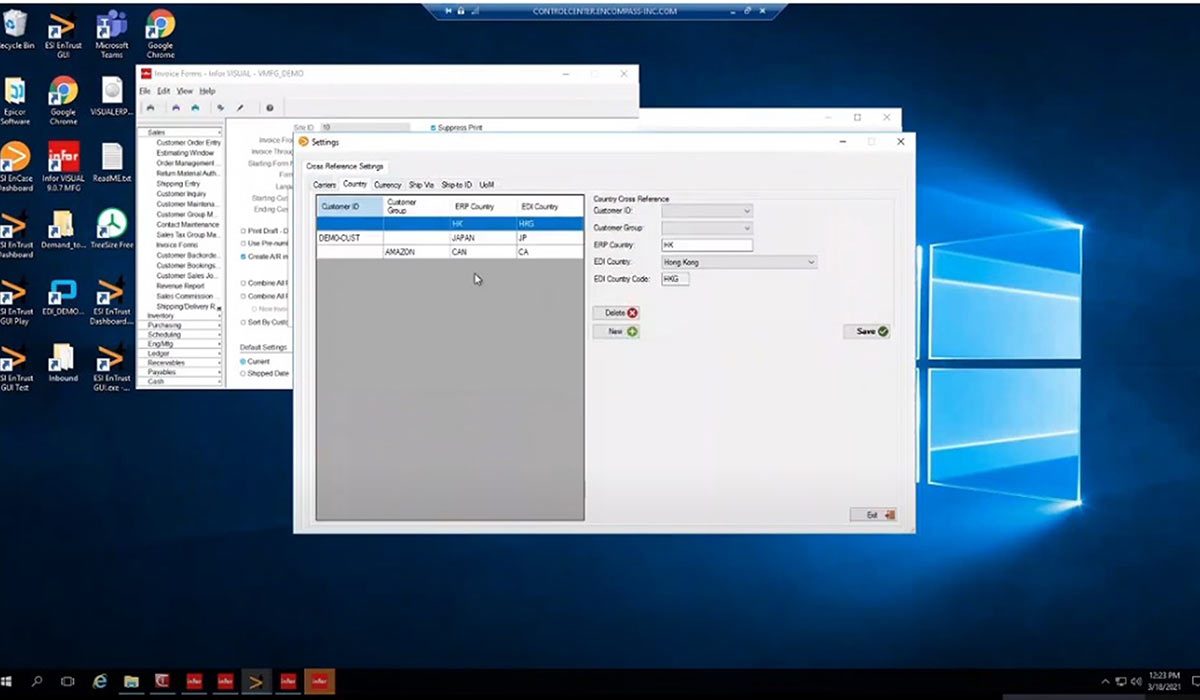
Entrust EDI is an ERP-agnostic solution that enables the automation of document exchange between a business, its trading partners, and customers. This Entrust EDI Automation Demo shows the manual steps Entrust EDI can remove from the document exchange process. This saves time, cuts down on errors, and improves supplier/trading partner relationships.

Implementation of the Entrust EDI solution will depend on your business’s level of preparation before engaging with Encompass. You can begin the process of readying your business by completing a simple checklist. We’ve outlined an EDI readiness checklist HERE with the most common information required to move forward with an EDI implementation project.

To expedite the process, you can complete the EDI discovery questionnaire at your convenience. This will help both Encompass and your organization to move through to implementation more swiftly.

For an idea of the costs associated with implementing EDI, you can use our convenient EDI quote calculator tool.

Want to know more about Entrust EDI? Contact our representatives from the Entrust EDI support team at edisupport@oldencompass.sevenagesdesign.com or get in touch with us for a general inquiry using the Contact Us link at the bottom of this page.

Watch the Entrust EDI Automation Demo Recording

Additional Entrust EDI Resources

Entrust EDI Brochure


Entrust EDI Functionality Technical Overview


Entrust EDI Managed Services Overview


About Encompass Solutions

Encompass Solutions is a business and software consulting firm that specializes in ERP systems, EDI, and Managed Services support for Manufacturers. Serving small and medium-sized businesses since 2001, Encompass modernizes operations and automates processes for hundreds of customers across the globe. Whether undertaking full-scale implementation, integration, or renovation of existing systems, Encompass provides a specialized approach to every client’s needs. By identifying customer requirements and addressing them with the right solutions, we ensure our clients are equipped to match the pace of the Industry.

1 2 3 7