In today’s fast-paced business landscape, organizations constantly search for ways to optimize their operations and gain a competitive advantage. One particular area that often presents challenges is supply chain management. The smooth flow of goods and information from suppliers to customers is critical for the success of any company. This is where the power of Enterprise Resource Planning (ERP) comes into play. ERP systems provide a comprehensive solution for streamlining supply chain management by integrating various processes and departments into one centralized platform. From procurement and inventory management to production planning and customer relationship management, ERP empowers businesses to make informed decisions, cut costs, and enhance overall efficiency. In this article, we will explore the potential of ERP in revolutionizing supply chain management and how it can help businesses stay ahead in today’s competitive marketplace.

What is ERP?

At its core, ERP is a software system that integrates various processes and departments into one centralized platform. It allows companies to manage and automate a wide range of business activities, including finance, human resources, procurement, inventory management, production planning, and customer relationship management. By providing a holistic view of the organization’s operations, ERP enables businesses to make informed decisions, reduce costs, and improve overall efficiency.

Benefits of Using ERP in Supply Chain Management

Implementing an ERP system for supply chain management offers numerous benefits. First, it enables real-time visibility into the entire supply chain. With a single source of truth, businesses can track inventory levels, monitor production processes, and identify potential bottlenecks or delays. This visibility allows for better planning and forecasting, ensuring the right products are available at the right time.

Secondly, ERP systems facilitate better collaboration and communication between different departments and stakeholders involved in the supply chain. By breaking down silos and enabling seamless information sharing, teams can work together more efficiently, resulting in faster decision-making and improved customer service.

Additionally, ERP streamlines critical supply chain processes such as procurement and inventory management. With automated workflows and integrated tools, businesses can optimize their purchasing activities, reduce lead times, and minimize stockouts or excess inventory. This not only saves costs but also improves overall supply chain performance.

Streamlining the Supply Chain with ERP

ERP systems play a vital role in streamlining the supply chain. One way they achieve this is through demand planning and forecasting. By analyzing historical data and market trends, ERP software can accurately predict demand and help businesses align their production and inventory levels accordingly. This proactive approach ensures that products are available when customers need them, reducing lead times and enhancing customer satisfaction.

Another key aspect of supply chain management that ERP addresses is order fulfillment. With integrated order management functionality, businesses can automate and streamline the order-to-cash process. ERP systems ensure smooth and efficient order fulfillment, from capturing customer orders to managing shipping and invoicing, reducing errors and delays.

Furthermore, ERP allows for effective inventory management. By providing real-time visibility into inventory levels, ERP systems help businesses optimize their stock levels, minimize carrying costs, and prevent stockouts or overstocking. This level of control ensures that the right products are available at the right time, reducing lead times and improving customer satisfaction.

Key Features of ERP for Supply Chain Management

To effectively streamline supply chain management, ERP systems offer a range of key features. These include:

Demand Planning and Forecasting

ERP software leverages historical data and market insights to accurately predict demand, enabling businesses to optimize their production and inventory levels.

Order Management

Integrated order management functionality allows businesses to automate and streamline the entire order-to-cash process, reducing errors and delays.

Inventory Management

Real-time visibility into inventory levels helps businesses optimize stock levels, minimize carrying costs, and prevent stockouts or overstocking.

Supplier Management

ERP systems enable businesses to effectively manage their supplier relationships, ensuring timely deliveries and maintaining high product quality.

Warehouse Management

ERP systems improve efficiency, reduce errors, and optimize storage and picking processes by automating warehouse operations.

Transportation Management

Integrated transportation management functionality allows businesses to optimize shipping routes, reduce costs, and improve delivery times.

Implementing ERP for Supply Chain Management

Implementing an ERP system for supply chain management is a complex undertaking that requires careful planning and execution. It involves several steps, including:

  1. Needs Assessment: Identify the specific requirements and goals of the organization to determine the right ERP solution.
  2. Vendor Selection: Research and evaluate different ERP vendors based on factors such as functionality, scalability, ease of use, and customer support.
  3. System Customization: Customize the ERP system to align with the organization’s unique supply chain processes and requirements.
  4. Data Migration: Transfer existing data from legacy systems to the new ERP system, ensuring data integrity and accuracy.
  5. User Training: Provide comprehensive training to employees to ensure they can effectively use and maximize the benefits of the ERP system.
  6. Testing and Deployment: Thoroughly test the ERP system before deploying it across the organization, ensuring a smooth transition and minimal disruption to operations.

Challenges and Considerations When Implementing ERP

While implementing an ERP system can bring significant benefits, it also comes with its fair share of challenges. Some common challenges and considerations include:

  • Cost: ERP implementation can be expensive, including upfront costs for software licenses, hardware infrastructure, customization, and ongoing maintenance and support.
  • Change Management: Introducing a new system can disrupt existing workflows and require employees to adapt to new processes. Effective change management strategies are essential to ensure a smooth transition.
  • Data Integrity: Migrating data from legacy systems to the new ERP system requires careful planning to ensure data integrity and accuracy.
  • Scalability: As businesses grow and evolve, the ERP system needs to be scalable to accommodate increased data volumes, users, and functionality.
  • User Adoption: Ensuring user buy-in and providing comprehensive training is crucial for successful implementation.

Best Practices for Optimizing Supply Chain Management with ERP

To maximize the benefits of ERP in supply chain management, businesses should follow these best practices:

  1. Define clear goals and objectives: Clearly define the desired outcomes and objectives of implementing an ERP system for supply chain management.
  2. Involve key stakeholders: Involve key stakeholders from different departments and levels of the organization to ensure their needs and requirements are considered throughout the implementation process.
  3. Ensure data accuracy and integrity: Invest time and resources in data cleansing and migration to ensure accurate and reliable data in the ERP system.
  4. Provide comprehensive training: Train employees on how to effectively use the ERP system and its specific features for supply chain management.
  5. Continuously monitor and improve: Regularly monitor key performance indicators and metrics to identify areas for improvement and optimize supply chain processes.

Conclusion

In today’s competitive marketplace, streamlining supply chain management is essential for businesses to stay ahead. ERP systems offer a comprehensive solution for integrating and optimizing supply chain processes, enabling real-time visibility, better collaboration, and improved efficiency. By leveraging key features such as demand planning, order management, and inventory management, businesses can unlock the full power of ERP in revolutionizing their supply chain. However, implementing ERP for supply chain management comes with challenges and considerations that need to be carefully addressed. By following best practices and learning from successful case studies, businesses can successfully harness the power of ERP to streamline their supply chain and gain a competitive edge in the market.

ERP streamlines supply chain management by integrating processes and departments, automating activities, and providing real-time visibility. It optimizes procurement, inventory, and order fulfillment, reducing lead times and ensuring product availability. However, implementing ERP has challenges like cost, change management, and data integrity. Best practices and involving key stakeholders help businesses harness ERP’s power to stay competitive.

If you’re ready to unlock the true potential of ERP in revolutionizing your supply chain management, contact us today for a consultation and take the first step towards operational excellence. You can learn more about Encompass Solutions by visiting our website or contacting us as sales@oldencompass.sevenagesdesign.com.


ERP for Furniture Manufacturing

The global furniture industry is expected to grow in market size from $541.52 billion in 2023 to $780.43 billion by 2030. It is a highly competitive market, with businesses striving to keep up with changing consumer demands and the latest technological trends.

For instance, today’s consumers are more likely to favor furniture that is customized and made with sustainable materials. They also seek multipurpose units that meet various needs, e.g., a sofa that doubles as a bed.

In recent years, furniture manufacturing companies have increasingly relied on Enterprise Resource Planning (ERP) software to better manage their operations and meet changing consumer demands. ERP for the furniture industry helps businesses automate processes, improve accuracy, streamline workflow, and gain real-time visibility into inventory and customer information. So by leveraging the technology, you, too, can improve client satisfaction, enhance competitiveness, and drive sustainable growth.

Common Challenges in the Furniture Manufacturing Industry

No industry is exempt from challenges, and furniture manufacturing is no different. Here are some of the common problems that companies often face:

  • Market competition. As one of the most in-demand and competitive industries, furniture manufacturers always search for innovative solutions to remain competitive.
  • Shifting consumer preferences. Consumers get driven by trends and changing fashions, leading to difficult decisions regarding design, materials, and colors.
  • Global supply chain complexities. You must navigate complex global supply chains if you’re a manufacturer that sources raw materials overseas.
  • Cost management. Furniture manufacturing can be costly, requiring you to manage costs effectively and efficiently.
  • Sustainability and compliance. With the ever-increasing focus on sustainability and compliance, furniture manufacturers must adhere to the latest regulations.
  • Design and innovation. You must keep up with the latest trends and design innovations to meet customer expectations.
  • Changing retail landscape. As online retail continues to expand, furniture manufacturers must adapt to the new landscape and offer a seamless customer experience.
  • Seasonality and inventory management. With the furniture industry being highly seasonal, you must effectively manage your inventory and ensure that customers can find what they need in-store or online.
  • Consumer expectations for customization. Consumers now expect more customization options for their furniture, and manufacturers must be able to meet those needs.
  • Talent acquisition and retention. You must find and retain quality talent to remain competitive.

How ERP Software Improves Furniture Manufacturing Processes

ERP systems can help furniture manufacturing companies overcome these challenges by streamlining operations and providing real-time visibility into data. But you should note that the importance of specific ERP needs may vary depending on the unique needs of each furniture manufacturing company. That said, below are some of the most critical functionalities:

Production Planning and Scheduling

The best ERP for furniture manufacturing should include modules that comprehensively overview production processes and stock management. Production planning and scheduling tools help you make timely decisions, manage your resources better, and reduce costs by optimizing the use of materials at each stage of production.

Inventory Management

For furniture manufacturers, managing inventory is critical to success. ERP software can help you track inventory in real time and build smarter forecasting models to maximize margins and minimize shrinkage. With a reliable ERP solution, you can effortlessly track raw materials, work-in-progress, and finished goods, improving overall supply chain efficiency.

Supply Chain Management

ERP systems help you manage global supply chains more effectively, including vendor management, procurement, and logistics coordination. That way, you can streamline processes, automate tasks, and monitor current stock levels to minimize costs and ensure materials get delivered on time.

Financial Management

ERP solutions should also include financial modules that enable you to track expenses, analyze profitability, monitor financial performance, and manage budgets more efficiently. With a comprehensive ERP system, you can easily create financial reports and get access to valuable insights into current spending and profits.

Business Intelligence and Analytics

The easiest way to edge over your competitors is to take advantage of ERP’s powerful reporting and analytics capabilities. You can improve your decision-making by gaining first-hand insights into customer behavior, production performance, and inventory management.

Quality Control and Compliance

ERP software can also help you comply with industry regulations and safety standards. Quality control modules enable you to monitor production processes, track materials used, and ensure all products meet quality standards. Moreover, you can effortlessly perform inspections, unmask non-conformities, and gain insights into potential risks.

Customer Relationship Management (CRM)

Did you know? Integrating a CRM module into your ERP system can give you an edge over your competition, allowing you to build better customer relationships and provide more personalized services. With ERP-CRM integration, you can track orders, monitor customer service, automate marketing processes, and access valuable insights into customer behavior.

Mobility and Remote Access

As a furniture manufacturer, you’re not limited to your office or production plant. A reliable ERP system allows you to access vital data and gain insights remotely from any device or location. You can also use mobile apps to stay connected with customers, vendors, and partners in real-time — an invaluable capability that enables you to manage operations more efficiently.

Scalability and Integration

Investing in a first-class ERP solution is like building a strong foundation for future growth. Your ERP system should enable you to easily scale up and down and integrate other applications or portals into your existing infrastructure without disruption. For example, a well-built ERP system can accommodate or encompass solutions like e-commerce stores, manufacturing execution systems (MES), accounting software, and CRM solutions.

Encompass is Your No.1 Rated ERP Software Consulting Firm!

ERP for furniture manufacturing is the ultimate solution for efficient inventory management, supply chain optimization, financial forecasting, and customer relationship management. By combining the power of ERP software with other business solutions, you can maximize process efficiency and gain invaluable insights into customer behavior to stay competitive in the ever-evolving furniture market.

At Encompass Solutions Inc., we take pride in helping manufacturers like you to modernize and optimize their operations. As Epicor’s Premier Partner and preferred value-added reseller, we aim to help you implement the most suitable ERP solution that meets your needs and requirements. So whether you’re in the market for a mission-critical ERP solution, custom development services, or process optimization, we have the expertise and experience to make it happen.

Make sure to reach out to us today and connect with one of our knowledgeable experts. We also encourage you to take advantage of our valuable resource, the guide on 7 Ways ERP Can Revolutionize Your Furniture Manufacturing Business. You can download it now.


Recently, we’ve been receiving many questions on Epicor’s Lifecycle Policy. This blog will outline the currently supported versions of the Epicor ERP system, the difference between Active and Sustaining support, and the upgrade options available.

Release Lifecycle

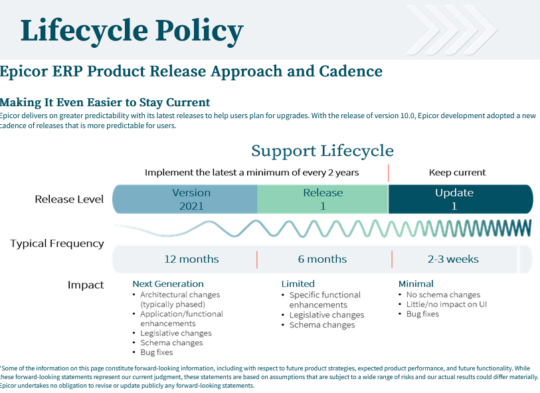
Like other software packages, Epicor Kinetic requires frequent patching. These can be for cosmetic (Updates), functional enhancements (Releases), or wholesale architecture changes (Version). Regular patching is necessary to keep the software running smoothly or plug security holes to keep you and your data safe. Epicor’s cadence is defined and outlined in the graphic below of how often you can expect updates, releases, and versions from Epicor. 

Support Lifecycle

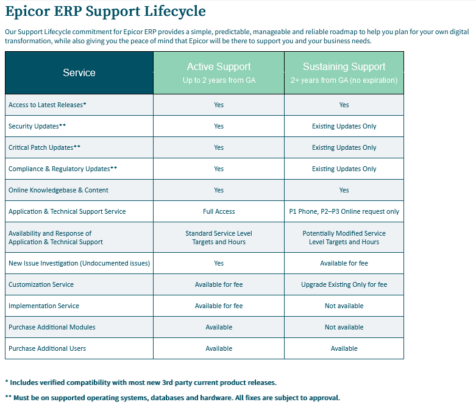
Support is an essential part of any software package, and when things are running smoothly, you seldom need it. However, when issues arise and you need support, having an active support contract is the difference between being down for a short period versus an extended outage. The chart below shows what you can expect from a support contract. 

Active support gives you full access to Epicor phone support, security updates, and new issue investigation, to name a few. Sustaining support gives limited phone support, access to the latest release, and an online knowledge base. While you will no longer be able to purchase new modules under Sustaining support, you can purchase additional users for your version.

Review the comprehensive FAQs for Epicor’s support lifecycle. You will need a valid Epicor EpicWeb ID to review the guide. 

Product Lifecycle

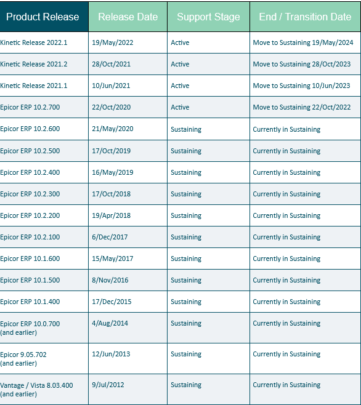
All good things must come to an end. Or so the saying goes, right? The good news is Epicor software supports versions back to Version 8.03.400 and earlier under their Sustaining support model. Below is a chart outlining the transition date for each version of Epicor Kinetic ERP. If you are on the Epicor Public Cloud model, you never have to worry about being out of Active support – more on this option below.

What are the Options?

Your options are straightforward. On-premise customers have two options:

  1. On-premise upgrade: As long as you have an active maintenance contract with Epicor, you are entitled to the latest version of the Epicor Kinetic versions. This version can be installed in your server farm, a hosted server farm, or your cloud subscription (i.e. Azure, AWS, Google, etc.)
  2. Migration to Epicor SAAS Cloud: You can migrate your on-premise database up to the Epicor public cloud. Doing so provides a future of hassle-free upgrades and allows you to get back to running your business.

No matter which option you choose you will need to do something if you are on Epicor ERP 10.2 or earlier. To have a conversation about upgrading your Epicor software, email info@oldencompass.sevenagesdesign.com.


The article “It’s 2020 — Should Business Owners Fear The Cloud?” was written by Epicor Software Corp. CEO Steve Murphy and published by Forbes on March 2, 2020. You can read the original article here.

The cloud. It’s a small word that packs a big punch. Defining what a cloud is can confuse some while implementing it raises concerns for others.

We should consider three key factors as we continue into a new decade and business owners ask if they should fear the cloud: privacy, interoperability, and cost.

But first, what is the cloud, and why are businesses migrating to this solution?

Essentially, the cloud is a delivery method for your software. It’s a network of servers that are linked together and operate as a single system. The cloud can perform a variety of functions (e.g., storing data, running applications, delivering content, etc.), and you can access it online. There are both public and private cloud options. The biggest difference with the cloud is what it doesn’t require. You don’t need any hardware or networking gear on-site – all you need is a tablet or a phone to run the software.

One of the major reasons I believe cloud adoption continues to grow is the flexibility and productivity enhancements it offers. As the CEO of a company that offers cloud platforms, I’ve found that these features are particularly attractive for business owners looking to build resiliency in the face of unpredictable trade wars and other geopolitical changes. Business owners often look to business management software to provide stability. According to Goldman Sach’s 2020 review (via CNBC), 23% of IT workloads are now in public clouds.

So, should business owners fear the cloud when it comes to privacy, interoperability, and cost?

Should I fear privacy in the cloud?

There is no denying privacy is a major concern when it comes to data. Data breaches continue to increase, as does the projected production of data. To keep pace, both software solutions and IT departments will have to up their game.

First, I’ll share the bad news. According to Hiscox’s 2019 Cyber Readiness Report, most businesses are unprepared for cyber threats. In fact, in the U.S., 73% of businesses are “novices” at cyber readiness.

The good news, however, is that the public cloud has proven safer than on-premise data center environments. Specifically, Gartner found that “to date, there have been very few security breaches in the public cloud” and that “through 2020, public cloud Infrastructure as a Service (IaaS) workloads will suffer at least 60% fewer security incidents than those in traditional data centers.”

If you decide to move to the cloud due to these safety findings, you should still be mindful of cloud vulnerabilities. Take stock of what kinds of sensitive information you are putting in the cloud, and ensure you understand how the cloud provider will protect that data. The time needed to safely migrate systems and data can be lengthy, but it shouldn’t be rushed at the expense of security infrastructure. Select a provider who prioritizes security during the migration process and who has a solid reputation for getting the configuration right, and communicate with your team so that they understand the migration timeline and can manage their expectations.

Regardless of your software solution, privacy issues will continue to be a concern. One of the most important things business leaders can do is ensure they have a crisis management protocol in place if and when a breach should occur.

Should I fear cloud interoperability challenges?

I have great news on this front. There have been major strides toward interoperability. Multiple systems can exchange and use information easier than ever before. This is due to a variety of reasons: Many application programming interfaces (APIs) continue to get better, standards continue to improve, and, notably, I see tech giants such as Google, Amazon, and Microsoft Azure frequently expand the universe of applications that can easily be put in their clouds. I believe their efforts have significantly moved the needle.

While interoperability isn’t perfect, there’s a lot of upward momentum. I expect that to progress.

Should I fear the cost of the cloud?

If you’re a business owner and you aren’t sure cloud makes sense for you from a cost perspective, ask yourself if you have a good grip on how much it costs to have your own data center in your business. Do you already have the IT skills in-house to run your system? If so, the cloud may not make sense.

However, many business owners are surprised to find that their IT operations cost them a lot more than they think and that implementing cloud solutions can save them both time and money when it comes to issues such as automatic upgrades (which keep your company current and competitive), labor and maintenance costs, or increases in workforce productivity, to name a few.

Just remember that the decision between on-premise and cloud will be unique for each business. When you’re evaluating your IT operations cost, ask yourself how scalable you need your solution to be in the future. How adept is your IT department at staying up to date with evolving technology? Will you need additional data storage, and do you have the physical space to accommodate an expansion of your on-premise data center? Do you need access to data on the go? If a natural disaster hits your business, how will you back up your data?

What it comes down to is the total current cost of your on-premise data center versus a cloud solution. For business leaders who are still on the fence about expenses, make sure you evaluate your options regularly. Cloud providers will have to continue to be cost-competitive, which could work in your favor.

Bottom line: Don’t fear the cloud. It could be a safer option than on-premise data. Its interoperability continues to improve. It can be highly effective at increasing productivity. It can save you money long-term. And the cloud will likely continue to improve over time. The year 2020 may be the one for you to move forward with implementation.

About Encompass Solutions

Encompass Solutions is a business and software consulting firm that specializes in ERP systems, EDI, and Managed Services support for Manufacturers and Distributors. Serving small and medium-sized businesses since 2001, Encompass modernizes operations and automates processes for hundreds of customers across the globe. Whether undertaking full-scale implementation, integration, and renovation of existing systems, Encompass provides a specialized approach to every client’s needs. By identifying customer requirements and addressing them with the right solutions, we ensure our clients are equipped to match the pace of the Industry.


With Industry 4.0 taking the lion’s share of headline space, smart manufacturing technologies are bigger than ever. For many manufacturers, these concepts can seem more than just a little intimidating, if not worthy of some cautious skepticism. Fortunately, there are manufacturing technologies that have been proven by years of practical application. Industry 4.0 concepts support them with more informed data and more efficient process improvements. We’re looking at you EDI. The concept of a digital twin is another one of these manufacturing technologies anyone can implement to improve operations.

What Is A Digital Twin?

The term “digital twin” refers to a digital replica of a physical asset. This asset can be any common hardware found on any factory floor. This includes heavy equipment, a smart machine, a robot, a work cell, an inspection station, or a manufacturing line. These “Physical Twins” are anything that can provide data to the Digital Twin for interpretation. Connection bridges the physical and digital to create a cyber-physical system, whereby data flows through and informs a process.

The digital twin concept can be broken down into three distinct parts:

  • a physical product
  • a digital/virtual product
  • connections between the two products

Digital Twins birthed in the Apollo Missions

The digital twin is a true example of the Industrial Internet of Things (IIoT) at work. However, the concept outdates the term Internet of Things by decades.  The term was coined by John Vickers of NASA in a 2010 Roadmap Report. however, the concept goes back even further in the NASA toolbox when the Apollo program utilized digital twins of the Command Module, Lunar Module, and Lunar Rover to carry out maintenance, support, and troubleshooting activities.

How Are Digital Twins Used In Manufacturing?

As we stated before, the connection between physical and digital twins creates a cyber-physical system that feeds real-time performance data to operators, analysts, and managers.

Individuals and groups fulfilling these roles within an organization can leverage Industry 4.0 concepts to analyze and interpret data to make sound predictions and carry out appropriate actions. Here, the Industrial Internet of Things (IIoT), Artificial Intelligence (AI), and Machine Learning (ML) all come together to troubleshoot, raise alarms to identify potential problems, view maintenance conditions, and support the various condition-based maintenance required to maintain seamless operations.

How Do The Components Of A Digitial Twin Work Together?

Analytics, Industrial Internet of Things (IIoT), Artificial Intelligence (AI), and Machine Learning (ML) technologies all have a hand in making Digital Twins work for manufacturers. Here’s how they come together to deliver leaps in process and operational improvement:

  • Industrial Internet Of Things (IIoT): Connects the physical and digital systems to provide accurate data in real time.
  • Artificial Intelligence (AI): Intelligent software analyzes the data, and provides an interpretation of what is physically taking place, what outcomes or problems may arise, and what actions should be carried out to maximize performance.
  • Machine Learning (ML): Builds on scenarios, both experienced and potential, to execute analysis more quickly and orchestrate improvements for the physical counterpart, ideally, without human intervention.
  • Analytics: Additional tools that simplify the data to communicate, diagnose, predict, and prescribe actions to optimize the operation of physical systems.

How Do Digital Twins Optimize Or Diagnose To Improve Operations?

By leveraging the data they receive, Digital Twins get a snapshot of how machinery or other physical systems operate throughout a process. The data serve to build a picture of what is good performance and what is bad or what is streamlined and what is bottlenecked.

Optimization comes into the picture when historical data can inform future operations to “say” This didn’t work well last time, let’s try something else. One example of how digital twins are used in optimizing machines emerges with the maintenance of power generation equipment such as power generation turbines, jet engines, and locomotives. How can we make this piece of machinery more efficient? Let’s look at the historical data and improve on past performance by trying other tweaks our engineers and machinists can implement. Or, better yet, what hypothetical concepts can we experiment with within the digital realm? The same is true for Enterprise Resource Planning (ERP) software. In enterprise architecture (EA), architects create EA blueprints as a digital twin for the organization.

A more relatable example may be found in autonomous vacuums. Many homes now employ robotic servants to clean while their owners are away. Digital twin technologies could effectively map the optimal vacuum path of a room and then employ that strategy to mitigate wasted energy and clean living spaces more quickly.

Diagnostics are another huge component of digital twins’ utility. By referencing historical data for machinery, a digital twin may be able to predict maintenance intervals, make service recommendations, and ensure downtime is kept to a minimum. In his case, the digital twin isn’t relegated to just one machine or just one plant. IIoT technology can connect like machines across an organization or several organizations to show a more complete picture of how machines perform under an array of conditions. This includes when they are most likely to break down or characteristics that can indicate a serious issue is looming on the horizon.

Leveraging The Digital Twin

To be certain, a digital twin and the technological concepts it relies on are no substitute for a skilled workforce. Those autonomous vacuums don’t dust or polish just yet. However, digital twins can inform and supplement your skilled workers to better utilize their machinery and improve operations overall. By now, it should be clear that implementing the concept of a Digital Twin within your organization can yield real benefits. Consider adding this invaluable tool as a complement to your business operations and remain competitive.

Epicor ERP delivers this technology in the form of a production environment. This component of the solution allows users to map their entire production process or even back-office process for simulated activities. This way, any company using Epicor ERP can experiment with their mad scientist, and what if we tried this idea on how to improve operations without the hassle of interrupting day-to-day operations? The result is a fine-tuned approach to process improvement that can be utilized in real time after pushing the changes into the live Epicor ERP environment.

About Encompass Solutions

Encompass Solutions, Inc. is an ERP consulting firm, NetSuite Solution Provider, and Epicor Gold Partner that offers professional services in business consulting, project management, and software implementation. Whether undertaking full-scale implementation, integration, and renovation of existing systems or addressing emerging challenges in corporate and operational growth, Encompass provides a specialized approach to every client’s needs. As experts in identifying customer requirements and addressing them with the right solutions, we ensure our clients are equipped to match the pace of the Industry.


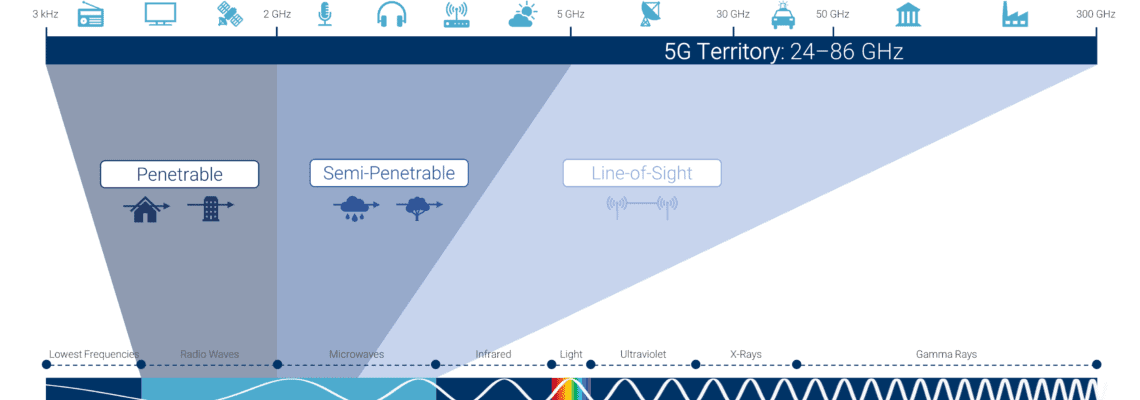
As I mentioned in the previous post, a bigger concern in 4G Versus 5G Wireless Technology is a physics problem – more specifically, an electromagnetic spectrum issue. If you’ll recall from your science class days, the electromagnetic spectrum is a collection of all known frequencies in the universe [reference image below]. Here in the United States, the spectrum is tightly regulated by the Federal Communications Commission (FCC) and frequencies are auctioned off to the highest bidder. If you want to learn more about how this works, check out the FCC’s website.

4G Versus 5G Wireless Technology Wavelengths

Let’s dive in and hopefully, I won’t lose you in the physics behind this – it’s important and the reason why 5G is slow to make any kind of traction. 5G operates at a higher frequency range (called millimeter waves) than legacy technologies. This gives 5G the speed and low-latency capabilities advertised but with a trade-off. Here is where the crux of the problem lies, physics dictates the higher the frequency the shorter the wavelength – which, if you’re keeping up, means higher speeds over shorter distances.

An image of 4G Versus 5G Wireless Technology wavelengths

Well, how short of a distance are we talking about here? Currently, it is about 100 meters. No need to adjust your monitor you read that right, 100 meters or about 300 ft on a clear day with no obstructions. In order to make 5G a reality, we will need millions of “stations” set up all over the country ranging from our neighborhoods to our highways. That’s not all, the signal is so fragile and prone to interruptions that stations will likely be in our houses before too long. Because of its limited scope, fewer subscribers will be able to access from a single cell tower.

I am not one to end on a sour note, but in my opinion, there are too many unanswered questions as to whether or not 5G will ever be more than a pipe dream. Some cities, such as Charlotte, NC, are working with lawmakers to bring 5G to their city for testing autonomous vehicles and other such technologies. It is still in the early stages and it’s proving to be an expensive endeavor. Some telecom companies expect to invest $275 billion into 5G infrastructure by 2025. For now, this technologist is in a holding pattern.

About Encompass Solutions

Encompass Solutions, Inc. is an ERP consulting firm, NetSuite Solution Provider and Epicor Gold Partner that offers professional services in business consulting, project management, and software implementation. Whether undertaking full-scale implementation, integration, and renovation of existing systems or addressing the emerging challenges in corporate and operational growth, Encompass provides a specialized approach to every client’s needs. As experts in identifying customer requirements and addressing them with the right solutions, we ensure our clients are equipped to match the pace of Industry.


As with any next-generation technology, headwinds and setbacks are bound to occur. When I hear the word headwind, I immediately recall my days as a road-warrior consultant and the vast number of airline miles I’ve racked up through the years. On occasion, an airliner will encounter headwinds slowing it down, but it keeps flying and eventually arrives at its destination – maybe not as soon as you would have liked. So too is the road ahead for 5G. Let’s jump right into the third-installment of our 4G versus 5G wireless technology series.

4G Versus 5G Wireless: What’s Stopping Advancement

Over the next two posts, I will cover two of the concerns keeping 5G technology from really taking flight. Security and unauthorized access to private small-cell networks is the first concern. Fortunately, this is likely solvable given enough resources. The signalling protocols (SS7) developed for earlier generation cell technologies are inadequate to handle the demand being placed on 5G networks.

In Part 1, I mentioned 5G is 10x faster than 4G. As a result of these faster speeds, it will open up new avenues for cybersecurity threats. Much like your home or office networks now, you will do more of these functions over 5G cellular networks. Things like email, video conferences, streaming NetFlix, e-commerce, and online banking will all be new avenues for cybercriminals. By a show of hands, how many of you have antivirus on your cell phones or cellular-connected devices today? Not many, if any.

Despite this challenge, many security experts predict increasingly complex security measures will emerge in the next twelve to eighteen months. These security advancements will give peace of mind to companies looking to harness the power and speed of 5G technology.

In part 4, I will examine the second biggest headwind; you might want to brush up on your physics.

About Encompass Solutions

Encompass Solutions, Inc. is an ERP consulting firm, NetSuite Solution Provider and Epicor Gold Partner that offers professional services in business consulting, project management, and software implementation. Whether undertaking full-scale implementation, integration, and renovation of existing systems or addressing the emerging challenges in corporate and operational growth, Encompass provides a specialized approach to every client’s needs. As experts in identifying customer requirements and addressing them with the right solutions, we ensure our clients are equipped to match the pace of Industry.


NASA has been busy developing advanced manufacturing technologies at its research and development labs for decades. Recently, they announced 2019 advanced manufacturing technologies that have real viability in the public sector.

2019 Advanced Manufacturing Technologies Revealed By NASA

While their advanced manufacturing technologies are initially developed for use in aerospace applications, many are applicable to an array of commercial manufacturing industries. Here are 6 exciting 2019 advanced manufacturing technologies form NASA that manufacturers may be able to apply to their operations in the near future.

Interim, In Situ Additive Manufacturing Inspection

Additive manufacturing, more colloquially known as 3D printing, has developed quickly in recent years. an array of materials and mechanisms to improve the output and efficiency of additive manufacturing technologies have emerged, with few solutions to how defects can be detected and mitigated. NASA addressed this void by developing its own additive manufacturing inspection system. utilizing infrared cameras and sensing equipment, engineers can monitor the build process in real-time, addressing defects before materials are wasted and make corrections on-the-fly.

Apply to license this technology

Benefits:
  • A reduction in false-positive readings
  • Flexibility when incorporating into existing systems
  • Reduced time, energy, and material wasted in nonconforming parts leading to significant cost-savings
  • Leverages infrared and visual cameras for thermal and spatial accuracy
Industry Applications:
  • Aerospace – complex injectors, internal coolant passage components, heat exchangers
  • Automotive –  exhaust system components
  • Medical –  orthopaedic implants

Modular Fixturing for Assembly and Welding Applications

As commercial rocket and aerospace vessel manufacturing ramps up a renewed interest in space flight and exploration, NASA’s need for faster lead and design times necessitated a modular approach to assembly and welding. These new fixtures developed at Marshall make managing metal components during assembly much easier on teams. Fixtures are adjustable, facilitating use on rocket sections of varying heights and diameters. The result is rapid rocket assembly with applications in other aerospace, maritime, and other vessel manufacturing industries.

Apply to license this technology

Benefits:
  • Modular fixtures can be reused and repurposed for multiple projects of various sizes.
  • Tooling design and configuration time is reduced by half.
  • Project costs are reduced by as much as an order of magnitude.
  • Modular fixtures can enable the economical adoption of friction stir welding.
  • Modular fixtures enable large-scale rapid prototype development in a wide range of industries.
Industry Applications:
  • Maritime – Shipbuilding and assembly
  • Aerospace – Airframe assembly, commercial space launch vehicle assembly
  • Mining, Energy, Transportation/Logistics – Pressure vessel assembly

Use of Beam Deflection to Control Electron-Beam Wire Deposition

Researchers at NASA’s Langley Research Center have long been developing the 3D printing process known as EBF3, short for an electron-beam (e-beam) free-form fabrication technology. The process utilizes several mechanisms to manufacture metallic structures used in parts tooling. The process involves an electron beam gun, a dual wire feed, and computer controls that shrink the fabrication process from days or weeks, to hours. The innovation has drawn significant attention because until recently, working with printed metals was an exceedingly difficult task. This technology solves the problem of even material distribution during the printing process, satisfying NASA’s need for rapid prototyping of parts in space. The innovation has far-reaching utility in commercial industries, such as industrial welding scenarios and the fabrication of structures and components of virtually any scale.

Apply to license this technology

Benefits:
  • Stable, optimized, and uniform wire heating during the deposition process
  • Continuous and predictable deposition pattern
  • Simplifies deposition of complex geometries
  • Optimizes management of macro-level microstructural characteristics of deposited metal
  • improves the efficiency of power and feedstock used
  • Improves automated operation
Industry Applications:
  • Automotive, Aerospace, and other industrial and commercial manufacturing: Welding of metal structures
  • Automotive, Aerospace and Defense, Field-service, MRO: Free-form fabrication of complex metal components in remote locations
  • Near-net shape manufacturing and rapid prototyping
  • From Automotive and Aerospace to Sporting Goods and Medical Devices: Metal fabrication

Variable-Power Handheld Laser Torch

Just what it sounds like, this handheld laser torch helps to repair hard-to-reach engine nozzles on NASA’s space shuttles. Designed for welding and brazing metals, this variable power torch brings many unique advantages to the repair bench. for example, its power can be adjusted in real-time, at-will. Additionally, it’s unique and ergonomic design provides for enhanced precision, portability, maneuverability, and safety for the user. The tool has many potential applications in manufacturing processes for consumer items like eyeglasses frames to jewelry to more complicated structures, like medical hardware.

Apply to license this technology

Benefits:
  • Enhanced accuracy using variable lenses to adjust depending on circumstantial welding needs.
  • Increased portability and maneuverability when to brazing in small or hard-to-reach places.
  • Improved user safety with the addition of sensors and emergency switches.
  • Decreased heat affected zone by applied heat to a very localized working area, preventing damage to the welding surface.
Industry Applications:
  • Opportunities include various welding applications where real-time laser variation may be needed due to the spatial/accuracy constraints of traditional welding methods:
  • Aerospace engine repair
  • Medical hardware manufacturing
  • Plastic mold and die restoration
  • Jewelry manufacturing and repair
  • Eyeglass frame welding

High-Speed Smart Camera Detects Supersonic Inlet Shocks

Researchers at NASA’s Glenn Research Center have developed high-speed image processing technology to monitor airflow of an aircraft engine’s intake. It’s an important tool in developing technologies that make aircraft faster and more efficient. This highly-customizable camera is designed to quickly identify precise location data. Machine vision and sensing technologies are used in just about every vertical of assembly line manufacturing. This versatile edge technology has the ability to further drive efficiencies in these industries while providing greater visibility into part placement and position monitoring.

Apply to license this technology

Benefits:
  • Quickly captures and processes linear images at a rate of over 900 fps
  • Highly customizable in response to digital signal transitions from low to high (positive edges) or high to low (negative edges) and permits threshold sensitivity variations
  • Compact dimensions result in a reduced size and system complexity when compared to conventional edge detection systems
  • Reliable design that is both simple and affordable, requiring very few parts
  • Efficient power usage when compared to a typical smart camera
Industry Applications:
  • Aerospace – Supersonic jets
  • General Manufacturing (assembly lines, part placement, and position monitoring) – Machine vision for quality control and OEE
  • Lane line tracking for autonomous motor vehicle control
  • Bar code scanners
  • Digital photography

Thermal Stir Welding

Researchers at NASA’s Marshall research center are developing an improved joining technology called thermal stir welding. It improves on fusion welding and friction stir welding technologies to provide superior joining methods for dissimilar materials as well as improve welding rates for existing industrial applications. Thermal Stir Welding is a technology that can easily be adapted to almost any industry that uses other forms of welding. This includes automotive parts, shipbuilding, fuel tanks, and railway manufacturing.

Apply to license this technology

Benefits:
  • Unique advantages of this technology over fusion welding or friction stir welding include the following:
  • Totally independent heating and stirring functions
  • More degrees of freedom for greater process control and optimization
  • Easy assembly-line use
  • Improved surface finish results
  • High travel rates
  • Separate heating function for easier welding of alloys with higher melting temperatures, such as steel and inconel alloys
Industry Applications:
  • Aerospace
  • Automotive
  • Shipbuilding
  • Storage tank or cylinder manufacturing
  • Construction
  • Railway cars

About Encompass Solutions

Encompass Solutions, Inc. is a software company. As a NetSuite Solution Provider, Suite Success Partner, and Epicor Gold Partner we offer professional services in business consulting, project management, and software implementation. Whether undertaking full-scale implementation, integration, and renovation of existing systems or addressing the emerging challenges in corporate and operational growth, Encompass provides a specialized approach to every client’s needs. As experts in identifying customer requirements and addressing them with the right solutions, we deliver business systems to fit the build.


5G wireless technology has a lot of potentials. In this post, I will explore several of the front-running industries setting themselves apart by taking advantage of 5G.

Ten years ago, autonomous vehicles were just getting started and were thought to be something out of “The Jetsons”. Fast-forward a few years and we finally have driverless cars being tested in some areas of the country. The backbone behind this? 5G technology. That’s right 5G is the mobile technology that will propel self-driving vehicles into large-scale adoption; you can read more about it here. Let’s continue the 5G vs 4G conversation taking place right now.

5G Wireless Technology Shortly

In the next few years, the healthcare industry is anticipating the use of 5G to quickly and reliably transmit large data files. MRI images, for example, currently take a long time to transfer over the network to other doctors or specialists. By using 5G technology, these transmissions will become quicker, more reliable, and sent securely to protect patient privacy. Healthcare systems also will use 5G to stream real-time high-quality video for better doctor-patient interaction. By doing so providers will make telemedicine an everyday occurrence. You can read a bit more about that, here.

an image of healthcare professionals and patients leveraging 5g wireless technology

How John Deere Plan To Leverage 5G Wireless Technology

When you hear the name John Deere, visions of tractors and Midwest America pop into your head, right? What if I told you this 180-year-old bellwether of a company is leading the charge in farming automation? You’d probably think I’m crazy – and you might be right – but not because of this. John Deere, with its acquisition of Blue River, is looking to advance farm equipment well beyond what most people thought possible. With their integration of automated driving technology, computer vision systems, and applications, some experts believe farmers will be able to double or triple their annual yield. Learn about 5G and the future of farming here.

Up Next For 5G Wireless Technology

While 5G wireless technology promises huge disruption in just about every global industry, it is not without resistance. There are quite a few barriers for 5G to overcome before it’s ubiquitous and in part 3 of this series, I will discuss some of the headwinds 5G wireless technology faces in the coming years.

About Encompass Solutions

Encompass Solutions, Inc. is an ERP consulting firm, NetSuite Solution Provider, and Epicor Gold Partner that offers professional services in business consulting, project management, and software implementation. Whether undertaking full-scale implementation, integration, and renovation of existing systems or addressing emerging challenges in corporate and operational growth, Encompass provides a specialized approach to every client’s needs. As experts in identifying customer requirements and addressing them with the right solutions, we ensure our clients are equipped to match the pace of the Industry.


Before talking about the future, we need to reminisce a bit. Remember when 4G technology was a pioneer in wireless networking? Remember when everyone wanted the latest smartphone so they could stream videos, check Facebook, or be the first to tweet about something the Kardashians did? Remember when everyone was excited about the latest-n-greatest and we all rushed out to get on the 4G bandwidth wagon – if you didn’t you weren’t one of the “cool kids”. Remember your first analog cell phone or bag phone with a curly “Q” car antenna (fake or otherwise)? Don’t kid yourself, you know you do! Now, we sit on the precipice of a new technological breakthrough in the form of 5G wireless connectivity. Here’s a bit about the 5G vs 4G conversation taking place right now.

What Is 5G Wireless Technology?

With big cellular conglomerates launching 5G cellular networks this year, you might be asking yourself–What is 5G? The G stands for generation, as in the 5th generation of wireless network technology. 5G wireless tech promises faster transfer rates, lower latency, and bigger bandwidth by orders of magnitude. However, Don’t get too excited just yet. Full utilization of 5G wireless networks is still out of reach for the everyday consumer.

The actual 5G radio system, known as 5G New Radio (5G-NR), isn’t compatible with 4G. However, 5 G-enabled devices will rely on existing 4G infrastructure where applicable until a connection to a 5G wireless network is possible. This whole effort is part of the ongoing wireless connectivity evolution and is currently on target to meet the usage requirements outlined in the International Mobile Telecommunications-2020 (IMT-2020). The requirements include such capabilities as a maximum achievable data rate of 20Gbit/s, 1ms Radio network contribution to packet travel time (read latency), and a total traffic coverage area of 1000 (Mbit/s)/m2.

How 5G Wireless Networks Will Impact Our Lives

Recently, I attended a seminar regarding the new 5G or “fifth generation” cell technology. It was an informative seminar shedding light on the future of 5G in the next five to ten years. As a primer to what’s ahead, 5G offers 10x the bandwidth and faster data transfers than current 4G technology (think wire speed through your cell phone)! Imagine streaming Netflix, Amazon, or other online content with a fraction of the buffering time or downloads happening 10x faster. While something to certainly be excited about and cellular providers are licking their chops to charge you more money (for those of us still on a capped data plan), there are several hurdles and challenges to overcome before mainstream adoption takes place. Over the next few blog posts, I will outline areas where 5G technology will enter the marketplace and several of the biggest challenges facing worldwide adoption.

About Encompass Solutions

Encompass Solutions, Inc. is an ERP consulting firm, NetSuite Solution Provider, and Epicor Gold Partner that offers professional services in business consulting, project management, and software implementation. Whether undertaking full-scale implementation, integration, and renovation of existing systems or addressing emerging challenges in corporate and operational growth, Encompass provides a specialized approach to every client’s needs. As experts in identifying customer requirements and addressing them with the right solutions, we ensure our clients are equipped to match the pace of the Industry.