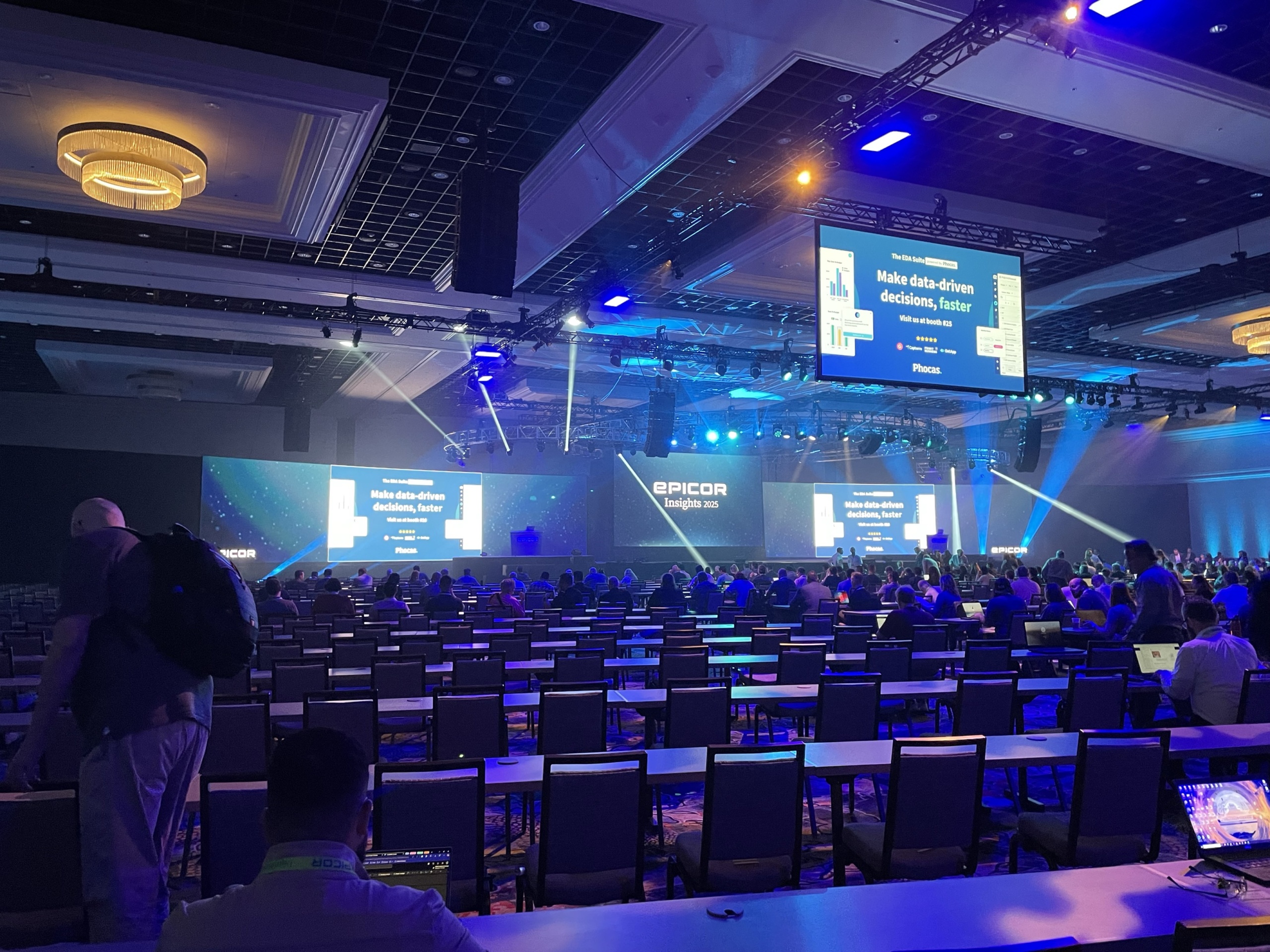
Innovation is what drives the future, and it drives our partnership with Epicor. Which is why we attended Epicor Insights 2025 to find out where things are going in this evolving ecosystem. If you use Epicor…or are considering an ERP…then it’s worth learning a bit about our and their insights for the future.

What’s Next with ERP: Key Takeaways from Epicor Insights 2025

The focus of Epicor Insights 2025 was on agentic AI. Epicor’s CEO, Steve Murphy, discussed  AI and the fact that Epicor is approaching integrating AI vertically, focusing on those existing Make, Move, and Sell verticals. With the current challenges that manufacturers are facing, particularly around realigning supply chains overnight due to tariffs, and how AI can be used to respond to these challenges if used correctly. Murphy mentioned that Epicor values the impact of AI and how it is an accelerator to help people gain insights into the data within an ERP, versus a tool that would replace them.

Epicor also unveiled Epicor Prism and Epicor Grow AI. The latter covers more than 200 use cases, while Epicor Prism can now integrate with Epicor Industry ERP Cloud, including Epicor Prophet 21, and Epicor Kinetic (which is our specialty).

This means our Kinetic customers can now experience faster employee onboarding, enhance decision making with rapid visual analysis, streamline information retrieval, and more. And Grow AI provides predictive AI modeling. Our Director of Operations and Advanced Support, Jason Claggett, had this to say: “Epicor showcased their AI solution, ‘Prism, ‘ that is aimed to empower the workforce.”

They also added a new Carbon Cost Rollup solution to Kinetic to support carbon tracking and treat CO2 emissions as currency.

Introduction – Why Epicor Insights 2025 Matters

Epicor Insights 2025 is a significant conference with around 4,000 attendees – large for a company-specific conference and an impactful event with 45 extended education sessions and 85 hands-on labs.

This allows customers, partners, and influencers to interact with the company and move their use of Epicor to their next level. For us, it’s a way to learn what Epicor is doing and changing, and how they are moving forward. We can then pass this knowledge on to our customers and help them use the platform better. We can, in particular, help current and future Epicor users customize tools and leverage people-centric AI to get the most value out of their ERP software.

Epicor’s Five Innovation Principles – Building a Future-Ready ERP

Epicor has long focused on five principles of innovation to build its ERP, and Epicor Insights is a timely reminder of them. They are:

  1. Great Experience. Epicor’s ERP is easy to use, keeping everything centralized. It provides a great, streamlined experience for employees and allows them to do more in less time.
  2. Data-Driven Insights. Using AI to crunch data, Epicor builds a data supply chain that improves accuracy and collaboration without compromising security. This allows you to use your data to the full.
  3. Industry Expertise. Epicor has deep experience in five areas – automotive, building supply, distribution, manufacturing, and retail. This allows thousands of companies to get the best out of Epicor and benefit from their expertise.
  4. Co-Innovation with Customers. This means working with customers to improve and listening to feedback – which is a major driving force behind Epicor Insights.
  5. People-Centric AI. AI that does not replace humans but rather makes their lives easier and more productive.

Spotlight on Emerging Solutions and Tools

A major purpose of Epicor Insights is to showcase emerging solutions and tools and give customers a chance to try them with the company’s help. Some of the new solutions Epicor demonstrated include:

  • SparkCentral – GROW. Epicor’s Grow AI provides predictive modeling and analysis to help customers manage their supply chain and predict demand.
  • Inventory Planning & Optimization (IP&O). Epicor continues to improve its IP&O solution. Adding more AI improves sales and inventory planning by offering probabilistic forecasting to help connect inventory optimization to your bottom line.
  • Prism, Ascend, Acadia, Kyklo. These AI solutions continue to develop. Acadia, for example, helps frontline workers gain real-time insights directly, instead of through dispatch.
  • Insights GO Demo. Epicor also demonstrated GO, 3D visual intelligence that will further improve data-driven insights and be a fantastic tool for showing data to stakeholders.

In particular, Ashley Limbers, our Marketing Manager, enjoyed the focus on AI. “It’s exciting to see how Epicor’s commitment to AI is already sparking action—and will continue to drive growth and competitiveness for our clients.”

Epicor Connected Process Control (CPC) and Acadia

Another focus was connected process control, which uses digital work instructions to enforce process control, connects devices to harvest IoT data, provides embedded quality management, and supports preventive maintenance. All of this allows manufacturing employees to work more effectively. The Andon solution allows all employees to view real-time production information and empowers them.

Acadia does the same thing for front-line workers. Both of these solutions improve employee trust by allowing them direct access to the data they need to do their jobs and encourage innovative solutions from the front line or factory floor.

CPC also matters for workforce readiness and compliance. It allows for the development of a Skills Matrix that directs job-based training so that employees have the skills and knowledge they need and opportunities to continuously improve.

Closing the Visibility Gap and Overcoming Data Challenges

According to Epicor, 79% of companies lack tier 1 supplier visibility, and 48% ignore critical insights. These pain points are something Epicor is working hard to address.

One way is the data supply chain, which ensures that accurate data is transmitted across companies to the people who need it. In many cases, insights are “ignored” because people simply don’t see them. Data from tier 1 suppliers can easily be brought into the data ecosystem.

Epicor also provides solutions for supply chain resilience that include improving visibility so that sourcing can be switched and balanced as needed. Supplier disruptions don’t turn into production disruptions.

3D data visualization is going to be another tool for overcoming data challenges by making data easily visible to stakeholders and showing them, clearly, the impact of changes on their bottom line.

Real-World AI Use Cases That Deliver ROI

Back to AI. Epicor’s AI is designed to support human innovation. Here are four areas in which Epicor’s AI really can help:

  1. Quoting. AI can analyze the supply chain, predict demand, and help you assess costs so you can provide more accurate quotes.
  2. Onboarding. New employees can get on track faster, with onboarding even starting before they come on-site.
  3. Ordering. AI ordering can allow for targeted upselling, dramatically increasing revenue.
  4. Analysis. Last, but far from least, AI can automate the interpretation of lists and charts so humans don’t have to spend hours poring over them.

Epicor AI – functional, practical, human-first.

Strategic Growth and Vision

Epicor also talked about its growth as a company. Since 2021, they have made 14 acquisitions. Their growth has averaged 12% year-over-year.

They have made over 100 major project releases and over 600 minor ones. All of this reinforces their deep vertical focus in the Make, Move, Sell economy.

Final Thoughts – Empowering the Maker Community

A clear thread through the Epicor Insights 2025 was that while AI has much potential, it is only valuable when applied in context. AI use cases need to be industry-specific, well-thought-out, and centered around supporting people in their activities. Our Director of Professional Services, Dave Cranshaw, had this to say: “I’m excited to work with Kinetic as not just a static ERP as we have all been working with most of our careers, but now as a platform to truly provide actionable insights to our customers very soon. What’s key is clients should be cleaning up their data so it’s good, then moving to the cloud, so they can use PRISM, and lastly turn on GROW post go-live so they can start being part of the change in the industry.”

Epicor also reinforced its commitments to innovation, security, and, above all, community.

At Encompass Solutions, we are here to help our clients learn what is coming next and take advantage of it to improve operations and your bottom line.

Are you ready to see how these innovations fit your business strategy? Talk to your Encompass Solutions account manager today or contact us to explore Epicor and how AI can be used can help your business.


AI and automation are changing shop floor operations in today’s manufacturing world. Automation has been around for a while, handling repetitive tasks and streamlining workflows. But now, AI is taking things up a notch—adding intelligence, learning, and adaptability to the mix. When you combine these two in an ERP system, manufacturers don’t just get a smooth system. They get one smart enough to adjust, predict issues before they happen, and make real-time decisions.

So, what’s the difference between AI and automation? How do they work together? And why should manufacturers care? Today, we’ll explore how automation and AI in manufacturing each offer something unique. We’ll also explain why integrating both is essential for anyone ready to level up their shop-floor operations.

AI vs. Automation: Key Differences

Discuss automation and AI and why both are vital on today’s manufacturing floor, especially within an ERP system.

Automation is the backbone of most ERP systems, handling repetitive tasks that follow set rules. Think about task scheduling, inventory forecasting, and production tracking—these reliable, rule-based functions keep the wheels turning. Take Epicor ERP as an example. Automation jumps in without human input when it’s time to update stock levels or trigger production orders. It’s quick, predictable, and great for saving time on tasks that don’t change.

AI, however, is in a league of its own. It moves beyond the limitations of rule-based routines by analyzing vast data sets and using machine learning to deliver deeper insights. AI can spot patterns and make predictions that go beyond simple automation. Imagine it identifying potential production delays based on weather data or adjusting schedules based on predicted demand fluctuations. With AI, your ERP system doesn’t just follow instructions; it learns and adapts, improving decision-making over time.

The key distinction here? Automation is about performing consistent, routine tasks efficiently, while AI brings intelligence and adaptability into the mix. When you combine both within an ERP, you get a system that doesn’t just work harder but also works smarter. ERP is the central platform, integrating automation’s speed and AI’s insight to streamline shop floor operations in real-time. This partnership between AI and automation turns the ERP into a powerful tool for managing and optimizing every aspect of the manufacturing floor. It truly gives you the best of both worlds.

AI on the Shop Floor: Practical ERP Applications

AI on the shop floor isn’t just about futuristic tech. It’s solving real, everyday challenges in ways traditional systems couldn’t dream of. Here’s how AI-enabled ERP is changing the game in three key areas:

  1. Predictive Maintenance: Picture this: machines that practically tell you when they need attention. With AI in your ERP, you can analyze machine data to predict when maintenance is due. Instead of waiting for breakdowns, your system flags potential issues before they happen, setting off automated alerts for repairs. This predictive approach means fewer surprises, less downtime, and smoother operations all around. Plus, it extends the lifespan of equipment, helping manufacturers save on replacement costs and reduce interruptions.
  2. Quality Control: Manufacturing quality control issues don’t stand a chance with AI’s ability to use image recognition and data analysis within ERP systems. AI-powered tools can scan products in real time, spotting defects early. By catching these issues before they pass the production line, AI helps keep standards high and prevents costly rework, letting you maintain consistent quality without slowing down production. This real-time detection also enables quicker responses to issues, ensuring customers receive a reliable, high-quality product every time.
  3. Inventory and Demand Forecasting: Imagine always having the right stock at the right time. With AI-driven ERP, your system analyzes historical data and market trends to predict future demand. It adjusts inventory levels accordingly, automatically replenishing stock when needed. This means no more excess inventory gathering dust—and no more stockouts that hold up production. The result? Reduced waste, lower costs, and an optimized supply chain allow manufacturers to improve profitability while meeting customer demands seamlessly.

AI in ERP is far more than just a nice system. It’s an innovative, powerful tool for optimizing shop floor operations in real-time. Whether predicting maintenance, ensuring product quality, or managing inventory, AI makes your ERP more intelligent and responsive, giving you a serious edge in today’s competitive manufacturing landscape.

Integrating AI with ERP Automation: The Best of Both Worlds

When you combine ERP with AI, magic happens on the shop floor. Together, they handle routine tasks and adapt, predict, and respond to changes faster than ever. Here’s how this powerful combo works:

Enhanced Efficiency

Imagine your ERP system scheduling tasks and adjusting those schedules based on live data from the supply chain. That’s what happens when AI steps in. With AI-enhanced data processing, ERP systems become smarter, adjusting production schedules and resources in real-time. Did a sudden change in supply? No problem—AI and automation keep things running smoothly without missing a step.

Data-Driven Decision Making

AI’s insights go beyond simple reports. AI learns from data to guide more intelligent automation within an ERP platform. Your workflows start adjusting independently, whether reordering supplies or adjusting machine workloads based on current demand. It’s like having a team of digital analysts constantly fine-tuning operations to ensure production and supply chain activities stay on track.

Case Study Example

Let’s look at a manufacturer. By integrating AI with their ERP, they’ve created a seamless flow where inventory levels update automatically based on predicted demand, ensuring they have exactly what they need without overstocking or running short. Production schedules also adjust dynamically, responding to real-time factors like supply chain disruptions or shifts in demand. Quality inspections have become more proactive, with AI catching potential defects early to maintain high standards and reduce costly rework.

The result? Less downtime, minimal waste, and a significant boost in productivity. This manufacturer didn’t just save time—they positioned themselves to thrive in a fast-moving industry with the agility to adapt to market demands, the efficiency to cut costs, and the foresight to anticipate and tackle challenges before they impact operations. Using AI-powered ERP, they’re not just keeping up but staying ahead of the competition.

With AI and automation working together in ERP, manufacturers gain an efficient, flexible, and ready-to-adapt system. This combination turns challenges into opportunities, giving manufacturers a real edge in a world where agility and efficiency mean everything.

Implementation Challenges and Considerations

Bringing AI into an ERP system sounds like a game-changer—and it is—but it comes with its challenges. Here’s what manufacturers should keep in mind to make the transition smooth and effective:

Integration with Existing Systems

Aligning AI tools with current ERP automation isn’t always plug-and-play. Manufacturers must ensure AI can work seamlessly with shop floor machinery and processes. This means choosing AI tools that mesh with legacy systems to avoid disrupting workflows. Think of it as bringing in a new team member who needs to play well with others from day one.

Data Requirements

AI doesn’t just run on any data; it needs clean, high-quality, and structured data to deliver reliable insights. AI can’t provide the actionable results you’re after without good data. For manufacturers, this means investing time and resources in organizing and refining data inputs so that AI-enhanced ERP systems can perform at their best. The quality of your data directly affects the quality of your AI-powered decisions.

Training and Skills Development

AI is more than a system add-on; it’s a new way of operating. To get the most out of AI-enhanced ERP systems, the workforce must know how to work with them. This means training employees to understand AI-driven insights, adapt to data-driven processes, and harness automation for smarter decision-making. Developing these skills ensures that employees feel confident and empowered, making the transition to AI smooth and beneficial for everyone.

Implementing AI in ERP isn’t without hurdles, but by focusing on these critical areas—compatibility, data quality, and training—manufacturers can set up their teams and systems for success. The payoff? An operation that’s agile, data-driven, and ready for the future of manufacturing.

Why AI and Automation Are the Future of Manufacturing

Bringing AI and automation together through an ERP system isn’t just an upgrade—it’s a complete shift in manufacturers’ operations. When you have AI’s predictive power working hand-in-hand with automation’s efficiency, you get a shop floor that’s agile, adaptable, and ready to handle whatever comes its way. From predictive maintenance to dynamic inventory management, AI-enhanced ERP gives manufacturers a natural edge in making faster, smarter decisions that reduce downtime and optimize every step of production.

Combining AI and automation is essential in a world where responsiveness and efficiency are key. Manufacturers who adopt this tech now will lead the industry, stay ahead of the competition, and set themselves up for a future where smart, data-driven operations are the standard.

Encompass Solutions brings deep industry expertise and a commitment to tailoring Epicor ERP solutions that meet the specific demands of modern manufacturing. With a track record of helping manufacturers integrate AI and automation seamlessly, we understand the unique challenges and opportunities on the shop floor.

Ready to explore how AI-powered ERP can transform your shop floor? Contact Encompass Solutions to learn more about custom ERP solutions that bring the best AI and automation to your manufacturing process. Together, let’s build the future of smart manufacturing.


Four key technologies promise to drive digital transformation over the next five years. They are expected to shape small- and medium-sized business investment strategies and priorities across industry sectors.

Technology is driving digital transformation and creating a futurescape where artificial intelligence (AI), the Industrial Internet of Things (IIoT), automation, and blockchain are converging in what some futurists call the fourth industrial revolution or Industry 4.0.

Digital transformation marks a radical rethinking of how organizations use technology, people, and processes to fundamentally change business performance. In the next five years, key technologies— including AI, IoT, automation, and blockchain—promise to better enable how companies use data-driven insights to improve operations and boost ROI.


About Encompass Solutions

Encompass Solutions is a business and software consulting firm that specializes in ERP systems, EDI, and Managed Services support for Manufacturers. Serving small and medium-sized businesses since 2001, Encompass modernizes operations and automates processes for hundreds of customers across the globe. Whether undertaking full-scale implementation, integration, or renovation of existing systems, Encompass provides a specialized approach to every client’s needs. By identifying customer requirements and addressing them with the right solutions, we ensure our clients are equipped to match the pace of the Industry.


The confluence of an improved market outlook, the shift to the cloud, the pressure of digital transformation, and replacement cycle dynamics have created one of the biggest growth opportunities for enterprise resource planning (ERP) refreshes. New cloud deployments provide a catalyst for improving and automating back-office processes like never before.

This Market Overview examines the wide range of cloud ERP solutions based on product- versus services-centric offerings and unregulated versus regulated solutions. While the number of vendors in the market has diminished due to mergers and acquisitions, the consolidation has led to concentrated platform investments in the cloud and exponential technologies such as artificial intelligence (AI), big data, augmented reality, the Internet of Things, 5G, and blockchain.

Successful deployments will achieve the elusive goal of improving efficiencies and preparing for exponential growth. The use of AI in the back office will power the next wave of post-digital ERP advancements.


About Encompass Solutions

Encompass Solutions is a business and software consulting firm that specializes in ERP systems, EDI, and Managed Services support for Manufacturers and Distributors. Serving small and medium-sized businesses since 2001, Encompass modernizes operations and automates processes for hundreds of customers across the globe. Whether undertaking full-scale implementation, integration, or renovation of existing systems, Encompass provides a specialized approach to every client’s needs. By identifying customer requirements and addressing them with the right solutions, we ensure our clients are equipped to match the pace of the Industry.


Key themes woven into our worldwide manufacturing top 10 predictions for 2021 include the focus on the ecosystems, supply chain management, product and service innovation, quality, technology consolidation, and AI. These predictions span the manufacturing value chain, as DX continues to be embraced by all parts of the business. This IDC study provides manufacturers with the top 10 predictions and underlying drivers that we expect to impact manufacturers’ IT investments in 2021 and beyond. Technology leaders and their counterparts in the line-of-business (LOB) operations can use this document to guide their IT strategic planning efforts.

IDC provides its top 10 predictions for the manufacturing industry with an analysis that covers five years. The predictions are designed to provide organizational decision makers with a call-to-action investment plan concerning these technologies


About Encompass Solutions

Encompass Solutions is a business and software consulting firm that specializes in ERP systems, EDI, and Managed Services support for Manufacturers. Serving small and medium-sized businesses since 2001, Encompass modernizes operations and automates processes for hundreds of customers across the globe. Whether undertaking full-scale implementation, integration, or renovation of existing systems, Encompass provides a specialized approach to every client’s needs. By identifying customer requirements and addressing them with the right solutions, we ensure our clients are equipped to match the pace of the Industry.


You have likely experienced the interminable hourglass spin while trying to open a large spreadsheet, or have spent multiple hours manually typing handwritten information into a system. In our data-driven world, it is safe to say that troubled encounters with large quantities of data are becoming the norm. Our data footprint has increased considerably over the past 15 years, jumping from 130 billion to 40 trillion gigabytes between 2005 and 2021. The data revolution opened up opportunities for organizations to analyze human behavior more deeply and develop more refined business strategies.


About Encompass Solutions

Encompass Solutions is a business and software consulting firm that specializes in ERP systems, EDI, and Managed Services support for Manufacturers and Distributors. Serving small and medium-sized businesses since 2001, Encompass modernizes operations and automates processes for hundreds of customers across the globe. Whether undertaking full-scale implementation, integration, or renovation of existing systems, Encompass provides a specialized approach to every client’s needs. By identifying customer requirements and addressing them with the right solutions, we ensure our clients are equipped to match the pace of the Industry.


Epicor Virtual Agent (EVA) is intelligence personified. An artificial intelligence (AI) tool for your ERP system, its context-aware, natural language processing (NLP) allows users to interact with EVA just like they would with any other colleague—either by talking or texting. This makes the breadth and depth of the industry-specific functionality and information available inside the system directly accessible to a larger audience—boosting productivity and efficiency and giving your company an improved return on ERP investment. But that is just one aspect of EVA. More than just a chatbot, EVA returns richly formatted information with multiple button choices for suggested next actions.


About Encompass Solutions

Encompass Solutions is a business and software consulting firm specializing in ERP systems, EDI, and Managed Services support for Manufacturers and Distributors. Serving small and medium-sized businesses since 2001, Encompass modernizes operations and automates processes for hundreds of customers across the globe. Whether undertaking full-scale implementation, integration, and renovation of existing systems, Encompass provides a specialized approach to every client’s needs. By identifying customer requirements and addressing them with the right solutions, we ensure our clients are equipped to match the pace of the Industry.


Recent technologies including artificial intelligence (AI), analytics, the cloud, the Internet of Things (IoT), machine learning, mobility, and robotics have the potential to connect billions of transactions to and from disparate systems, to smart machines, and unimaginable amounts of data.

To remain competitive, manufacturers must deliver high-quality, innovative products and get them to market faster. By making better use of data, manufacturers can better predict customer demand, quickly adjust to changes in the marketplace, accelerate the engineer-to-order process, and communicate more efficiently within an optimized value chain.


About Encompass Solutions

Encompass Solutions is a business and software consulting firm specializing in ERP systems, EDI, and Managed Services support for Manufacturers and Distributors. Serving small and medium-sized businesses since 2001, Encompass modernizes operations and automates processes for hundreds of customers across the globe. Whether undertaking full-scale implementation, integration, and renovation of existing systems, Encompass provides a specialized approach to every client’s needs. By identifying customer requirements and addressing them with the right solutions, we ensure our clients are equipped to match the pace of the Industry.


Defining Industrial Transformation (IX), measuring companies’ progress along the journey, and identifying the best practices of leaders ― that’s been the focus of LNS Research for several years. A wide range of emerging technologies power industrial companies’ transformation efforts, and they’re changing the way organizations run operations. Chief
among them are:

  • Industrial Internet of Things (IIoT) technologies are designed to make sense of the incredible stream of data generated in plants and factories; and
  • Artificial intelligence (AI), monitors and analyzes that data and seeks ways to improve operations through digital insights.

After an extensive period of testing and pilot projects, these rapidly evolving technologies and use cases are having a real-world impact on industrial operations and production today ― in some surprising ways.


About Encompass Solutions

Encompass Solutions is a business and software consulting firm that specializes in ERP systems, EDI, and Managed Services support for Manufacturers and Distributors. Serving small and medium-sized businesses since 2001, Encompass modernizes operations and automates processes for hundreds of customers across the globe. Whether undertaking full-scale implementation, integration, and renovation of existing systems, Encompass provides a specialized approach to every client’s needs. By identifying customer requirements and addressing them with the right solutions, we ensure our clients are equipped to match the pace of the Industry.


About Encompass Solutions

Encompass Solutions is a business and software consulting firm that specializes in ERP systems, EDI, and Managed Services support for Manufacturers and Distributors. Serving small and medium-sized businesses since 2001, Encompass modernizes operations and automates processes for hundreds of customers across the globe. Whether undertaking full-scale implementation, integration, and renovation of existing systems, Encompass provides a specialized approach to every client’s needs. By identifying customer requirements and addressing them with the right solutions, we ensure our clients are equipped to match the pace of the Industry.