Tax compliance is a challenging undertaking for a business of any size. Regulations are changing constantly at local, state, and federal levels. Business relationships with suppliers and customers undergo similar changes regularly. All of this ties into how tax liability is organized, calculated, and addressed. Streamlined sales tax can deliver the answers your business needs with ease.
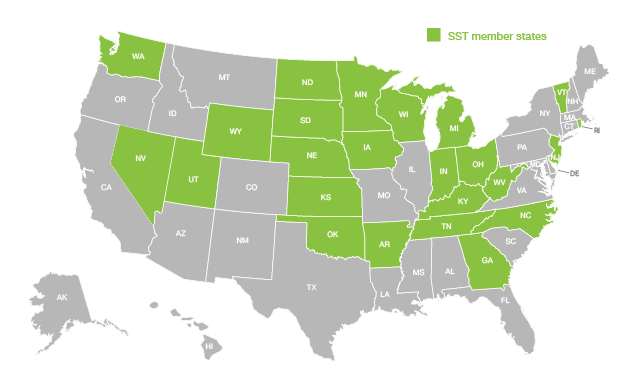
Now, what would you say to an offer that included all of these services and more, for free? Kind of a no-brainer, right? Well, if your company does business in one of the 24 member states, you can take advantage of this special program, free of charge. Click here to get started.
Take advantage of free:
State registrations
Tax calculations
Tax returns preparation, filing, and remittance
Audit assistance.
Streamlined Sales Tax Agreement Details
Here’s how you can apply at no cost to your business. The Agreement enables participating states to simplify and modernize sales tax administration, to substantially reduce the tax compliance burden. As one of only a few certified SST service providers, our partners at Avalara perform the above tasks. The states pay Avalara for the services and qualifying businesses get them for free.
Contact Encompass Solutions, Inc. using the link below to start the qualification process.
The effort that became the Streamlined Sales Tax Governing Board began in March 2000. The goal of this effort is to find solutions for the complex in-state sales tax systems that resulted in the U.S. Supreme Court holding (Bellas Hess v. Illinois and Quill Corp. v. North Dakota) that a state may not require a seller that does not have a physical presence in the state to collect tax on sales into the state. The Court ruled that the existing system was too complicated to impose on a business that did not have a physical presence in the state. The Court said Congress has the authority to allow states to require remote sellers to collect tax.
The result of this work is the Streamlined Sales and Use Tax Agreement. This Agreement simplifies and modernizes sales and uses tax administration to substantially reduce the burden of tax compliance. The Agreement focuses on improving sales and uses tax administration systems for all sellers and all types of commerce through all of the following:
State-level administration of sales and use tax collections.
Uniformity in the state and local tax bases.
Uniformity of major tax base definitions.
A central, electronic registration system for all member states.
Simplification of state and local tax rates.
Uniform sourcing rules for all taxable transactions.
Simplified administration of exemptions.
Simplified tax returns.
Simplification of tax remittances.
Protection of consumer privacy.
Today twenty-four states have adopted the simplification measures in the Agreement (representing over 31 percent of the population) and more states are moving to adopt the simplification measures.
Experts in all things revolving around tax compliance, Avalara makes tax compliance easy and efficient. This enables you to do what you do best, without constantly worrying about rate changes or filing deadlines.
Encompass Solutions, Inc. is an ERP consulting firm, NetSuite Solution Provider, and Epicor Gold Partner that offers professional services in business consulting, project management, and software implementation. Whether undertaking full-scale implementation, integration, and renovation of existing systems or addressing emerging challenges in corporate and operational growth, Encompass provides a specialized approach to every client’s needs. As experts in identifying customer requirements and addressing them with the right solutions, we ensure our clients are equipped to match the pace of the Industry.
Industrial automation is a topic of conversation that manufacturers all over the globe are discussing on the shop floors of production facilities and in board rooms. Industrial automation is no longer an optional component of manufacturing industries. To remain competitive, industrial automation must be considered to maintain a level of competitiveness in modern manufacturing scenarios.
What Is Industrial Automation?
As far as an Industrial automation definition is concerned, the concept can be defined as completing an operation or procedure without human assistance by utilizing control systems, such as computers or robots, and information technologies, like ERP platforms and EDI, for handling different processes and machinery.
Types of Industrial Automation
There are several types of industrial automation in use today. They can be broken down into four main categories:
Fixed (Hard) Automation
Programmable Automation
Flexible (Soft) Automation
Integrated Automation (TIA)
These types of automation are leveraged in different scenarios, some data-driven and some production-driven. We’ll go into that a little later.
For now, it’s important to understand that industrial automation technologies and concepts can be applied most readily to data collection, data processing, and predictable physical work, such as welding, soldering, painting, food prep, packaging, and materials handling.
Fixed (Hard) Automation
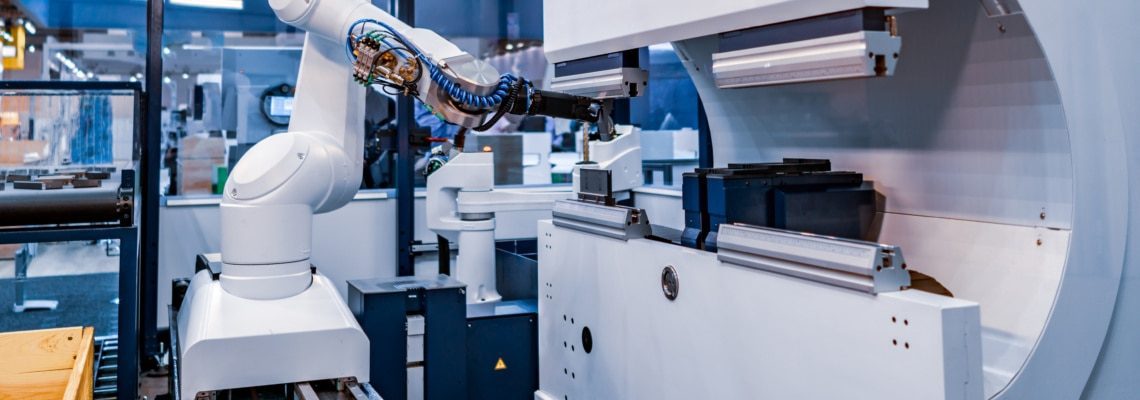
Fixed automation refers to the use of special purpose equipment to automate a fixed sequence of processing or assembly operations.
In this example, the application is usually simple and will involve a process or assembly that is dictated by programmed commands. It is relatively difficult to accommodate changes in the product design in a fixed automation process, which is set up with one purpose or process per application in mind.
Fixed (Hard) Automation Examples include:
Mechanized assembly
Machining transfer lines
Automated material handling
Fixed (Hard) Automation Advantages:
High production rates
Low unit cost
Fixed (Hard) Automation Disadvantages:
Relatively inflexible in accommodating product variety
The high initial investment for custom-engineered equipment
High vulnerability to failure
Obsolescence
Programmable Automation
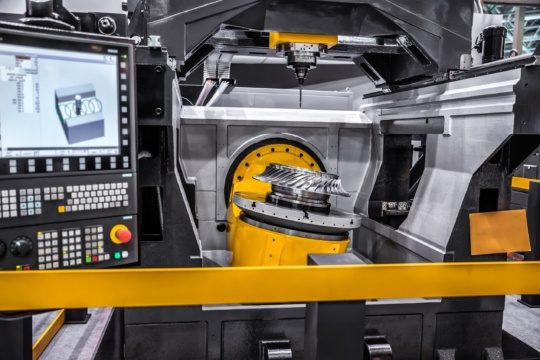
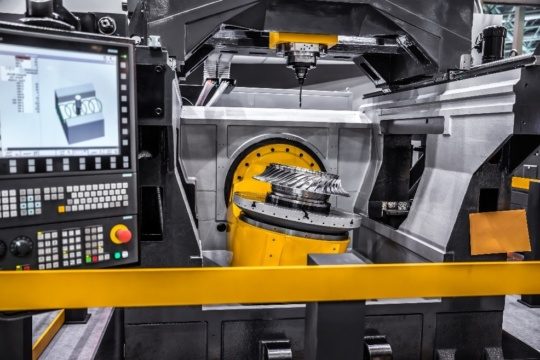
In programmable automation, the production equipment is designed with the capability to change the sequence of operations to accommodate different product configurations.
Programmable automation is used most often when manufacturing products in batches. It allows for customization and frequent changes throughout the manufacturing process.
In this case, the operation is controlled by a program of instructions that are read and interpreted by the system. New programs can be prepared and entered into the hardware to produce new products at any time.
Programmable Automation Examples include:
Computer Numerical controlled (CNC) machine tools
Industrial robots
Programmable logic controllers (PLC)
Programmable Automation Advantages:
Flexible and able to deal with design variations
Suitable for batch production
Programmable Automation Disadvantages:
High investment in general purpose equipment
Lower production rate than fixed automation
Flexible (Soft) Automation
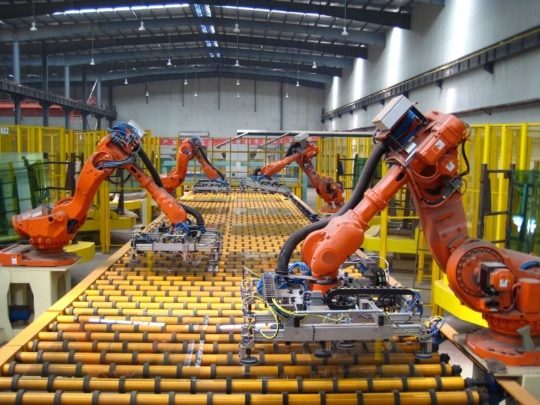
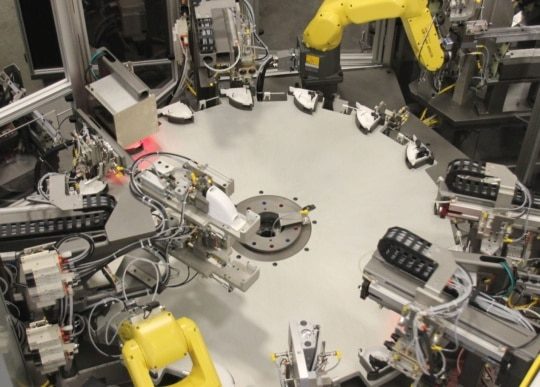
With flexible automation, several machine tools are linked together by a material-handling system, and all components of the system are controlled by a central computer. This configuration offers rapid and smooth changes to products and processes.
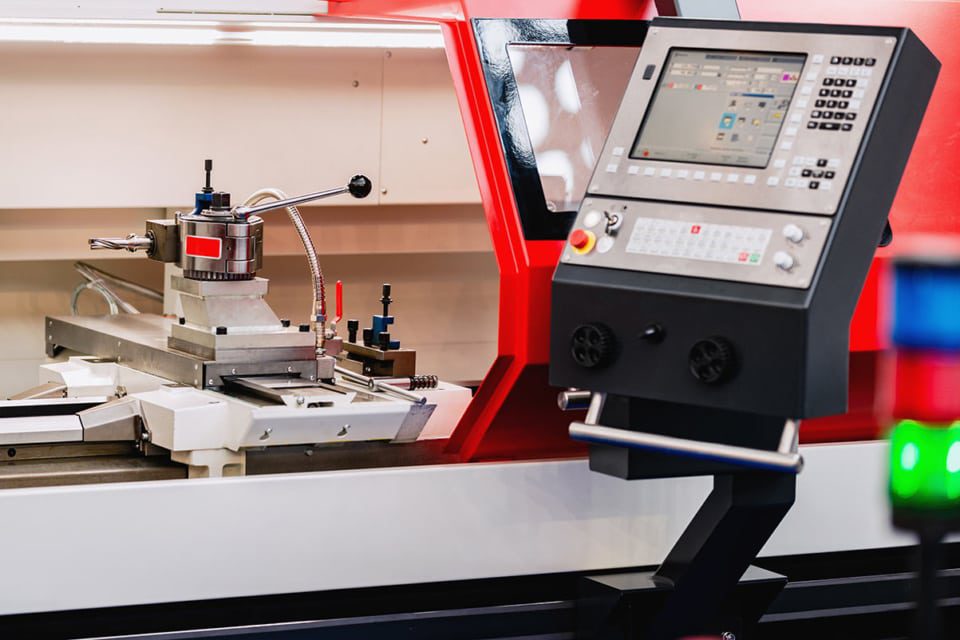
Utilizing multiple tools that are linked by a material handling system, like this rotary indexer, a flexible approach to automation is capable of producing a variety of parts with virtually no time lost for changes in the configuration. The same is true when reprogramming the system or altering the physical setup.
Flexible (Soft) Automation Examples Include:
Robot arms can be programmed to assume multiple tasks, such as insert screws, drill holes, sand, weld, insert rivets, and spray paint objects on an assembly line.
Flexible (Soft) Automation Advantages:
Continuous production of variable mixtures of products
Flexible to deal with product design variation
Offers Medium production rate
Flexible (Soft) Automation Disadvantages:
Requires a High amount of investment
High unit cost relative to fixed automation
Integrated Automation (TIA)
More of a philosophy pioneered by Siemens Automation and Drives than a tangible system, TIA includes several core concepts:
A common software environment
A common data management system
A common communication method
TIA implementation is ideal for many industries, including:
In the past, ERP software has served, in large part, to automate traditional business functions and record-keeping activities. Today, IIoT technologies extend those automation capabilities to the production floor. Taking into account the vast amounts of data production processes, robotics, and edge devices provide to centralized ERP systems, maintenance schedules, demand planning, and reporting can all be completed without the need for human intervention. By setting conditions and responses within the ERP system, users can monitor facility operations to expend energy or resources only when conditions warrant. The results are a more connected, streamlined business from the shop floor to the top floor with less waste at every level.
EDI further optimizes operations by eliminating manual communications between trading partners that used to take the form of faxes, phone calls, and emails. Electronic Data Interchange is an ERP agnostic technology that communicates critical order and shipping details instantaneously between digital devices. Standardized document formats, ensure that your logistics are in sync. Data exchanged through EDI is kept secure end-to-end and remains easy to interpret for both active orders and historical records.
Encompass Solutions, Inc. is an ERP consulting firm and Epicor Gold Partner that offers professional services in business consulting, project management, and software implementation. Whether undertaking full-scale implementation, integration, and renovation of existing systems or addressing emerging challenges in corporate and operational growth, Encompass provides a specialized approach to every client’s needs. As experts in identifying customer requirements and addressing them with the right solutions, we ensure our clients are equipped to match the pace of the Industry.
Traditionally, the procurement process requires a great deal of manual effort as businesses commit resources to find and acquire goods, services, or work from external sources. These agreements require further attention as contracts need to be drawn, terms agreed to, and those agreements are managed throughout the life of the manufacturer/supplier relationship. This often extends far beyond one source to incorporate many external suppliers who can fulfill needs when another supplier cannot or for materials of varying quality and composition. The process has been most often achieved through a tendering or competitive bidding process. Fortunately, modern procurement automation solutions have enabled manufacturers to hand off many of their manual tasks to self-guided systems. The resulting procurement process improvement frees valuable internal resources for business-critical decision-making and strategizing efforts. Our partners at SourceDay have developed these industry-leading procurement automation solutions for use in an array of manufacturing and supply chain scenarios.
SourceDay Procurement Automation Solutions
SourceDay Procurement Automation Solutions For Buyers And Suppliers
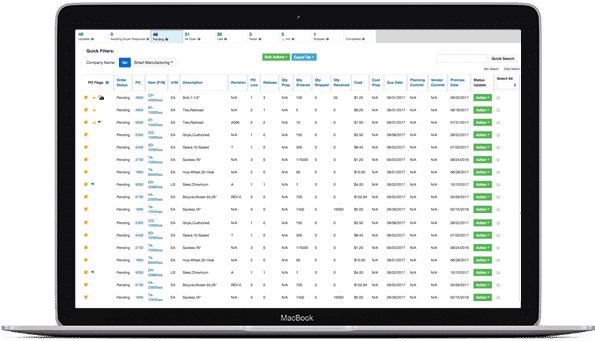
For suppliers, Managing customers’ needs can be a daunting task. SourceDay allows you to handle it all in one convenient place. Purchase order management and buyer/supplier collaboration solutions work together to eliminate the headaches that come with managing an extensive list of customers. What’s even more attractive is the fact that SourceDay’s procurement automation solutions are free for suppliers.
For buyers, maintaining an effective and intuitive collaboration process with suppliers brings many challenges. when parts are being ordered in vast quantities the sheer volume of parts being ordered and so much relying on those parts arriving perfectly, supplier relationships are critical. A delay, an error, poor quality materials, or miscommunication can have detrimental implications with ripple effects that impact the end customer.
ERP systems, like Infor, SAP, NetSuite, and Epicor, help companies manage their businesses from financial operations to inventory management, production, and customer fulfillment. As good as ERP systems are, they all have feature gaps in functionality. Today’s ERP systems lack effective tools for managing purchase orders and suppliers. Once the ERP establishes requirements and the POs are generated, most buyers leave their ERP systems and rely on static, manual spreadsheets, emails, phone calls, and faxes to handle the rest. This equates to data in the ERP system being out of sync and creates aggravation, and mistakes while making it impossible for manufacturing and distribution companies to schedule production runs and forecast deliveries to their customers.
SourceDay ERP Integrations
SourceDay has developed seamless integrations alongside the most widely used ERP systems. This extends manufacturers’ investments in technology, amplifies the power in controlling internal and external processes, as well as boosts the functionality of existing ERP systems. By digitizing and automating supplier purchase order updates into existing ERP systems, customers receive a complete data transfer that eliminates errors and wasted time that results from manual-entry tasks, all while maintaining up-to-date data in your ERP system. Implementing SourceDay, further increases the return on existing ERP system investments.
SourceDay can integrate into nearly any ERP:
Epicor
Epicor Eclipse
Epicor Prophet 21
SAP
NetSuite
ECI M1
Exact Macola
Infor
Infor CloudSuite Industrial
Infor-SyteLine
Infor Visual
Microsoft Dynamics AX
Microsoft Dynamics NAV
Plex
QAD
Shoptech E2
If you don’t see your current ERP system in the list below, you can reach out using the contact us link below to confirm that your system is eligible for SourceDay ERP Integration.
Mobile SourceDay Procurement Automation Solutions
SourceDay is the only procurement management software specifically made to solve the most common challenges manufacturing and distribution companies face in managing their direct spending. Now, with SourceDay Mobile, procurement leaders, and their teams can manage procurement from anywhere at any time from their smartphones. Users will have quicker access to view, acknowledge and communicate on procurement data, where the data is being consumed, for endless collaboration. No other solution brings greater execution and visibility into the procurement and PO lifecycle while reducing risk, costs, and delays.
The benefits of mobility are felt several times over with SourceDay procurement automation solutions, including:
Manufacturing and distribution business flexibility that delivers agility in decision-making processes anywhere, regardless of location, country, or time zones
Stronger and more easily managed buyer/supplier partnerships with collaboration tools that can be leveraged anytime, anywhere
More efficient and proactive customer support to drive supply chain performance
Real-time notifications delivered to your mobile devices provide the framework for immediate action and quick decision-making
Encompass Solutions is a business and software consulting firm that specializes in ERP systems, EDI, and Managed Services support for Manufacturers and Distributors. Serving small and medium-sized businesses since 2001, Encompass modernizes operations and automates processes for hundreds of customers across the globe. Whether undertaking full-scale implementation, integration, and renovation of existing systems, Encompass provides a specialized approach to every client’s needs. By identifying customer requirements and addressing them with the right solutions, we ensure our clients are equipped to match the pace of the Industry.
Traditionally, the procurement process requires a great deal of manual effort as businesses commit resources to find and acquire goods, services, or work from external sources. These agreements require further attention as contracts need to be drawn, terms agreed to, and those agreements are managed throughout the life of the manufacturer/supplier relationship. This often extends far beyond one source to incorporate many external suppliers who can fulfill needs when another supplier cannot or for materials of varying quality and composition. The process has been most often achieved through a tendering or competitive bidding process. Fortunately, modern tools have enabled manufacturers to hand off many of these manual tasks to procurement automation solutions. The resulting procurement process improvement frees valuable internal resources for business-critical decision-making and strategizing efforts. Here are our top 10 procurement automation use cases to help start automating the procurement process in your organization.
1. Direct Procurement Tasks: Minimizing The Manual
Spreadsheets, faxes, and emails have long been staples of direct procurement processes. unfortunately, the variability of the results can lead to an unreliable supply chain. There is simply too much opportunity for data entry errors, lost communications, and missed deadlines. This poor visibility in your supply chain and the procurement process can prove to be a significant hurdle to overcome and even potentially cause a halt in manufacturing and machinery. Production stoppages can cost millions in labor, expedited shipping costs, and poor customer satisfaction. By minimizing the manual entry of data and other associated tasks, procurement automation improves your business performance from the inside out.
The benefits of working with a quality supplier cannot be overstated. suppliers are often overlooked as a critical business component as they can impact the functions of your entire organization. Unfortunately, the manual nature of most procurement management makes it difficult to stay on top of past-due or poor-quality materials.
By operating with outdated and disparate tools, there is no visibility into supplier on-time performance and responsiveness to PO acknowledgments and confirmations. Communication between buyers, suppliers, and stakeholders turns into a moving target when what you need is a predictable performer. Automation tools built specifically for the procurement process bring clear and reliable communication channels to the forefront while helping to reduce errors, missed deadlines, and unhappy customers.
3. Supplier Accountability Improves
Procurement automation solutions hold historical data for you to use when evaluating which suppliers are keeping in line with the standards you have set for your relationship. Scorecards keep track of what matters most, including:
Supplier price variance
On-time delivery
Quality
Responsiveness
These scorecards ensure that ISO-certified companies maintain adherence to an in-depth supplier scoring system to remain ISO compliant. If your suppliers are delivering below your expectations, you can see a complete history of events leading to a downgrading of their rating. This makes having conversations about delivery easy, thanks to concrete historical data you can access from anywhere.
4. Procurement Automation Improves Collaboration
The simplicity and clarity of purpose-built procurement automation tools represent a monumental shift in supplier performance and supply chain efficiency. These systems are designed to integrate seamlessly with your ERP system. They deliver the ability to see and react to changes in real time from a single source of data. By automating your needs, from manual buying processes to performance analytics, business becomes streamlined at every level. You’ll find tremendous benefits through procurement automation in:
Collaboration – Increase collaboration between the buyer and supplier.
Visibility – Update data automatically in the ERP and view the information in real time.
Performance – Enhance performance with more accurate information and consistent communication and alerts.
Transformation – Improve productivity and supplier performance with better internal resource allocation and more accurate data.
5. Purchase Order Systems Become Streamlined
Automated purchase order management systems extend the power of your ERP. This provides you with the ability to manage direct spending and buyer-supplier relationships. when purchase orders are created these systems expedite purchase order acknowledgments, track due dates, and status changes, and alert your suppliers to important PO changes. All purchase order details and buyer/supplier communications can be tracked directly with each purchase order. Just like with EDI, updates are sent in real-time and immediately sync to your ERP.
6. Better Document Management
As operations expand, more trading partners and suppliers are brought into the fold. Communications, contracts, purchase orders, invoices, and a host of other documents are being routed back and forth between internal and external resources every day. Procurement automation tools will make sharing and managing all types of documents with your suppliers a hassle-free endeavor. By ensuring your suppliers automatically receive the latest revisions of manuals, prints, bill-of-materials, and specifications, they are better able to meet your needs and deliver on their obligations. Uploading your documents into these procurement automation tools will share the latest version of existing documents with your supplier automatically. New documents being uploaded need initial permissions and routing protocol set up, but it’s on autopilot after that, in most cases. You can even require a supplier to confirm receipt of your document and easily send reminders to suppliers who are slow to accept, further aiding in accountability and supplier performance.
7. Advance Shipment Notifications, Simplified
Completing detailed Advance Shipment Notification (ASN) documents, saving them to a given platform, and automatically sending them to buyers before shipment is made easy with procurement automation. The tools help buyers and receiving departments improve performance as it pertains to incoming supplier shipments with standardized barcodes and shipping labels. A quick scan of a barcode and receivers instantly know the contents of any box.
8. Superior Quality Control
Procurement automation tools track the incoming inspection of materials, placing parts in a quality queue and flagging them for review to simplify your quality control processes. If the item(s) fails inspection, the reviewer inputs the reasons into the tool and collaborates with the supplier to disposition the material.
9. Easy Request For Quote (RFQ) Management
Spreadsheets only slow things down when you want RFQs promptly and intuitive layout. With procurement automation, you can send a request for a quote to your suppliers to track every step of the way, automatically. A comprehensive view of every supplier on your list will allow you to make an informed decision without having to jump between multiple sheets. Tracking responses that align with the best pricing and scorecard rating make it easy to compare offers and choose the suppliers who best fit your requirements.
10. Mobile Utilization Of Procurement Automation
Mobility is key for any modern organization. If you can’t make decisions on the move, you are essentially desk-bound. That means, if you’re not in the office, chances are you’re not taking action. Today, procurement automation solutions place simple and intuitive smartphone apps in your hands. These native-developed applications assist in managing procurement and purchase orders from anywhere, at any time. Leveraging quicker access to view, acknowledge, and communicate procurement data where the data is being consumed allows you to make smarter business decisions, faster.
Want to know more about procurement automation? Get in touch with the experts at Encompass Solutions using the contact us link below. We’ll help you identify the ideal procurement automation solution for your business’s unique needs.
Encompass Solutions, Inc. is an ERP consulting firm, NetSuite Solution Provider, and Epicor Platinum Partner that offers professional services in business consulting, project management, and software implementation. Whether undertaking full-scale implementation, integration, and renovation of existing systems or addressing emerging challenges in corporate and operational growth, Encompass provides a specialized approach to every client’s needs. As experts in identifying customer requirements and addressing them with the right solutions, we ensure our clients are equipped to match the pace of the Industry.
Interactive interfaces are the next stage in workforce agility, providing more visibility into data and processes while enabling faster reaction times. Epicor Virtual Agent (EVA) is Epicor Software Corp.’s answer to manufacturers’ desire to extract more value from their current assets and investments without incurring higher costs or sacrificing product quality. The Epicor Virtual Agent, aptly named EVA, is a cutting-edge digital assistant designed to help users work more intelligently.
Epicor Virtual Agent (EVA) At Work
With built-in artificial intelligence, EVA can simplify user interactions with the ERP system and automate manual tasks to speed up operations. Text and voice cognitive skills enable EVA to transform data into visual representations. The result is an intuitive experience that allows users to complete actions on native devices with ease. The technology is powered by Natural Language Processing (NLP), a human-computer interactive technology that users can leverage from mobile devices with requests and tasks that will be addressed by the Epicor Virtual Agent. Targeted information and data to enable faster, better decision-making is then delivered in real-time.
According to Scott Hays, Epicor senior vice president of product marketing, “When EVA responds within the Epicor solution, she does so with more visuals,” offering the example, “If I ask for a typical part, I’ll get back an image of the part with the key information I need to know right away. And, she’ll have a ‘next best action button.” Users can also request more information, including part price or quantity on hand, which will be provided by the Epicor Virtual Agent via the request and response interface.
Taking The Epicor Virtual Agent Beyond Conversation
While the request/response conversational experience may be what most users are familiar with when it comes to virtual agents, the Epicor Virtual Agent extends functionality into proactive suggestions based on best practices. The proactive decision-making process takes into account combinations of events, market statistics, and historical data. Designed to extend and support the workforce, EVA can provide insights teams can easily overlook to improve accuracy, and problem-spotting, and can even forecast or adjust production or distribution levels according to customer demand.
When conversation falls short, actional insights reinforce the agent’s effectiveness according to Hayes, who elaborated on what it means to be an effective virtual agent, stating “The second capability is taking action. If EVA has noticed something going on, she may say that based on what she’s seeing happening on the factory floor I should schedule maintenance on a machine.” The data described includes that from shop floor machines and IoT sensors. These devices, coupled with Epicor ERP, create a virtual nervous system that enables seamless and informed communications between EVA and users’ mobile devices.
The Epicor Virtual Agent In Action
By utilizing the EVA via an interface device, management can confirm or deny suggestions from the Epicor Virtual Agent with just a few clicks or taps. Production managers can schedule maintenance for a machine, shift production to other machines, and carry out an array of other actions with ease.
The Epicor Virtual Agent goes beyond traditional manufacturing scenarios, too. Other applications and industry-specific use cases include:
Distribution — EVA can provide outside sales and field service representatives with instant and easy access to information they need, such as product details, price, and availability information, as well as the ability to create a quote on their mobile devices while meeting with customers face-to-face.
Retail — EVA utilizes an AI-powered recommendation engine based on market basket analysis to suggest relevant cross-sell or up-sell recommendations in real time. This can take place in the aisle, in real-time, where purchase decisions are made.
Automotive Aftermarket — By using AI to evaluate huge datasets that include vehicle registrations and parts failure rates by region, EVA can communicate to auto parts distributors that specific parts are in high demand and stock levels of specific parts need to be replenished or increased to meet that projected demand.
Leveraging The Epicor Virtual Agent Alongside Epicor ERP
Developed using AI services from Microsoft Azure AI services are an integral part of EVA’s development. As such, the Epicor Virtual Agent can accompany any size and type of Epicor implementation, be it on-premise or in the cloud. By delivering the power of EVA to customers of every size, even small and medium-sized companies can leverage the innovative tech the biggest enterprises use to grow their businesses.
Hays emphasizes EVA’s machine learning component and how extended use will make the tool even more ubiquitous, “With EVA, you interact naturally with your ERP system. It’s as easy as just talking or typing to a colleague. This makes the breadth and depth of the industry-specific functionality and information available inside the system directly accessible to a larger audience, boosting productivity and efficiency, and giving the company an improved return on their ERP investment.”
EVA will be available as part of the latest releases of Epicor ERP and Prophet 21, which are planned for general availability in May 2019.
Encompass Solutions, Inc. is an ERP consulting firm and Epicor Gold Partner that offers professional services in business consulting, project management, and software implementation. Whether undertaking full-scale implementation, integration, and renovation of existing systems or addressing emerging challenges in corporate and operational growth, Encompass provides a specialized approach to every client’s needs. As experts in identifying customer requirements and addressing them with the right solutions, we ensure our clients are equipped to match the pace of the Industry.
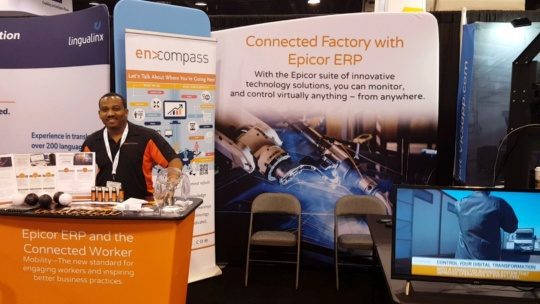
We came, we saw, it was awesome. Encompass Solutions’ participation as exhibitors and speakers at Automate 2019 gave us the perfect vantage point from which to experience the show and deliver an Automate 2019 recap.
Automate 2019 At a Glance
Produced by the Association for Advancing Automation (A3), the show featured more than 500 exhibitors in the massive 160,000-square-foot exhibition space at McCormick Place in Chicago, IL. In addition, the show hosted five educational tracks that included practical training in How to Automate, Automation Solutions & Innovation, Collaborative & Mobile Robotics, AI, Digitalization & Smart Manufacturing, Certified Vision Professional (CVP) Basic, Certified Vision Professional (CVP) Advanced, Certified Motion Control Professional (CMCP), and Advanced Robotics for Manufacturing (ARM) Updates. These tracks included content from introductory level to advanced topics for users, students, educators, and operators. While we delivered an introductory seminar on current automation types, robotics in use on the factory floor, and how you can get started implementing in your facilities, we attended several breakout and advanced sessions. During each of those talks, one theme emerged over and over–ours is the age of automation.
Here are just a few more happenings from Automate 2019 regarding new advanced robots and robot vendor developments that are rolling out into facilities worldwide.
Automation 2019 Key Takeaways
There were too many things we learned at Automate 2019 to list in one post. However, we want to share a few highlights that we think everyone needs to consider moving forward:
Automation is here and it’s only gaining more momentum as advancements in hardware, software, and utilization become more refined.
If you are not thinking about leveraging automation and robotics, you are already behind.
While many are expecting an economic downturn between 2020-2022, now is still the best time to begin investing in these technologies.
Start small. You don’t have to outfit your entire operation to remain competitive. start with one robot or one instance of automated assembly. build from there.
Empower your staff and involve them in the transformation that is coming.
Focused Automation and Robotics specializations for employees will be necessary, as there will be less and less room for unskilled staff in modernized facilities.
Upskilling current staff will be of greater benefit and lower cost for employers than training and onboarding new staff.=
It’s going to be a hard-fought battle to outpace competitors as automation becomes more affordable and more accessible to small and medium-sized enterprises. Start training and experimenting with automation today and you’ll be ready to weather the bout.
ERP At Automate 2019
We spoke with hundreds of users and manufacturers thinking about robotics and automation during the weeklong Automate 2019 event. While the robots and automation enclosures were captivating, to say the least, one thing few seemed to consider during that time was how they were going to connect those robotics and automated systems to the rest of their enterprise. In short, the answer is an ERP solution.
It’s one thing to install a robot on your factory floor to install windshields, make welds, or assemble PCBs. However, what are you doing with that data from your manufacturing processes? Are you even tracking it? By plugging your robotics and automation data into your ERP system, you are getting more detailed accounts of performance, quality, material and time optimization, maintenance cycles, and so much more. Everyone we spoke with, from attendees to exhibitors to organizers, agreed that ERP connectivity is an essential component of automation and robotics on the factory floor. We look forward to carrying those conversations further and urge everyone looking to automate processes or install robots in their facilities to consider the necessity for visibility and connectivity when evaluating such technologies.
Encompass Solutions, Inc. is an ERP consulting firm and Epicor Gold Partner that offers professional services in business consulting, project management, and software implementation. Whether undertaking full-scale implementation, integration, and renovation of existing systems or addressing emerging challenges in corporate and operational growth, Encompass provides a specialized approach to every client’s needs. As experts in identifying customer requirements and addressing them with the right solutions, we ensure our clients are equipped to match the pace of the Industry.
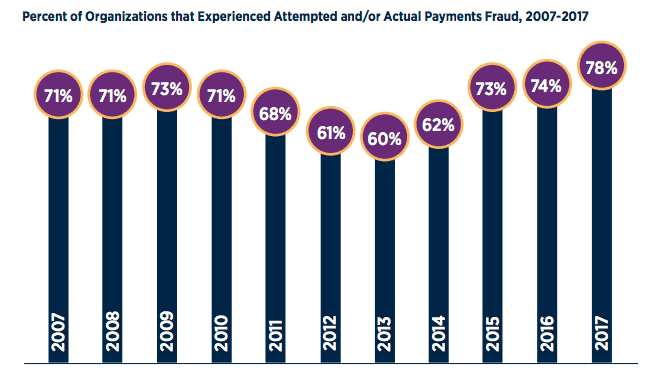
Fraud has been a thorn in the side of B2B business transactions as long as those transactions have existed. With more advanced technology at their disposal, illegitimate parties’ payment fraud attempts become more elaborate. According to the Association of Finance Professionals, last year saw the highest percentage of businesses impacted by payment fraud in the last decade. Here are a few of the payment control best practices your business can put into action today to combat fraud.
Photo: Association for Finance Professionals
IT And Security Professionals On Payment Control Best Practices
The rising instance of payment fraud has It and security staff concerned. As many as 85% of security professionals surveyed responded that their companies lacked the necessary security and infrastructure to combat payments fraud.
The biggest windows of opportunity for fraud reside in the Accounts Payable (AP) department of a business. Errors made during the process of manual data entry and inefficient email communication concerning dozens of invoices at any given time are just two examples of significant vulnerability. However, a majority of fraud cases result from the most insecure payment method accepted by businesses — paper checks.
Why You Need To Implement Payment Control Best Practices
While most businesses are aware of fraud and do implement some steps to mitigate its effects, few are willing or capable of giving the subject the undivided attention it requires.
Common activities businesses use to combat fraud include:
Reconciling validity against invoices, department heads, and their vendors
manual comparison of invoices to purchase orders
compiling checks over time to have the CFO sign off at a later date
These activities may be sufficient to insulate Accounts Payable, in theory. However, with an increase in volume as a company grows, these methods fall short of providing the security AP needs. If Outlook is where your invoice approval process resides, chances are a few of those invoices are getting lost in the shuffle. Bottlenecks emerge when it comes time to audit or get approval through a CFO, who may have only a small window of availability.
Payment Control Best Practices To Mitigate Risk
Despite the growing prevalence of fraud in B2B transactions, here are some payment control best practices you can put into place today to insulate your company from the associated risks.
1. Ditch the paper in favor of electronic payment methods
Electronic transaction support can deliver a lot of benefits to businesses of any size. not only are they convenient, secure, and efficient, these types of payments add multiple layers of security through encryption. Virtual cards take things further with the inclusion of tokenization, a process by which data is assigned a series of symbols that retain essential information without compromising security.
Beyond security, electronic payment methods expedite the payment process significantly. These more opportunities reduce liabilities and increase working capital benefits that your business can leverage. the convenience of electronic payment methods can be felt on the other side of the transaction, as well. customers and vendors that can leverage an easy-to-use payment system in conjunction with your business will feel greater satisfaction from your B2B relationship. Increased partner satisfaction results in stronger relationships and can lead to more referrals for your business.
2. Remove Autonomy Over The Payments Process
Accounts payable are no exception to the rule when it comes to checks and balances. It is never a good idea to give a sole individual complete control of the flow of money in and out of company accounts. Breaking up the process to include several staff members ensures that no single person is responsible for the flow of capital. Designating one team member to set up payments and another to approve and release those payments ensures proper checks and balances during the process.
3. Automate Accounts Payable
Automation isn’t just a buzzword when it comes to your accounts payable department. with volumes of data to be received, recorded, and processed, there is plenty of room for error when the tasks are carried out manually.
Fortunately, modern tools and solutions that can be leveraged alongside your ERP system exist. The automation of these tasks increases security, efficiency, and the benefits your company can leverage as a result. putting manual data entry errors and headaches aside, how easy is it for your accounting department to keep up with rapidly changing rates, rules, and laws? automated software that integrates with ERP delivers that real-time visibility you need to remove mistakes from the equation.
An automated accounts payable process embeds payment controls — like the aforementioned segregation of duties — into the AP process and establishes them as simple and repeatable processes:
Segregation of duties: AP automation solutions designate separate roles in the accounts payable process by creating separate login credentials and separate dashboards. Not only does this make it incredibly challenging to forge approvals, but it also preserves receipt of all approvals in one central location for easy access at any time.
Two-factor authentication: adopting an AP automation solution that requires dual-factor authentication will decrease the probability of an account becoming compromised. the process dictates that a password and text message-delivered verification code must be entered before access to the system is granted.
Auto AP three-way match: For businesses working with purchase orders, AP automation can take the pain out of matching them to corresponding invoices by doing it automatically and flagging any that are mismatched within your ERP system. The “three-way” part of the three-way match refers to the three documents that will be compared:
The vendor’s invoice that was received will become part of an organization’s accounts payable when it is approved
The purchase order that was prepared by the organization
The receiving report that was prepared by the organization
With these controls in place, it’s much easier to protect and sustain your AP process, even as you continue adding vendors every month. The results are felt in:
Improved compliance and supplier relationships
Simplified vendor setup and management
Improved visibility, insight, and control of the entire accounts payable (AP) process
Ability to focus your AP team on higher-value work
When automation is factored into the equation, the benefits are felt even further with:
Reduced cost per invoice (CPI)
Instant storing, securing, and cataloging of electronic documents
Streamlined AP workflow processes
Dramatically reduced paper and storage expenses
Improved cash flow with fewer data entry errors and early pay discounts
The ability to work anywhere, anytime, on any device
We Can Help With AP Automation And Payment Control Best Practices
For more information on how to implement these best practices and automate AP for your business, get in contact with the experts at Encompass Solutions.
Encompass Solutions is a business and software consulting firm that specializes in ERP systems, EDI, and Managed Services support for Manufacturers and Distributors. Serving small and medium-sized businesses since 2001, Encompass modernizes operations and automates processes for hundreds of customers across the globe. Whether undertaking full-scale implementation, integration, and renovation of existing systems, Encompass provides a specialized approach to every client’s needs. By identifying customer requirements and addressing them with the right solutions, we ensure our clients are equipped to match the pace of the Industry.
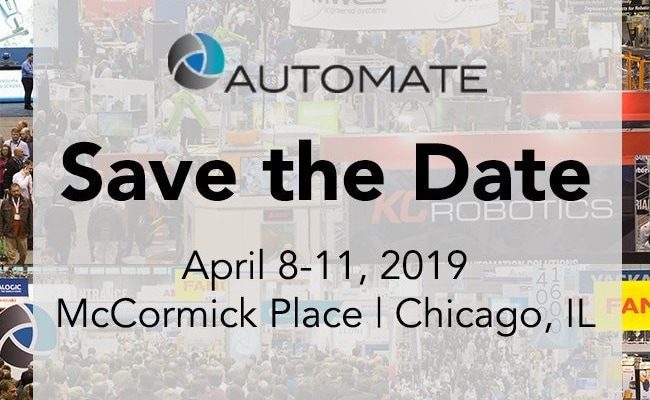
Encompass Solutions is proud to announce it has been selected to deliver an educational Automation and Robotics presentation at the largest Automation conference and trade show in the United States, Automate 2019.
About Automate 2019
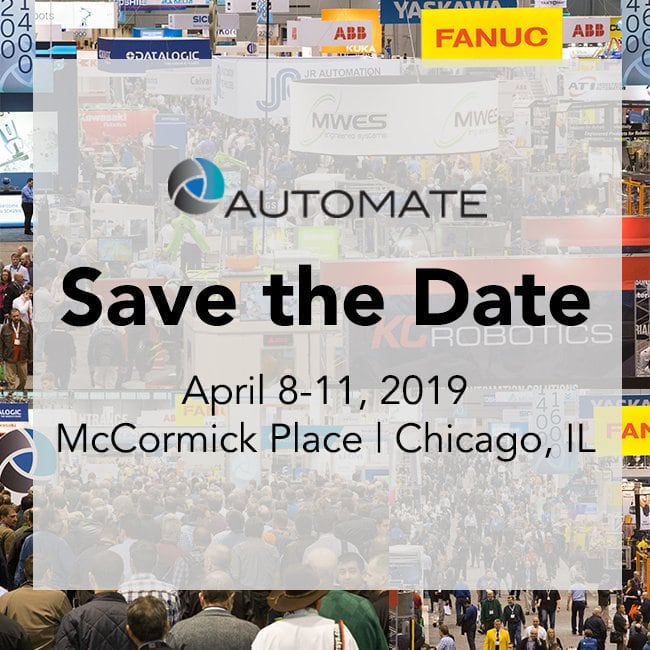
The event will take place April 8-11, 2019 at McCormick Place in Chicago, IL. Featuring the latest in automation technology and solutions for manufacturers and businesses, Automate 2019 is looked forward to by tens of thousands of industry professionals. Whether you are looking to buy automation technology, learn about the latest trends and applications for businesses, or simply want to admire the innovations advancing manufacturing in the United States, this show is an exceptional experience that you won’t want to miss.
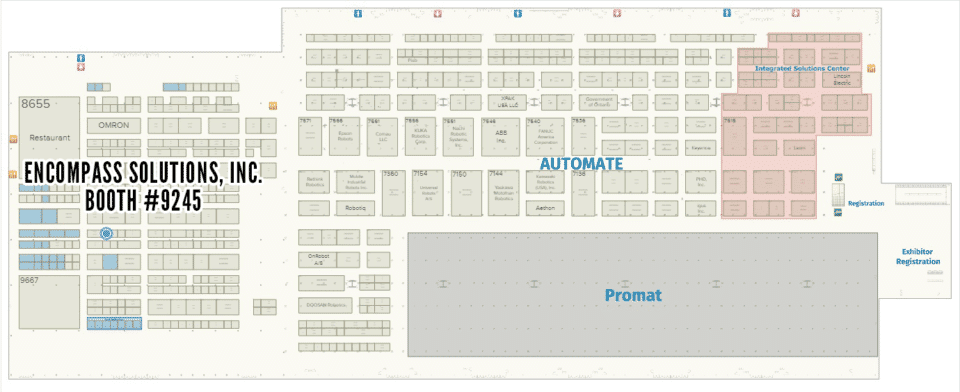
Come visit Encompass Solutions at Booth #9245 to discuss what your business can do with clear direction and clear results.
About The Encompass Automation And Robotics Presentation
This presentation, developed by senior consultants and industry experts at Encompass Solutions, is designed to be an educational breakout session for manufacturers who are interested in learning more about automation and robotics on the factory floor. Topics covered in the presentation include:
Types of automation used in manufacturing processes
Types of Robots used in Manufacturing processes
Concepts and components that are peripheral to these topics
What steps to take as you begin implementing Automation, Robotics, or both in your business
The presenter for this event is Jason Claggett, Encompass Solutions’ Managed Services Manager. Jason is an infrastructure and information systems professional with more than 20 years of experience. With particular expertise in process improvement and business systems, such as ERP and Manufacturing Execution Systems, Jason regularly presents to software user groups throughout the Midwest and Southwest regions regarding the latest technology and innovations available to manufacturers.
Encompass Solutions is a business and software consulting firm that specializes in ERP systems, EDI, and Managed Services support for Manufacturers and Distributors. Serving small and medium-sized businesses since 2001, Encompass modernizes operations and automates processes for hundreds of customers across the globe. Whether undertaking full-scale implementation, integration, and renovation of existing systems, Encompass provides a specialized approach to every client’s needs. By identifying customer requirements and addressing them with the right solutions, we ensure our clients are equipped to match the pace of Industry.
Whether you’re new to the world of IT or a bastion of knowledge for your organization in all things tech, there are exciting technologies poised to disrupt Industry in the very near future. the top 5 technology trends in 2019 are full of Innovation and advancements. These rapidly maturing and increasingly adopted technologies are some of the most exciting concepts you may or may not have heard of. Each example is poised to change the way we approach fortifying our systems and advancing our workforces to tackle the challenges of corporate and operational growth.
Here are what we think will be the top 5 technology trends in 2019 that will likely have a significant impact on businesses:
1.) Hyper-Converged Infrastructure (HCI)
Hyper-converged infrastructure, or simply hyper-convergence, is a software-defined IT infrastructure. Counter to traditionally constructed systems that involve several components of on-premise hardware that may not speak to each other, HCI seeks to virtualize and combine systems that have traditionally been “hardware-defined”, like storage systems, servers, and networking switches. HCI seeks to modernize organizations through the virtualization of computing, SAN, and networking components of infrastructure into one unified appliance set. That means one source for all resources. The methodology comes in a few forms, including a standalone appliance, a reference architecture, and a software-only model.
What Does It Mean For Businesses?
By doing away with siloed physical hardware systems, HCI seeks to establish a business’ IT infrastructure in a purely software-defined environment that eliminates traditional data-center inefficiencies and reduces the Total Cost of Ownership (TCO). It is a trend that seeks to marry the agility and versatility of cloud infrastructure without requiring companies to give up their on-premise systems.
When companies no longer have a need to rely on disparate computing and storage systems, management becomes simplified and resource utilization becomes much more efficient. To that end, operations become far less complex and scalability becomes easier to achieve, making HCI one of our first picks for the top 5 technology trends in 2019.
2.) Software-Defined Wide Area Network (SD WAN)
To better understand that SD WAN is, it helps to understand standard Wide Area Network (WAN). A WAN is a telecommunications or computer network that extends across a large distance and is capable of transferring data across that distance. This distance can be between regions, countries, or reach across the globe. These networks are generally created with leased telecommunications circuits.
In the case of SD WAN, what you might also refer to as Link Load Balancing, organizations can expand their Wide Area Network to scale alongside requirements, such as increased bandwidth, media streaming, video conferencing, and VOIP calls, much more affordably and with improved performance. SD WAN is designed to address and avoid the pitfalls of networking maintenance and troubleshooting, such as network congestion, packet delay variation, packet loss, and service outages.
According to Gartner, a research firm, SD WAN carries with it four main qualities:
The ability to support multiple connection types, such as MPLS, frame relay and higher speed LTE wireless communications
The ability to do dynamic path selection, for load sharing and resiliency purposes
A simple interface that is easy to configure and manage
The ability to support VPNs, and third-party services such as WAN optimization controllers, firewalls and web gateways
What Does It Mean For Businesses?
Because SD WAN is a virtualized WAN, businesses reap the benefit of being able to utilize any transport protocol needed. Uptime is further ensured thanks to the utilization of multiple providers for failsafe and bandwidth allocation as necessary. This virtualization also lends the added security benefit of covering security protocols, like malware defenses and botnet intervention, for multiple branches and remote devices. Provisioning on the fly is another substantial benefit of SD WAN. You can send an un-configured device to a site and have all the required network certificates, keys, and policies applied upon installation, immediately implementing the necessary permissions, documentation of traffic patterns, and access of network users. The tech may not be as new as some of the others to make our list of top 5 technology trends in 2019, but it will no doubt become more prevalent.
3.) Internet of Things (IoT) and Industrial Internet of Things (IIoT) Connectivity
The Internet of Things (IoT) exists as a network of interconnected devices that communicates data to a central system that makes sense of it all.
This network consists of all edge devices connected to the many interchanges of an enterprise. From the deli counter to eCommerce platforms, the data gleaned from this network provides invaluable insight into what is successful and what is not in terms of the products and processes that form the inner workings of a business.
The Industrial Internet of Things (IIoT) brings this interconnectivity and data-focused paradigm to the terminals, sensors, and other systems on the factory floor.
What Does It Mean For Businesses?
These data-fueled factories become “intelligent” environments, capable of informing enterprises from the top down of the efficiency and shortcomings of their factory processes and performance both in real-time and over time. In short, the IoT and IIoT data enables manufacturers further to refine and improve operations with relevant and up to date data for smarter, faster decision making. There is no doubt continued invetment in IoT and IIoT technologies and connectivity secure this concept as top 5 technology trends in 2019.
4.) AI-Enabled Security
As more and more data flows through digital devices and connections, the need for improved security protocol and tools increases in tandem. AI-enabled security is one way enterprise security teams and individuals can protect critical data and infrastructure, even when in-house resources are relatively scarce.
Did you know that malicious actors will typically spend 200+ days in a system before extracting critical and valuable data? Learning who the players are and who holds the keys to the most protected data takes time and malicious actors have the patience that pays off in the long run. However, AI has the potential to be infinitely more patient, resourceful, and vigilant.
What Does It Mean For Industry Businesses?
AI-enabled security makes the list as one of the top 5 technology trends in 2019 because by establishing baselines for normal behavior, traffic patterns, bandwidth allocation, permissions, and user access, system anomalies can be detected within seconds. Intelligent security systems can then act according to the parameters designed by security professionals.
5.) Augmented Reality (AR) And Virtual Reality (VR)
There are numerous applications for AR and VR. Take for instance training of new employees. If a business operates in a single location, managers can give hands-on training and face-to-face feedback with relative ease. What happens when a business operates in multiple locations and needs to onboard multiple resources in a finite amount of time. With the capabilities AR and VR present, managers can work and train remotely with staff. By using vision systems to see what they see, audio to hear what they hear and communicate clearly, and even present schematics, diagrams, and drawing in real-time, managers can to direct training programs from anywhere and at any time.
What Does It Mean For Industry Businesses?
Interactive walkthroughs, first-hand product demos, disaster preparedness, and a multitude of training simulations are only a handful of examples where AR and VR will be one of the top 5 technology trends in 2019 and a major game changer for businesses big and small.
Encompass Solutions, Inc. is an ERP consulting firm, NetSuite Solution Provider and Epicor Gold Partner that offers professional services in business consulting, project management, and software implementation. Whether undertaking full-scale implementation, integration, and renovation of existing systems or addressing the emerging challenges in corporate and operational growth, Encompass provides a specialized approach to every client’s needs. As experts in identifying customer requirements and addressing them with the right solutions, we ensure our clients are equipped to match the pace of Industry.
In the era of Industry 4.0,automation has been one of the most effective apparatuses driving efficiency for manufacturers. Leveraging automation in manufacturing alongside advanced technologies, like robotics and robotic process automation through ERP software, is enabling even greater gains in productivity to be made each day.
Want to learn more about process automation for your manufacturing business? Contact Encompass to see how we can improve your performance and profitability today.
Modern Manufacturing
Modern manufacturing’s goals can be summarized as an attempt to achieve sustained growth and earnings through building customer loyalty, creating high-value products, and weathering disruption in very dynamic global markets. These are not easy components to juggle all at once. That’s why a basic understanding of the most impactful and accessible aspects of automation currently in use is so important.
Industry 1.0 to Industry 4.0
To talk about automation and modern manufacturing. It’s important to understand how the concepts and practical applications of automation have evolved.
Industry 1.0 introduced mechanization. Also known as the first industrial revolution, Industry 1.0 consisted of water-, steam-, and fossil fuel-powered systems that replaced animal power with machine power.
Industry 2.0 introduced mass production. The second Industrial revolution saw the arrival of Aviation, Radio, and Assembly-line manufacturing, with electricity powering it all.
Industry 3.0 introduced digitization. Industry 3.0 was a massive accomplishment in how productivity was achieved. This was due largely to the invention and adoption of such technologies as computers, the internet, and Information Technology. These tools provided the framework required for modern automation, mass production, and robotics.
Industry 4.0, where we are now, features cyber-physical systems (CPS) in the manufacturing environment. These systems consist of machines, their computer-controlled protocols, and their users working together in unison.
Keep in mind that Industry 5.0 is not far off and modern manufacturers can expect exciting new technologies and process improvements to emerge in the coming years.
Connectivity With The IoT And IIoT
The Internet of Things (IoT) is a network of connected devices that communicate data to a central system that makes sense of it all.
This network consists of an enterprise’s connected edge devices, terminals, and input/output points. The data captured through this network provides an understanding of what is successful and what is not in terms of operations and processes.
The Industrial Internet of Things (IIoT) puts a focus on this interconnectivity and data provided by the terminals, sensors, and other systems on the factory floor.
These data-fueled factories become “intelligent” environments, which are capable of informing enterprises from the top down. They provide visibility regarding the efficiency of factory processes and performance both in real-time and over time. In short, the data enables manufacturers to refine and improve operations with relevant and up-to-date data.
Types of Automation In Manufacturing Operations
Automation can be thought of as the mechanization of processes in such a way that procedures can be followed and products can be created without human involvement.
There are several types of automation used on the factory floor. The type of automation utilized by a manufacturing operation will be implemented considering the products being produced, the machines required, and the resources available.
In the case of industrial automation, control systems, like computers or robots, and information technologies are utilized to handle different processes and pieces of machinery to complete a task. It can be applied most readily to data collection, data processing, and performing predictable physical work. This includes tasks like welding, soldering, painting, food prep, and packaging.
Fixed (Hard) Automation
In this example, the application is usually simple and will involve a process or assembly that is dictated by programmed commands. It is relatively difficult to accommodate changes in the product design in a fixed automation process, which is set up with one purpose or process per application in mind.
Examples include:
Mechanized assembly
Machining transfer lines
Automated material handling
Advantages:
High production rates
Low unit cost
Disadvantages:
Relatively inflexible in accommodating product variety
The high initial investment for custom-engineered equipment
High vulnerability to failure
Obsolescence
Programmable Automation
Programmable automation is used most often when manufacturing products in batches. It allows for customization and frequent changes throughout the manufacturing process. In this case, the operation is controlled by a program of instructions that are read and interpreted by the system. New programs can be prepared and entered into the hardware to produce new products at any time.
Examples include:
Computer Numerical controlled (CNC) machine tools
Industrial robots
Programmable logic controllers (PLC)
Advantages:
Flexible and able to deal with design variations
Suitable for batch production
Disadvantages:
High investment in general purpose equipment
Lower production rate than fixed automation
Flexible (Soft) Automation
Utilizing multiple tools that are linked by a material handling system, A flexible automation system is capable of producing a variety of parts with virtually no time lost for changeovers from any one part style to the next. The same is true when reprogramming the system or altering the physical setup.
Examples Include:
Robot arms that can be programmed to assume multiple tasks, such as insert screws, drill holes, sand, weld, insert rivets, and spray paint objects on an assembly line.
Advantages:
Continuous production of variable mixtures of products
Flexible to deal with product design variation
Offers Medium production rate
Disadvantages:
Requires a High amount of investment
High unit cost relative to fixed automation
Totally Integrated Automation (TIA)
More of a philosophy pioneered by Siemens Automation and Drives, TIA includes three core concepts:
A common software environment
A common data management system
A common communication method
TIA implementation is ideal for many industries, including:
Automotive
General machine construction
Special-purpose machine manufacturing
Standard mechanical equipment manufacture, OEMs
Plastics processing
The packaging industry
Food, beverages, and tobacco industries
Defining Characteristics:
Facilitates shorter time-to-market
Higher productivity
Lower life-cycle costs
Reduced complexity
Greater security of investment
Preventative Maintenance (PM) Versus Predictive Maintenance (PdM)
In Preventive Maintenance, tasks are completed when the machines are shut down. Predictive Maintenance activities are carried out as the machines are running in their normal production modes. Both are essential in saving manufacturers money and maintaining production quality. More recently, special focus has been placed on Predictive Maintenance. Qualities like real-time condition monitoring allow longer periods of operation between preventative maintenance tasks, resulting in less downtime for essential machinery.
Mobile Control Of Automation in Manufacturing
Mobility is the future of your workforce.
This is visible in the increased interconnectivity between applications and hardware we use in our daily lives. Mobile control is flexible, intuitive, and powerful. The concept has taken a prominent focus within manufacturing and a call for new industry-wide standards to be adopted has come from automation research and engineering professionals all over the world.
Mobile apps are already being relied on as fast and user-friendly means of accessing plant information with a tap of the finger or swipe of the hand. Mobile access can save substantially on costs, time, labor, and maintenance. The practice also enables operational problems to be identified and addressed remotely.
The Growing Pains Of Automation In Manufacturing
While it’s true the application of automation upsets work roles and employment demographics within the industries where they are applied, the real pains are felt in the short-term transition process.
“The distinction between work and learning might need to become more amorphous. We currently have a dichotomy where those who work need not learn, and those who learn do not work. We need to think about getting away from the traditional five-day working week to one where I spend 60% of my time doing my job and 40% learning on a regular basis.”
– Bhagwan Chowdhry, professor of finance at the University of California, Los Angeles
In the quote, Bhagwan Chowdhry, a noted professor of finance at the University of California, Los Angeles, explains his reasoning for a shift in thinking when it comes to working and learning.
It’s understood that while robots and automation are being used to scale operations, your workforce and their skillsets need to be scaled alongside to maintain these processes and equipment.
This enables workers to learn about and take ownership of the most technical concepts and roles within a given manufacturing operation.
Encompass Solutions is a business and software consulting firm specializing in ERP systems, EDI, and Managed Services support for Manufacturers and Distributors. Serving small and medium-sized businesses since 2001, Encompass modernizes operations and automates processes for hundreds of customers across the globe. Whether undertaking full-scale implementation, integration, and renovation of existing systems, Encompass provides a specialized approach to every client’s needs. By identifying customer requirements and addressing them with the right solutions, we ensure our clients are equipped to match the pace of the Industry.
Encompass Solutions is a business and software consulting firm that specializes in ERP systems, EDI, and Managed Services support for Manufacturers and Distributors. Serving small and medium-sized businesses since 2001, Encompass modernizes operations and automates processes for hundreds of customers across the globe. Whether undertaking full-scale implementation, integration, and renovation of existing systems, Encompass provides a specialized approach to every client’s needs. By identifying customer requirements and addressing them with the right solutions, we ensure our clients are equipped to match the pace of Industry.