Storage, as it relates to inventory management is exactly what the name suggests—the way goods, components, and materials are stored in a warehouse before moving to the next step in a manufacturing process or awaiting purchase.

How your inventory is stored will depend on several factors, such as budget, risk of spoilage, toxicity, weight, and dimensions. Not only this, but your method of inventory management will no doubt influence how your goods are stored in the warehouse.

Why Your Storage Method Is Important

It may go without saying that if you are a distributor of dairy products, it would be a good idea to store your inventory in a consistently cold environment. This will ensure your goods won’t spoil overnight.

Chemicals and other hazardous materials have their own set of storage requirements according to safety standards. Those might require the materials to be held in a specific container type, humidity level, behind locked entry or exit points, and various other safeguards.

These are examples you might consider to be generally obvious. However, how you store your inventory can impact your operations significantly.

Don’t want to tuck away completed orders in a far corner of your facility if they’re to be shipped out the next day. Don’t mix unlike items in racks or bins. And don’t store items in out-of-reach places if you don’t have the means to retrieve them later easily. There’s a reason most goods are kept at a height that staff can reach with both feet on the ground–Safety. For everything else, there’s a forklift.

What I’m getting at is the idea that there is good reasoning for storing items one way or another depending on size, frequency of access, and other unique factors.

Sound storage methodology also makes it easier on your staff when the annual full physical inventory needs to be carried out or more frequent cycle counting. You can save yourself a lot of hassle by considering these activities when planning your inventory storage system.

How Warehouse Layout And Design Impact Storage

Initially, a business interested in better storage techniques for inventory management needs to complete a few crucial processes to maximize efficiency. Namely, how the facility housing the inventory will be arranged and navigated.

First, it is important to have concrete objectives for your organization’s goals for warehousing. This will govern your overall design strategy and serve as the foundation for how efficient your organization’s warehouse management is or is not. For example, for a new facility design process, an organization may:

  • Consult your local building codes to coincide with your design plans.
  • Consult department heads, managers, and staff who will conduct activities in the facility.
  • Consider investing in a Warehouse Management System (WMS)
  • Build a blueprint or schematic of the physical layout
  • Build a process map for day-to-day operations
  • Use the two items above to determine potential bottlenecks or production impediments
  • Consider additional schematics for future buildouts and expansions to accommodate future growth.

This, of course, is a rudimentary set of initial steps in the design process. There will be many more factors to consider and the steps will change from organization to organization as well as from new design to redesign of existing facilities. These steps serve to give a simple idea of where to begin.

Second, you need to know what moves. That is, your business needs to know exactly what inventory in your facility is utilized in production or sold most often. Using sales data, you can rank inventory based on volume and how often it is utilized. Use this information to work from the back to the front, with your most mobile inventory remaining at the forefront of your facility. Maintaining your most popular inventory in a position close to shipping and receiving minimizes time in retrieval.

Third, you should map your facility. By ensuring your staff knows where items reside and their current quantity at any given time, you minimize time wasted looking for lost, misplaced, or miscategorized inventory. This brings up another important topic, labeling. However, that inventory management concept is covered in-depth in our article on scanning, barcoding, lot tracking, and serial numbering.

How Businesses Use Storage To Manage Warehouse Inventory

We touched on a few obvious use cases for specific storage methods in the sections above, but there are many ways to control inventory so that it is neat, known, and nearby. Some of these concepts include:

Block Stacking – Block Stacking can be something as basic as pallets of inventory resting directly on the floor of your warehouse or other facilities. It’s a cheap method of storage as it doesn’t require any additional equipment to organize material, beyond perhaps a forklift. If you are stacking pallets on top of one another, you must be certain the items serving as the foundation can handle the weight of the goods to be placed above them.

One drawback of Block Stacking is that these pallets can expand into a sprawling maze of obstacles. If a forklift needs to retrieve or access a pallet at the center of the arrangement or bottom of a stack for one reason or another, it may take a significant amount of time to complete the task. The issues could be compounded if pallets contain mixed arrangements of goods or components. Your staff may have to sift through potentially hundreds of boxes to locate the correct parts for an assembly or customer order. This method of storage works best for any inventory that moves quickly, either through use or sales.

Racks – Racks serve as a storage method that delivers the support and convenience that Block Stacking lacks. You can arrange aisles in your warehouse that can be easily navigated by foot or forklift to retrieve items that are conveniently separated on rack shelves. Racks are part of complex and dynamic warehouse management methodologies like Last-In, First-Out, and First-In, First-Out.

Shelves and Bins – as their name implies, shelves and bins serve to be filled. They can be stationary, mobile, and modular depending on the use case. These inventory storage units can be placed on track systems that slide or act as carousels for easy access and eliminate the need to retrieve goods from multiple areas of a warehouse facility. That said, Shelf and Bin storage generally offers limited space to house items and works best with small quantities.

Central Storage – Central Storage refers to a fixed location for any inventory that operators and users can reliably reference and interact with when retrieving or storing inventory. It is a dedicated space, like a warehouse or facility partition reserved exclusively for inventory.

Point-of-Use Storage – Point-Of-Use Storage refers to storage practices utilized during repetitive production processes. Namely, those associated with Just-In-Time manufacturing. In this case, each operator’s or user’s station retains the inventory necessary to complete their specific operation or production activities. This storage method emerges when there is no need for dedicated, central storage.

Dry Storage – Dry Storage is a storage method used to maintain the environment around perishable or dry goods that would otherwise spoil when exposed to elevated temperatures, humidity, light, and generally unsanitary conditions. Beyond maintaining tight control on these environmental factors, it is important to label and secure goods in Dry Storage to prevent the effect of spoilage from spreading to other inventory or inviting rodents and other pests into the facility.

Cold Storage – Cold Storage, like dry storage, is generally reserved for inventory whose environment needs to be heavily controlled. These controls are in place both for safety and to preserve inventory quality. Examples include freezers, refrigerators, and coolers that house produce, dairy products, beverages, and dough products.

Hazardous Materials Storage – Hazardous materials storage is a unique storage category with multiple levels of requirements that go well beyond what the standard facility may be expected to meet. Such items need to be labeled and handled appropriately or the facility will face steep fines and potential legal recourse. This includes conforming to the appropriate initial containment, secondary containment, and defined exposure safeguards. Some storage requirements you may encounter when working with hazardous chemicals include:

  • Storing like chemicals together and away from chemicals that might cause a reaction if mixed
  • All chemicals should be labeled and dated.
  • Flammable materials should be stored in an approved, dedicated, flammable materials storage cabinet.
  • Liquids should be stored in unbreakable or double-contained packaging or a storage cabinet should have the capacity to hold the contents if the container breaks.
  • No flames or hot work in or around inflammable/combustible storage area.
  • Respirator and skin covering requirements.

Consult the OSHA guidelines for hazardous chemicals storage to ensure compliance.

This covers some of the more prevalent storage methods relating to inventory management. For more information on Warehouse Management and Inventory Management relating to storage concepts, contact us using the link below.

About Encompass Solutions

Encompass Solutions is a business and software consulting firm that specializes in ERP systems, EDI, and Managed Services support for Manufacturers and Distributors. Serving small and medium-sized businesses since 2001, Encompass modernizes operations and automates processes for hundreds of customers across the globe. Whether undertaking full-scale implementation, integration, and renovation of existing systems, Encompass provides a specialized approach to every client’s needs. By identifying customer requirements and addressing them with the right solutions, we ensure our clients are equipped to match the pace of the Industry.


The article “How to Consider the “What-ifs” in Times of Uncertainty” by Wayne Slater was originally published on the Prophix blog in April 2020. you can read the original article, Here.

How to Consider the “What-ifs” in Times of Uncertainty

The word “uncertainty” immediately invokes feelings of anxiety and fear. This is not unusual, as it’s a natural human reaction to prefer the comfort of predictability over the vagueness of uncertainty. It’s in our nature to plan our day, week, and year on the data available to us. Businesses and finance professionals are no different. When the future is uncertain, this increases the risk to businesses and anxiety escalates around how to tackle the situation quickly.

Uncertain times are just that, uncertain. They make predicting the future much harder at the precise time you need to plan for it the most. Like people, businesses need to change with the times as well. Plans are no longer set in stone and need to be revisited more than twice or thrice in a year.

The need for active forecasting based on real data is paramount to making well-informed decisions about the future. In uncertain times, it’s all about becoming agile. Think about how the United States went from one COVID-19 case in Jan. 2020 to over 140,0001 by the end of Mar. 2020. Whether your organization operates in healthcare or hospitality, your plans need to adapt quickly because new decisions need to be made. Project management has already started moving from waterfall methodologies to agile for more frequent output. Ask yourself, has this sort of innovation happened in FP&A? It’s high-time finance teams are equipped with the right tools to “shift from generating data to producing insights2” that drive superior decisions.

Get access to our short 20-minute webinar on how your business can better react to and prepare for market volatility with CPM software.

an image of the future-proof your business webinar hosted by Prophix

The World of CPM

Welcome to the world of CPM – Corporate Performance Management – a tool that transforms your finance department by making processes more efficient, agile, and automated, so that you can leverage your data to improve planning, reporting, security, workflows, and consolidations, all while reducing human error. Ultimately, CPM lets your organization be proactive and forward-thinking and enables finance leaders to better guide the organization during uncertain times.

Agile Scenario Planning

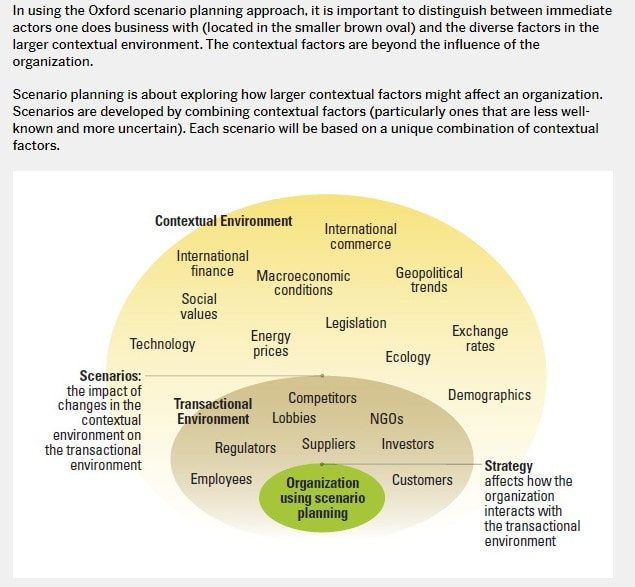
An especially important application in these uncertain times is scenario planning (see Fig.1 for contextual and transactional environmental factors involved in scenario planning). What realities is your business facing? What happens if consumer spending falls by 25%? Or if product revenue falls by 15%? Or do customers need to renegotiate payment terms? Whether sales are booming or declining, finance leaders need to go back and revisit their forecasts to assess the impact on cash flow and profitability and set correcting strategies. Having a centralized CPM tool like Prophix can make your life easier because it allows you to easily run scenarios on-the-fly.

Fig. 1: The Role of the Contextual Environment in Scenario Planning | https://sloanreview.mit.edu/article/using-scenario-planning-to-reshape-strategy/

an iamge of how to future-proof your business using contextual planning

Powerful tools let you transform your data and allow you to better model your operations, especially regarding “what-if” scenario planning. Positioning your company for success involves tough modeling to ensure business continuity.

Some industries are experiencing tremendous growth like healthcare, pharmaceuticals, and groceries. Concurrently, some are being hit hard financially such as hospitality, aviation, and retail. Cash flow planning becomes critical during uncertain times. With a robust CPM tool, you can easily model changes to your plans and move forward. It’s all about enabling you to plan smartly.

Your finance department probably spends long nights doing month-end and operational tasks. If they’re already spending 80% of their time on transactional tasks, it can be hard to shift focus to complex planning. Is your team equipped and ready to model endless scenarios in price adjustments, changes in capital spending, and fluctuating labor needs? Now, try to imagine a world where you already had a plan and solution in place to successfully steer you out of uncertainty…

Unsure how to move forward in uncertain times? Listen to the upcoming Prophix webinar on the benefits of proactive scenario planning.

Planning for Uncertainty

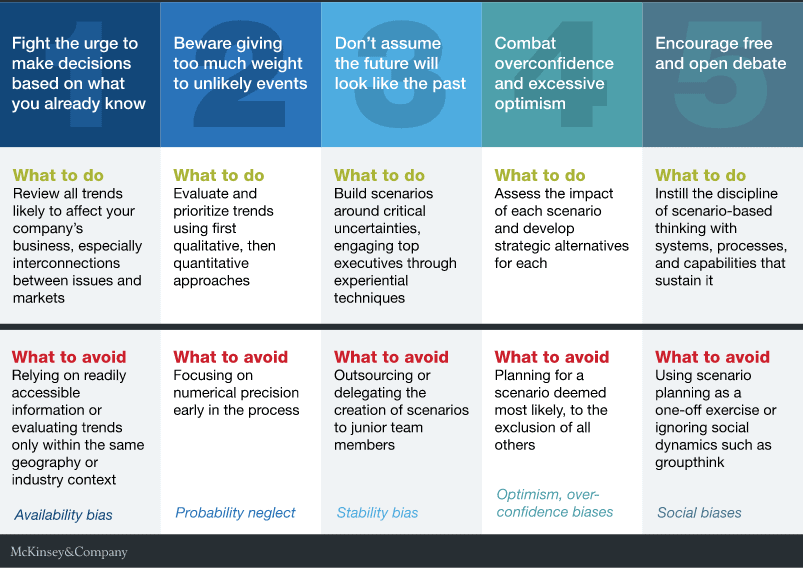
So, how you do you plan for uncertainty (see Fig. 2 for some tips on scenario planning)? Well, it depends on many factors, but it starts with having a tool that can effectively and centrally manage your data so that all your users can view and interpret the same information.

To prepare for uncertainty, you need to set the baseline financial plan and the appropriate objectives/strategic goals. Next, prepare for different outcomes by involving more people in your planning process and considering best- and worst-case scenarios. CPM software lets you do this seamlessly through workflow project management capabilities.

Once your data is centralized, it’s easy to assess your performance against planned objectives. As you understand your variances, you can measure performance, visualize the future, and adapt accordingly with agility. Once everyone agrees, you can automate report distribution, buying you more time for value creation and generating insights.

Get your guide to corporate financial planning during the pandemic – watch the webinar.

Fig. 2: The DOs and DON’Ts of Scenario Planning | https://www.mckinsey.com/business-functions/strategy-and-corporate-finance/our-insights/overcoming-obstacles-to-effective-scenario-planning

an image of how to future proof your business using the do's and don'ts of scenario planning

As you can see, scenario planning is closely linked with both budgeting and forecasting. Things change, uncertainty arises, and plans evolve. In finance, scenarios act as guiding frameworks about events that may or may not take place in the future.

As finance leaders, we must proactively plan for the unknown and incorporate it into our forecasts. We must assess more frequently whether we are meeting our objectives, and if these objectives need to be changed. Scenario planning helps mitigate variances by focusing on the realities of the business. It helps finance leaders manage resources and improve decision-making by considering opportunities and risks.

Recap

In summary, the strategy is all about envisioning and implementing ideas and goals that let you compete and win in the marketplace. Don’t let old habits of the past slow down your organization and its predisposition to change. CPM tools like Prophix provide you with the technological solutions that help innovate the Office of Finance in a rapidly evolving environment to give you a competitive edge in a world of big data and increasing complexity.

Consider the “what-ifs” in Prophix’s webinar on proactive scenario planning – watch now.

Join the live discussion with Q&A to learn what CFOs around the globe can do to respond to changing conditions and ensure business continuity while improving planning and minimizing risk.

Footnotes:

1 – https://www.cdc.gov/coronavirus/2019-ncov/cases-updates/cases-in-us.html

2 – https://images.info.deloitte.ca/Web/DeloitteManagementServicesLP/%7B161111db-4cc2-4d68-a272-96bd0a7d551a%7D_ca_en_FinanceTrends_16_3730T.PDF

About Prophix

Prophix develops innovative software that automates critical financial processes such as budgeting, planning, consolidation, and reporting — improving a company’s profitability and minimizing its risks. Thousands of forward-looking organizations in more than 90 countries use software from Prophix to gain increased visibility and insight into their business performance.

About Encompass Solutions

Encompass Solutions is a business and software consulting firm that specializes in ERP systems, EDI, and Managed Services support for Manufacturers and Distributors. Serving small and medium-sized businesses since 2001, Encompass modernizes operations and automates processes for hundreds of customers across the globe. Whether undertaking full-scale implementation, integration, and renovation of existing systems, Encompass provides a specialized approach to every client’s needs. By identifying customer requirements and addressing them with the right solutions, we ensure our clients are equipped to match the pace of the Industry.


The article “It’s 2020 — Should Business Owners Fear The Cloud?” was written by Epicor Software Corp. CEO Steve Murphy and published by Forbes on March 2, 2020. You can read the original article here.

The cloud. It’s a small word that packs a big punch. Defining what a cloud is can confuse some while implementing it raises concerns for others.

We should consider three key factors as we continue into a new decade and business owners ask if they should fear the cloud: privacy, interoperability, and cost.

But first, what is the cloud, and why are businesses migrating to this solution?

Essentially, the cloud is a delivery method for your software. It’s a network of servers that are linked together and operate as a single system. The cloud can perform a variety of functions (e.g., storing data, running applications, delivering content, etc.), and you can access it online. There are both public and private cloud options. The biggest difference with the cloud is what it doesn’t require. You don’t need any hardware or networking gear on-site – all you need is a tablet or a phone to run the software.

One of the major reasons I believe cloud adoption continues to grow is the flexibility and productivity enhancements it offers. As the CEO of a company that offers cloud platforms, I’ve found that these features are particularly attractive for business owners looking to build resiliency in the face of unpredictable trade wars and other geopolitical changes. Business owners often look to business management software to provide stability. According to Goldman Sach’s 2020 review (via CNBC), 23% of IT workloads are now in public clouds.

So, should business owners fear the cloud when it comes to privacy, interoperability, and cost?

Should I fear privacy in the cloud?

There is no denying privacy is a major concern when it comes to data. Data breaches continue to increase, as does the projected production of data. To keep pace, both software solutions and IT departments will have to up their game.

First, I’ll share the bad news. According to Hiscox’s 2019 Cyber Readiness Report, most businesses are unprepared for cyber threats. In fact, in the U.S., 73% of businesses are “novices” at cyber readiness.

The good news, however, is that the public cloud has proven safer than on-premise data center environments. Specifically, Gartner found that “to date, there have been very few security breaches in the public cloud” and that “through 2020, public cloud Infrastructure as a Service (IaaS) workloads will suffer at least 60% fewer security incidents than those in traditional data centers.”

If you decide to move to the cloud due to these safety findings, you should still be mindful of cloud vulnerabilities. Take stock of what kinds of sensitive information you are putting in the cloud, and ensure you understand how the cloud provider will protect that data. The time needed to safely migrate systems and data can be lengthy, but it shouldn’t be rushed at the expense of security infrastructure. Select a provider who prioritizes security during the migration process and who has a solid reputation for getting the configuration right, and communicate with your team so that they understand the migration timeline and can manage their expectations.

Regardless of your software solution, privacy issues will continue to be a concern. One of the most important things business leaders can do is ensure they have a crisis management protocol in place if and when a breach should occur.

Should I fear cloud interoperability challenges?

I have great news on this front. There have been major strides toward interoperability. Multiple systems can exchange and use information easier than ever before. This is due to a variety of reasons: Many application programming interfaces (APIs) continue to get better, standards continue to improve, and, notably, I see tech giants such as Google, Amazon, and Microsoft Azure frequently expand the universe of applications that can easily be put in their clouds. I believe their efforts have significantly moved the needle.

While interoperability isn’t perfect, there’s a lot of upward momentum. I expect that to progress.

Should I fear the cost of the cloud?

If you’re a business owner and you aren’t sure cloud makes sense for you from a cost perspective, ask yourself if you have a good grip on how much it costs to have your own data center in your business. Do you already have the IT skills in-house to run your system? If so, the cloud may not make sense.

However, many business owners are surprised to find that their IT operations cost them a lot more than they think and that implementing cloud solutions can save them both time and money when it comes to issues such as automatic upgrades (which keep your company current and competitive), labor and maintenance costs, or increases in workforce productivity, to name a few.

Just remember that the decision between on-premise and cloud will be unique for each business. When you’re evaluating your IT operations cost, ask yourself how scalable you need your solution to be in the future. How adept is your IT department at staying up to date with evolving technology? Will you need additional data storage, and do you have the physical space to accommodate an expansion of your on-premise data center? Do you need access to data on the go? If a natural disaster hits your business, how will you back up your data?

What it comes down to is the total current cost of your on-premise data center versus a cloud solution. For business leaders who are still on the fence about expenses, make sure you evaluate your options regularly. Cloud providers will have to continue to be cost-competitive, which could work in your favor.

Bottom line: Don’t fear the cloud. It could be a safer option than on-premise data. Its interoperability continues to improve. It can be highly effective at increasing productivity. It can save you money long-term. And the cloud will likely continue to improve over time. The year 2020 may be the one for you to move forward with implementation.

About Encompass Solutions

Encompass Solutions is a business and software consulting firm that specializes in ERP systems, EDI, and Managed Services support for Manufacturers and Distributors. Serving small and medium-sized businesses since 2001, Encompass modernizes operations and automates processes for hundreds of customers across the globe. Whether undertaking full-scale implementation, integration, and renovation of existing systems, Encompass provides a specialized approach to every client’s needs. By identifying customer requirements and addressing them with the right solutions, we ensure our clients are equipped to match the pace of the Industry.


The recent Financial Service Network (FSN) survey on Planning, Budgeting, and Forecasting (PBF) showed two key characteristics for those organizations that produced the most insightful financial forecasts. First, was the ability to leverage non-financial data. Second, was the application of advanced analytics. We will look at how the most successful organizations expand their vision beyond the narrow financial view of the future to produce more valuable foresight in their PBF processes.

Finance: The Home of Truth

The financial component of enterprise resource planning, whether part of a full-fledged ERP system or a mom-and-pop shop running Quickbooks, has historically been the ‘home of truth’. Finance was where everyone turned for answers since the only quantitative test of performance and sustainability was the P&L and the balance sheet. Finance largely birthed the IT function in a bid to automate the production of some of these answers. Most famously, in the production of payroll. Despite this, finance has now lagged in technology investment for some years, being overtaken by marketing, sales, and operations.

With new technology at their fingertips and an increasingly scientific approach, other functions in the business have begun to answer their questions, collecting and analyzing their data. The numbers in marketing may still be a little hazier than in finance but marketing has begun to offer insight into things that finance cannot, or has not. Market trends and consumer behavior tell leaders not just about what is but what might be. This forward-looking insight has often contrasted with finance’s view of the future.

The Past, Give or Take

Finance’s view of tomorrow has, by contrast, been rather singular in its source – the past. Predictions of tomorrow have been based on the evidence of the most recent year, with management’s desire for growth most often being the biggest factor steering the positivity, or otherwise, the forecast for the year ahead. Only negative macro factors have dissuaded forecasters from positivity about the bottom line and all the pressure that brings to bear on sales for revenue growth and operations for ever greater efficiency.

The figures from FSN’s report might suggest this had changed. 72% of finance leaders say their forecasting processes are now inclusive, drawing on sources from across the company, but dig further into the figures and this starts to feel more like an aspiration than a reality.

78% of the senior finance executives surveyed agreed that greater use of non-financial data is the best way to improve their PBF process and outcomes. 76% recognized the importance of connecting with more stakeholders from outside of the finance function to improve the accuracy of forecasts. The need to connect with other functions and share data is acknowledged.
But 74% say they are struggling to identify all relevant non-financial data sources. Why? Over 55% of respondents say that the lack of involvement of non-finance personnel is amongst the greatest barriers to forecast accuracy.

The obvious conclusion is that the connections between finance and the rest of the organization just aren’t there.

Additional Barriers

The lack of cross-cutting relationships through the business is not the only issue blocking the better application of non-financial data for improved forecasts. A quarter of respondents say their senior managers do not appreciate the value of non-financial data. And surprisingly, 23% delegate non-financial data tasks to more junior staff despite 43% of respondents ranking it in their top 3 sources of ‘most insightful data’.

Insightful it may be but there remain concerns about the quality of non-financial data when compared to the sources with which finance professionals are more familiar. 41% of CFOs are concerned about its integrity and believe it is less reliable than financial sources. This may well be true but these issues can be addressed, with appropriate weighting and analysis. The potential value of the data is clear, to ignore it would be nonsensical.

Taking Steps

So, how do finance leaders address these issues to improve insight into their planning, budgeting, and forecasting?

Relationships across the business rely on reciprocation and communication, not just shared goals. Finance has to be able to bring value to the other functions of the business if it is going to extract value back.

That value comes from the insight finance can bring. Most functions in the business are seeking better analysis of their situation and environment, and finance should have the skills to deliver that.

That comes with a time penalty of course but increasing automation of the base functions of finance should be releasing resources. This is a great way to apply the released resources to improve results.

Relationships will be hard to build without the soft skills of communication, and this is another area where finance has historically fallen. In our interactions with younger members of finance teams, we consistently find a lack of training on offer in anything beyond technical skills. This frustrates the ambitious and leads them to move on. Training then offers a two-fold benefit to the business: better collaboration and a greater chance of retention.

This isn’t to say technical skills aren’t important. Finance leaders need to be constantly up-skilling their teams in planning and analysis, and equipping them with the right tools to apply their learning. Then, they can efficiently integrate non-financial data into their models, improving forecasts and returning value to the other business functions.

As FSN says in its report, “Mastering non-financial data is the key to being able to forecast accurately and further into the future.” The only way to do this is to enhance the relationships that finance holds across the organization, by investing in the skills of its people.

For more information on ERP and the future of financial systems, read the FSN report on the topic – HERE

About Prophix

Prophix develops innovative software that automates critical financial processes such as budgeting, planning, consolidation, and reporting — improving a company’s profitability and minimizing its risks. Thousands of forward-looking organizations in more than 90 countries use software from Prophix to gain increased visibility and insight into their business performance.

About Encompass Solutions

Encompass Solutions is a business and software consulting firm that specializes in ERP systems, EDI, and Managed Services support for Manufacturers and Distributors. Serving small and medium-sized businesses since 2001, Encompass modernizes operations and automates processes for hundreds of customers across the globe. Whether undertaking full-scale implementation, integration, and renovation of existing systems, Encompass provides a specialized approach to every client’s needs. By identifying customer requirements and addressing them with the right solutions, we ensure our clients are equipped to match the pace of the Industry.


Businesses of every size contend with keeping the availability of materials, components, products in sync with their rate of production and customer demand. Finding the balance between these factors is, at a high level, the core concept of inventory management.

Why Inventory Management Important

As a business digs deeper into the specifics of inventory management, it will refine its goals. This includes all the additional details that make the process more efficient. Suffice it to say, good inventory management goes beyond the weight, dimensions, quantity, and location of items.

At a foundational level, your business will need a system of categorization to manage inventory. This also requires a means of interacting with this system when adding, removing, and identifying items.

Your system may require software and interactive technologies. These technologies can include computers, barcoding hardware, and scanners.

Knowing what you have in inventory and where is only one part of the equation. Forecasting demand to inform a business of when to replenish stock or when to buy more materials to manufacture those products is just as essential.

By ensuring that warehouse space is used efficiently and in sync with the rate of sales and replenishment, the cost associated with goods held in inventory is kept to a minimum.

In a broader sense, Inventory management is the component of your business’ supply chain that keeps material flowing into and out of your facility.

This is kept by production processes and customer demand.

Inventory Management Principles

Suppliers may experience fluctuations in the ability to fulfill POs and global events may shake up availabilities across the board. However, you can keep your own house in order with inventory management best practices.

For example, keeping a detailed record of products as they enter and leave your warehouse provides visibility to your business needs. This ensures you can deliver on customers’ and supply chain partners’ requirements at any given time.

Businesses of every size use inventory management principles to manage their flow of goods. However, there is no defined set of guidelines that all businesses can look to for the answers.

The best inventory management strategies will change from business to business, but generally accepted best practices can be applied in almost every case.

Identifying the right set of guidelines for your mode of operation will ensure you can deliver the right goods in the right quantities to your customers at the right place and time.

The Difference Between Inventory Management And Inventory Control

While these terms may seem the same at face value, they are generally not considered interchangeable.

A strong inventory management system ensures a business can source, store, and sell materials or finished goods in such a way that yields a consistent and dependable profit for the business overall. Good inventory management is a sustainable practice.

Inventory management follows a structure of thought as a business principle. It is an overarching set of concepts that address a larger business model.

Inventory Control is housed, pun-intended, within the larger concept of inventory management. Inventory control is focused on maintaining visibility and understanding of the materials and their flow. Namely, where and how much inventory can be found on-hand and readily accessed in a retail location, stockroom, or warehouse.

Why Inventory Management Is Important

Global supply chains are complex and in a state of constant ebb and flow.

Manufacturing processes that utilize raw materials and components are also changing continually according to customer demand, specification, and regulatory requirements.

In short, what is available today may not be available tomorrow. However, there are usually indicators of when a supply shortage may be looming or new regulations will be coming into effect.

Keeping up with these constant changes is more than simply difficult, it’s outright unnerving and even chaotic at times. Being stuck with an abundance of stock that can’t be used, spoils, or becomes obsolete can cost a considerable amount of capital, running a business well into the red. This is where the balancing act of inventory management becomes so critical.

The costs of carrying goods can be considerable. For this reason, many organizations seek to refine and optimize their methods for ensuring they have just enough material on hand to deliver on anticipated production levels or sales.

Streamlining inventory management will keep inventory levels low, which keeps costs sunk into stock on hand to a minimum. Furthermore, lower stock levels will ensure less space is required to match material requirements to production levels. With less space required, facilities can be kept to a more manageable size and minimize warehouse leasing costs.

How You Can Implement Best Practices

Fortunately, for many decades, businesses have been refining how they bring stability to the unpredictable world of global supply chains, manufacturing processes, and inventory management.

As part of those efforts, two major philosophies of inventory management have emerged as the most widely accepted and utilized: Just-In-Time (JIT) and Material Requirements Planning (MRP). Both instances have their benefits and drawbacks. We go into more detail in dedicated articles on JIT and MRP inventory management strategies.

Technology And Software

Beyond JIT and MRP inventory management, there are several technologies and software that make the process of managing inventory easier for businesses, staff, supply chains, and customers.

ERP software is one such technology that delivers all the critical data needed to inform demand forecasting and purchasing, whether a business is based in manufacturing or wholesale and distribution.

Inventory management data housed within the ERP system is accessed and reported digitally, while also easily sharable for key stakeholders and managers to use in their decision-making processes.

About Encompass Solutions

Encompass Solutions is a business and software consulting firm that specializes in ERP systems, EDI, and Managed Services support for Manufacturers. Serving small and medium-sized businesses since 2001, Encompass modernizes operations and automates processes for hundreds of customers across the globe. Whether undertaking full-scale implementation, integration, and renovation of existing systems, Encompass provides a specialized approach to every client’s needs. By identifying customer requirements and addressing them with the right solutions, we ensure our clients are equipped to match the pace of the Industry.


Cycle Counting is an inventory management concept that focuses on auditing a warehouse’s inventory.

Cycle counting Objectives

The objective of a cycle count is to track and document inventory levels. While most warehouses will carry out a cycle count at least once a year, it is recommended to complete one more often. This process and its associated procedures ensure warehouse and production teams are working with accurate inventory data. Performing accurate cycle counts often will help maintain the accuracy of your data and the efficiency of your inventory management.

Cycle Counting Versus Full Physical Inventory

Cycle counting is a manual process and can be carried out at any time on specific groups of items and helps refine procedures for tracking and inventory management. The process is designed to be carried out without interrupting a facility’s operation.

Cycle counting benefits include:

  • Provides high levels of inventory accuracy
  • More accurate financial reporting
  • Considered less disruptive to operations when compared to a full physical inventory
  • Can focus on subsets of inventory and items based on specific criteria
  • A reduction in errors associated with bad data
  • Higher levels of customer satisfaction
  • Fewer inventory write-offs
  • Reduced losses due to inventory shrinkage

Cycle counting disadvantages:

  • Highly dependent on buy-in from company leadership down to warehouse staff
  • The process needs to be carried out at regular intervals

A full physical inventory is a complete physical count of a business’s entire inventory, most often carried out on an annual basis. The process is generally manual, time-intensive, and requires shipping and receiving operations to be shut down for the duration of the process. As a result, the full physical inventory process can be disruptive.

To minimize the disruption, businesses often attempt to schedule these procedures during a slow period, when inventory levels are low.

Full physical inventory benefits include:

  • Improved inventory accuracy
  • More accurate accounting records
  • Tax burden relief attributed to the record of losses
  • Control over inventory shrinkage

Full physical inventory disadvantages:

  • Shipping and receiving operations are ceased during the process
  • Time-consuming
  • Inconvenient for customers and supply chain partners
  • An expensive, non-revenue-generating activity
  • A high tendency for human error, resulting in bad data

Many companies complete annual physical inventories as a way of controlling their understanding of what’s in stock at any given time. However, performing a once-a-year activity to give that visibility leaves gaps.

For this reason, cycle counting is a preferred method of inventory management for businesses of every size. It is not uncommon for businesses to employ both a full physical inventory annually alongside incremental cycle counting throughout the year.

How To Complete A Cycle Count

Cycle counting garners appeal by offering an ongoing and easily achieved approach to inventory management. It is in maintaining the discipline of cycle counting that many organizations find issues.

It should be noted that every organization is different and a cycle count will be adjusted to fit each business’ method of operation. If your organization is interested in implementing a cycle counting program, it would be a good idea to consult a warehouse and inventory management professional. This way, you can avoid costly mistakes associated with trial and error.

Cycle counting involves a physical count of some sub-section of inventory located in a warehouse or other storage facility. It is recommended to complete a cycle count at least once a quarter.

These small cycle counts reveal discrepancies in data that can be logged and rectified within enterprise systems for accurate inventory management.

Here’s a general outline of what’s involved in a cycle count:

  1. Update your inventory records before carrying out a cycle count. You need a baseline from which to work.
  2. Determine the scope of your count. For example, a small cycle count will cover X amount of SKUs, while a larger count will cover XXX amount of SKUs. You could also choose to count items over a designated period, such as the fiscal year.
  3. Decide which inventory to count first and item subsets to follow. Most businesses generally count their “A”-list products first. That is, the 20% of your inventory that makes up 80% of your inventory value.
  4. Determine the tools and equipment required to perform the cycle count. For example, if your inventory is barcoded, do you have handheld scanners available? If goods can’t be physically counted or handled, do you have a scale to weigh them?
  5. Decide who will perform the cycle count.
  6. Carry out the cycle count based on the details outlined in preparation.
  7. Review discrepancies between the cycle count results and warehouse records.
  8. Make the appropriate adjustments for incorrect data based on your baseline inventory record.

Cycle Counting Workshops

Encompass Solutions can train your staff to carry out Cycle Counts that Count through an educational workshop series led by our experienced inventory and warehouse management consultants.

Learn more about our Cycle Counting workshops HERE or contact us using the link below to speak with a representative.

About Encompass Solutions

Encompass Solutions is a business and software consulting firm that specializes in ERP systems, EDI, and Managed Services support for Manufacturers and Distributors. Serving small and medium-sized businesses since 2001, Encompass modernizes operations and automates processes for hundreds of customers across the globe. Whether undertaking full-scale implementation, integration, and renovation of existing systems, Encompass provides a specialized approach to every client’s needs. By identifying customer requirements and addressing them with the right solutions, we ensure our clients are equipped to match the pace of the Industry.


The latest update for Epicor ARM (Advanced Requisition Management) has been released as Epicor ARM 10.3 SP7. The developer, Precise Business Solutions, is an Independent Software Vendor (ISV) creating Epicor ERP solutions and more tools dedicated to minimizing waste and maximizing efficiency for small and medium-sized businesses.

What is Epicor Advanced Requisition Management?

Epicor Advanced Requisition Management (ARM) is online requisition management and workflow solution designed to deliver full-cycle procurement functionality securely to your organization’s desktops or mobile devices. ARM’s real-time budget visibility empowers your company to make informed purchasing decisions, while consolidated purchase orders allow you to negotiate contract pricing with your suppliers-ultimately reducing costs and maximizing efficiency across your entire enterprise.

Solution Benefits

Epicor Advanced Requisition Management (ARM) is an online solution for managing the cycle of requisitioning, ordering, and receiving. Benefits include:

  • Reduce purchasing costs and effort
  • Improve communication internally and with vendors
  • Assign preferred suppliers or default supply locations
  • Gain visibility of the purchasing process

Features

The web browser-based application allows easy deployment throughout the enterprise and facilitates the entire requisition process electronically-from requisition submission through to purchase order creation and optional distribution to vendors.

Epicor ARM automates and streamlines the procurement process, utilizing a web browser to integrate with and extend the Epicor Supply Chain Management module. Multiple approval methods provide a flexible framework that can be configured to meet the requirements of any organization.

Epicor ARM 10.3 SP7

In addition to features incorporated as part of the Epicor ARM scheduled product roadmap, the updates in this release have been influenced by requests received from Epicor ARM customers.

Epicor 10.2.600 compatibility, enhanced attachment capability, and support for multiple invoices against a single purchase order receipt are just some of the features we have incorporated in this release to enhance your overall ARM experience.

An overview of some of these enhancements is outlined below.

New features and enhancements in Epicor ARM 10.3 SP7

  • E10.2.600 Compatibility (E10) – ARM 10.3.7 is compatible with E10.2.600.
  • Split BIL for APM and non-APM Environments (E10) – ARM has now split BIL with one version supporting APM and the other supporting non-APM environments. Choose the appropriate version when installing this product in your environment.
  • Support Edit Tax at Line level in AP Module (E10) – This is a ‘Manual Tax Override’ function that enables you to edit and override the tax on the line. Note that the line tax will be reset to the default values when copying the Invoice.
  • Support Project, Phase, and Cost Code (APM) in AP Module (E10) – AP Invoice and Debit Memo now support Project, Phase, and Cost Code (APM).
  • Support Hold Invoice and Hold Payments in AP Module (E10) – When selected, the ‘Hold Invoice’ check box represents a hold status on the entire Invoice. If you post a group that contains an Invoice on hold, this Invoice will not be posted. You will need to clear this check box and then re-post the group. When selected this check box also indicates that payments will not be made against the Invoice. ARM only enables this check box functionality in the time before the AP document is approved.
  • Support PO Receipt Attachments (E10) – Users can now attach a receipt document when entering PO receipts. ARM receipt attachments will not be integrated into Epicor at this time.
  • Support Receipt Attachment Visibility in AP Approval (E10) – In addition to the support for PO Receipt Attachments (above), ARM also supports the ability to view the Receipt Attachments during the AP Approval process.
  • Original Order Value on AP Invoice (E10) – Some new read-only fields have been added to the AP Invoice screen. The Ordered field shows the original value of the order raised. The Un-receipted field shows the value of the line that is not received yet.
  • AP Invoice Filter Settings Enhancement (E10) – The AP Search filtering criteria are retained for each ARM user.
  • Support Multiple Invoices Against a Single PO Receipt (E10) – ARM now supports partial Invoices for a single Purchase Order receipt. After adding a PO Receipt line to an AP Invoice, a new check box entitled ‘Final’ is shown on the main Invoice screen. When ticked, this action indicates the line is finished with Invoicing stage. To perform partial Invoicing the AP documents need to be within the same Invoice Group. When the first partial Invoice is created and approved, it will move from the ARMUNAPP Group to the nominated Invoice Group. If a second Invoice is raised, an error will be shown in ARM due to the two Invoices present in different Groups. Therefore, the first Invoice will require posting in Epicor to proceed with creating any subsequent Invoices. This functionality requires configuration in Epicor. Go to Company Configuration> Modules> Finance> Accounts Payable and enable the ‘Allow Multiple Invoicing of Receipts’ check box.
  • AP Invoice Search Results Set and Export (E10) – The Export feature now includes the Vendor name and Invoice Date on the export file.
  • AP Approval Process Enhancement (E10) – A new <Next> button feature has been added to the AP document screen. This allows the user to move and load the next AP document from the AP Search results.
  • Punchout Enhancement (E10) – The PunchOut processing has been altered to conform with the SameSite cookie policy that was introduced in newer versions of Google Chrome and Microsoft Edge browsers.

Read the Epicor ARM 10.3 SP7 Release Guide for further detail on all the features and enhancements outlined above.

Epicor ARM 10.3 SP7 Upgrade Eligibility

Epicor ARM 10.3 SP7 is compatible with Epicor 10, Epicor 9.0.5, and Enterprise 7.4 SP7.

Users upgrading to Epicor ARM 10.3 SP7 should note the following:

  • If you are upgrading from ARM versions 10.0 SP6, ARM 10.1.0, or ARM 10.1 SP1 – SP4, you must run the Upgrade Manager to migrate data so that it will be compatible with the enhanced approvals process that was introduced in ARM 10.1 SP6.
  • If you are upgrading from ARM 10.1 SP5 (or above) you do not need to run the Upgrade Manager to migrate your data as it will already be compatible with the enhanced approvals process (introduced in ARM 10.1 SP6).

Users upgrading to this version should perform a full synchronization on the GLAccountDefinition and GLAccount jobs within the Integration Manager

Spotlight on ‘Blanket Order’ functionality

Two common questions we receive are “What is a blanket order?’ and “Can I use it for the ordering of maintenance and repair services?”

‘Blanket Orders’ go by a few names – sometimes called ‘blanket purchase agreements’ or ‘call-off orders. These orders allow an organization to create a requisition for a contracted amount with a supplier, to be consumed over some time. Expenses can then be ‘drawn down from this approved amount incrementally, as required. This makes it very convenient for utilities and services-related expenses, where the exact amount cannot be known in advance.

Epicor ARM Blanket Order Demonstration

To see how ARM Blanket Order functionality works, click the demonstration video below:

About Precise Business Solutions

An award-winning and market-leading provider of ERP software solutions. Precise provides global software solutions, coupled with local business expertise. Precise is a leading provider of business software solutions and associated services to the Australian and international marketplace. A wholly-owned Western Australian company, Precise has been in business since 1989. Over the last 25 years, Precise has assisted organizations to maximize efficiencies and gain a competitive advantage. Precise Business Solutions is also the developer of integrated companion solutions for Epicor ERP  – Epicor Advanced Requisition Management (ARM) – Precise Point of Sale (POS) These solutions are distributed worldwide through their alliance partner Epicor Software Corporation. Precise continues to be a market leader in implementation, support, and services. Partnering with their customers to help them be the best they can be, has always been Precise’s primary focus.

About Encompass Solutions

Encompass Solutions is a business and software consulting firm that specializes in ERP systems, EDI, and Managed Services support for Manufacturers and Distributors. Serving small and medium-sized businesses since 2001, Encompass modernizes operations and automates processes for hundreds of customers across the globe. Whether undertaking full-scale implementation, integration, or renovation of existing systems, Encompass provides a specialized approach to every client’s needs. By identifying customer requirements and addressing them with the right solutions, we ensure our clients are equipped to match the pace of the Industry.

Sudden and abrupt changes can interrupt anyone’s mode of operation. This couldn’t be truer than in the manufacturing and distribution industries. When that change affects supply chains, livelihoods, and communities, anxieties are compounded. In these situations, people look for business leadership as a source of answers to the unknowns that are feeding their anxiety. Here are 3 ways to lead your organization through a crisis and towards a better outcome.

Business Leadership – Success From Uncertainty

Many qualities make a great leader, such as passion, delegating, owning responsibility, honesty, and active listening. However, not all leadership qualities are created equal when it relates to business. This is punctuated when situations are considered critical. Our current business and economic climate qualify soundly for this designation. From this point of view, below are three of the most effective and essential business leadership qualities that will help your organization endure a tough situation and lead to overall business success.

1. Give Clear Direction

A light in the dark can be more than a means of finding your way around after the power goes out. A clear path delivers comfort and confidence to move forward. In the dark, your teams may stumble over their anxiety about what may or may not come next. Direction delivers many essential signals to your organization, here are four among the most effective:

Be Calm – “Calm is Contagious” I’m not sure if it’s an idiom, but it should be. People react to the signals they are given every day. The most primal of which is behavior. Your calm and reassuring body language, sincerity, and timeliness reinforce the reassuring effect that is essential to every level of your organization. Understanding you’ve provided a behavior to emulate every member of your organization can move forward focused and unencumbered with anxiety.

Communicate Openly – By maintaining direct and open communication, you negate the inherent anxiety that comes with moving through the dark. Whether delivering good or bad news, your communications need to come when they are needed and provide details that lead forward. You don’t have to have all the answers, but you must let your teams know the ones you do have.

Be Precise – Clarity is an important part of giving direction. Don’t leave room for misinterpretation. Keep your workplaces free of inefficient language and processes. By communicating in clean, clear, crisp directives, everyone remains on the same page and works towards the common goal.

Maintain Your Connection – Your organization may have been founded by an individual, but I guarantee it was built by people. Some of them may be senior members of your organization, and some of them may have joined you days before any significant change upended your day-to-day. It’s important to remember that they are all invested in your continued success. If you don’t treat them as though they have a stake in the game, you may be compounding the problems you are already facing.

By giving your teams a clear direction moving forward, you enable them to keep their focus and put the unanswered questions out of their path. This leaves them free from distractions to continue towards their goal. This leads us to the next point.

2. Outline achievable goals

One of the biggest components of business leadership is to include yourself as part of the solution. Having a goal in mind helps to maintain focus. To that effect, the notion of “here’s what I, you, and we can do now…” can be real foundational support for those who can let their minds wander into the great expanse of what comes next.

By ensuring everyone has a goal, is on task, and maintains accountability throughout your organizational structure, your place in the supply chains remains uninterrupted, your products reach their destinations, and your relationships remain in good standing.

3. Identify Opportunity And Implement

This is where you show your organization that you are in control of the situation. You’ve given everyone the rundown on what’s happening from an operational standpoint and measures being taken to alleviate constraints. With the staff at ease, they can go about achieving goals and completing tasks in their “new now” modes of operation.

By identifying key opportunities that you can take advantage of during this change of pace, you communicate to everyone that growth is still happening, even if it may not be apparent on the surface. Big ships take time to steer and those efficiency projects that kept being pushed onto the back burner due to high volume orders fulfillment or staff shortages are now primed and ready to be implemented. At the very least, you can outline your strategy to achieve the implementation of new ideas and projects so that you can hit the ground running when the conditions permit.

About Encompass Solutions

Encompass Solutions is a business and software consulting firm that specializes in ERP systems, EDI, and Managed Services support for Manufacturers and Distributors. Serving small and medium-sized businesses since 2001, Encompass modernizes operations and automates processes for hundreds of customers across the globe. Whether undertaking full-scale implementation, integration, and renovation of existing systems, Encompass provides a specialized approach to every client’s needs. By identifying customer requirements and addressing them with the right solutions, we ensure our clients are equipped to match the pace of the Industry.


AIA and the Association for Advancing Automation are hosting a week-long virtual conference, AIA Vision Week 2020, covering the latest in machine vision and imaging innovations.
Broken into 5 tracks, each day of AIA Vision Week will bring you a new set of sessions geared to help you with your current vision challenges and questions. As part of AIA Vision Week, you will have the opportunity to connect with more than 100 leading vision and imaging companies. Learn about their technology innovations and how they can help your company successfully deploy its vision to increase your quality, efficiency, and global competitiveness.

About AIA Vision Week

AIA brings you a full week of educational conference sessions, enlightening keynote speakers, and connections to the industry’s top suppliers showcasing the latest vision and imaging technologies – all from your convenient computer, tablet, or mobile phone screen.

Participation is FREE and anyone working with vision and imaging technologies – or those who would like to – are encouraged to register.

You’ll get access to educational sessions that are taught by leading vision experts where you’ll learn how vision can help you increase profitability, improve throughput, reduce defects, comply with regulations, solve your automation problems, and more!

Whether you are seeking entry-level training for a basic understanding of machine vision, imaging, and sensors, or are looking for more advanced solutions, AIA Vision Week has something for you.

Each day of the week, starting Monday, May 18, we’ll have multiple conference sessions, followed by a break, then we’ll resume with more topics. The conference will be presented live based on Eastern Daylight Time (GMT-4), starting about 10:00 am EDT and ending at about 3:00 pm EDT each day. See the agenda for details.

Be sure to spend time in the Vision Products Showcase, where you can see the latest in vision and imaging technologies and connect with more than 100 leading companies. You can learn about their technology innovations and how they can help your company successfully deploy its vision to increase your quality, efficiency, and global competitiveness.

AIA Vision Week Study Tracks

At this time, The AIA vision Week agenda is available in full. There are 5 unique learning tracks that attendees can leverage to learn more about each technology’s unique applications. Keynote speakers are delivering informative talks and breakout sessions deliver detailed looks into more specific areas of machine vision technology. come with questions and be prepared to learn about the latest in technological innovation relating to Machine Vision, AI, applications, and robotics. Here are the available learning tracks:

About The AIA – The World’s Largest Machine Vision Trade Association

Founded in 1984, the AIA was organized specifically to advance the global understanding and implementation of vision and imaging technologies to help our members grow. We are committed to providing support and leadership on common industry issues.

Today, AIA is the world’s largest global vision and imaging trade group serving over 375 member companies from 32 countries. Our members include manufacturers of vision components and systems, system integrators, distributors, OEMs, end-users, consulting firms, academic institutions, and research groups directly involved with vision and imaging.

Key AIA activities include standards development for the industry; market research and analysis (including a quarterly Vision Market Report for members); trade show sponsorship – The Vision Show and Automate; educational workshops, conferences, and networking opportunities throughout the world; Online and in-person certification training; and Vision Online, the world’s leading resource for vision and imaging information.

We invite you to see AIA’s Vision of the Future video here.

About Encompass Solutions

Encompass Solutions is a business and software consulting firm that specializes in ERP systems, EDI, and Managed Services support for Manufacturers and Distributors. Serving small and medium-sized businesses since 2001, Encompass modernizes operations and automates processes for hundreds of customers across the globe. Whether undertaking full-scale implementation, integration, and renovation of existing systems, Encompass provides a specialized approach to every client’s needs. By identifying customer requirements and addressing them with the right solutions, we ensure our clients are equipped to match the pace of the Industry.


Whether you are a large or small organization and have low or high turnover, you probably think you understand the cost of hiring someone new into your company. There’s the cost of advertising, interviewing, drug testing, onboarding, training, etc. But what are the hidden costs of hiring the wrong person? What if you find out months or even years down the road that you hired the wrong person from the beginning?

The True Cost Of Making The Wrong Hire

Research from Gallup shows that 67% of your employees are not engaged at work. What does that mean in practical terms?

  • Organizations with low engagement experience higher turnover.
  • Companies with low engagement scores earn an operating income of 32% lower than companies with more engaged employees.

In contrast, companies with high engagement:

  • Have earnings-per-share levels 2.6 times higher than companies with low engagement
  • Organizations with highly engaged employees experience a 7x-greater 5-year total annual shareholder return than organizations with less engaged employees.

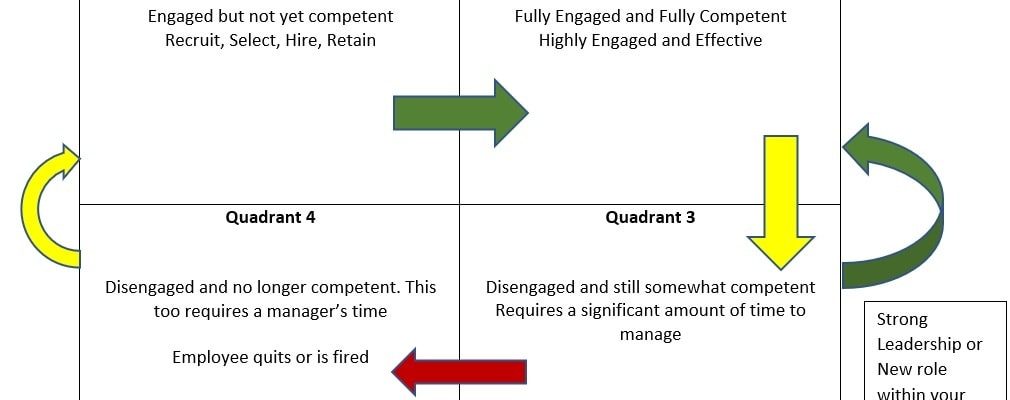
Think back to when you started your job, you were likely excited and eager to learn. So how do your employees become disengaged? The chart below illustrates a typical process for having engaged or unengaged employees:

 an infographic explaining the true cost of a bad hire

Quadrants

In Quadrant 1 employees are hired and brought into the organization. Regardless of the job, most employees are highly engaged and chomping at the bit to get started. They are not particularly competent at this stage but are learning and their competency and value to the organization grow each day. Employees stay in Quadrant 1 for 3-12 months depending on the complexity of the job.

In Quadrant 2 employees are highly engaged and have learned enough to be fully competent and of high value to the organization. If the job is a good fit for the motivational needs of the employee, they may stay in Quadrant 2 for quite a while and this is obviously where we want all our employees to be and stay if possible. Unfortunately, we know most employees are not fully engaged so many moved to Quadrant 3.

In Quadrant 3 employees become disengaged and over time begin to lose their competence. If they stay in Quadrant 3 long enough, they may move to Quadrant 4. The employee can become re-engaged either through strong leadership or through a new project or role opportunities within the company, moving back to Quadrant 2.

If employees move to Quadrant 4, they can become so disengaged they lose competency. If an employee stays in Quadrant 4 for very long, they will either leave on their own or be fired at which point the employer starts the cycle over, hiring a new employee.

What causes loss of employee engagement? Is it:

  1. Lack of effective leadership
  2. No shared vision
  3. Weak or toxic organizational culture
  4. Poor communication
  5. The job does not meet the motivational needs of the employee
  6. All of the above

The answer varies from one organization to the next but most often the answer is some level of “All of the above.”

Turnover is just the cost of doing business, right? But what is the cost? Earlier we shared how engagement impacts performance metrics over time. Based on the employee engagement process model let’s explore the real $ cost of low engagement.

Sample Cost To ABC Widget Company
Total number of employees 100
X Percentage in Quadrant 3 (per Gallup research) 67%
Estimated number of employees in Quadrant 3 67
X Average Monthly Compensation per employee in Quadrant 3 $4,000.00
Estimated Average monthly compensation for Employees in Quadrant 3 $268,000.00
X Cost of lost effectiveness (100-67%) 33%
Estimated Monthly Cost of employees in Quadrant 3 $88,440.00
Estimated Annual cost of lost productivity of employees in Quadrant 3 $1,061,280.00

This is just a model and you may say that number is wrong and unfortunately, you would be right. This example only considers the hard cost of each disengaged employee in Quadrant 3. That’s bad enough but these disengaged individuals don’t just sit there quietly.  They play a game called “Ain’t it awful”, recruiting others to their side. They do this in the break room, over a beer after work, or even at company events. You know it’s true because you’ve seen it and maybe at some point in your career played the game yourself.

How To Avoid The True Cost Of The Wrong Hire

It doesn’t have to be this way. Even under the best circumstances, you will have disengaged employees, but you can dramatically reduce their numbers and improve your bottom line in doing so. Here are a few things you should consider:

  1. Use assessments in your hiring process. Scientifically valid assessments like those Jamesson Solutions offers are the only way to get an objective view of how the person will show up to work behaviorally and if the job fits the motivational needs of the person. You are not doing yourself or the applicant any favors by putting them in a job that does not fit them.
  2. Have a clear mission and vision for your company and make sure everyone in the organization knows them, what they mean, and what their role is in making the mission and vision happen
  3. Assess your current organizational culture and whether that culture is conducive to enacting your company’s mission and vision. If not, actively work to make the needed changes to your culture.
  4. Most are not born leaders but rather grow to become leaders over time, through learning on the job, through mentorship, and through dedicated, focused leadership development. It is as critical to your organization for you to have a solid leadership pipeline as it is to have a solid sales pipeline. So, make sure you are developing your people at every level.

About Jamesson Solutions

Specializing in workforce development, talent selection, and personality assessment and evaluation, Jamesson Solutions provides numerous proprietary tools and methodologies to find the right people to fit the right roles, provide visibility and action plans for management, and Business Simulations that allow people to learn through self-discovery and by doing.

Each Jamesson Solutions Associate brings her/his own unique experience in developing individuals and improving organizational effectiveness to each client engagement. Their interest, their passion, and their commitment are in supporting you, the client, and your organization in achieving your objectives NOW and in the future.

About Encompass Solutions

Encompass Solutions is a business and software consulting firm that specializes in ERP systems, EDI, and Managed Services support for Manufacturers and Distributors. Serving small and medium-sized businesses since 2001, Encompass modernizes operations and automates processes for hundreds of customers across the globe. Whether undertaking full-scale implementation, integration, and renovation of existing systems, Encompass provides a specialized approach to every client’s needs. By identifying customer requirements and addressing them with the right solutions, we ensure our clients are equipped to match the pace of the Industry.