Talent management is quickly becoming the human resource industry’s hottest buzz term. Preparing your workforce for the future is important. Equally important yet often overlooked, however, is managing your employees in the present. How your employees are performing today sets the foundation for how your workforce will look in the future. Don’t overlook the importance of performance management and optimizing your workforce today.
Managing employee performance may seem like a common sense business practice, but a recent study revealed that many employees have never had a performance review or found their review to be not useful. Though this number is troubling, it is just the tip of the iceberg when it comes to performance management—while slightly more than 40 percent of employees are receiving useful feedback from employees, it does not include those employees who don’t receive continued support or guidance from their employers. Performance management goes beyond an annual performance review. It involves keeping employees engaged and motivated to achieve a high level of professional success. How do you manage this? There are three main steps to increase employee performance today.
Work with employees to set defined goals.
Make these goals challenging yet achievable.
Provide consistent feedback.
Sounds simple enough, right? It can be if you have just a handful of employees to manage. On the other hand, managing the performance of a sizeable workforce can be more challenging. By implementing best practices for performance management company-wide, you can increase the likelihood that employees will be doing their best work possible while reducing the ineffectiveness of a fragmented performance management policy.
Encompass Solutions is a business and software consulting firm that specializes in ERP systems, EDI, and Managed Services support for Manufacturers and Distributors. Serving small and medium-sized businesses since 2001, Encompass modernizes operations and automates processes for hundreds of customers across the globe. Whether undertaking full-scale implementation, integration, or renovation of existing systems, Encompass provides a specialized approach to every client’s needs. By identifying customer requirements and addressing them with the right solutions, we ensure our clients are equipped to match the pace of the Industry.
Encompass Solutions is a business and software consulting firm that specializes in ERP systems, EDI, and Managed Services support for Manufacturers and Distributors. Serving small and medium-sized businesses since 2001, Encompass modernizes operations and automates processes for hundreds of customers across the globe. Whether undertaking full-scale implementation, integration, and renovation of existing systems, Encompass provides a specialized approach to every client’s needs. By identifying customer requirements and addressing them with the right solutions, we ensure our clients are equipped to match the pace of the Industry.
Sudden and abrupt changes can interrupt anyone’s mode of operation. This couldn’t be truer than in the manufacturing and distribution industries. When that change affects supply chains, livelihoods, and communities, anxieties are compounded. In these situations, people look for business leadership as a source of answers to the unknowns that are feeding their anxiety. Here are 3 ways to lead your organization through a crisis and towards a better outcome.
Business Leadership – Success From Uncertainty
Many qualities make a great leader, such as passion, delegating, owning responsibility, honesty, and active listening. However, not all leadership qualities are created equal when it relates to business. This is punctuated when situations are considered critical. Our current business and economic climate qualify soundly for this designation. From this point of view, below are three of the most effective and essential business leadership qualities that will help your organization endure a tough situation and lead to overall business success.
1. Give Clear Direction
A light in the dark can be more than a means of finding your way around after the power goes out. A clear path delivers comfort and confidence to move forward. In the dark, your teams may stumble over their anxiety about what may or may not come next. Direction delivers many essential signals to your organization, here are four among the most effective:
Be Calm – “Calm is Contagious” I’m not sure if it’s an idiom, but it should be. People react to the signals they are given every day. The most primal of which is behavior. Your calm and reassuring body language, sincerity, and timeliness reinforce the reassuring effect that is essential to every level of your organization. Understanding you’ve provided a behavior to emulate every member of your organization can move forward focused and unencumbered with anxiety.
Communicate Openly – By maintaining direct and open communication, you negate the inherent anxiety that comes with moving through the dark. Whether delivering good or bad news, your communications need to come when they are needed and provide details that lead forward. You don’t have to have all the answers, but you must let your teams know the ones you do have.
Be Precise – Clarity is an important part of giving direction. Don’t leave room for misinterpretation. Keep your workplaces free of inefficient language and processes. By communicating in clean, clear, crisp directives, everyone remains on the same page and works towards the common goal.
Maintain Your Connection – Your organization may have been founded by an individual, but I guarantee it was built by people. Some of them may be senior members of your organization, and some of them may have joined you days before any significant change upended your day-to-day. It’s important to remember that they are all invested in your continued success. If you don’t treat them as though they have a stake in the game, you may be compounding the problems you are already facing.
By giving your teams a clear direction moving forward, you enable them to keep their focus and put the unanswered questions out of their path. This leaves them free from distractions to continue towards their goal. This leads us to the next point.
2. Outline achievable goals
One of the biggest components of business leadership is to include yourself as part of the solution. Having a goal in mind helps to maintain focus. To that effect, the notion of “here’s what I, you, and we can do now…” can be real foundational support for those who can let their minds wander into the great expanse of what comes next.
By ensuring everyone has a goal, is on task, and maintains accountability throughout your organizational structure, your place in the supply chains remains uninterrupted, your products reach their destinations, and your relationships remain in good standing.
3. Identify Opportunity And Implement
This is where you show your organization that you are in control of the situation. You’ve given everyone the rundown on what’s happening from an operational standpoint and measures being taken to alleviate constraints. With the staff at ease, they can go about achieving goals and completing tasks in their “new now” modes of operation.
By identifying key opportunities that you can take advantage of during this change of pace, you communicate to everyone that growth is still happening, even if it may not be apparent on the surface. Big ships take time to steer and those efficiency projects that kept being pushed onto the back burner due to high volume orders fulfillment or staff shortages are now primed and ready to be implemented. At the very least, you can outline your strategy to achieve the implementation of new ideas and projects so that you can hit the ground running when the conditions permit.
Encompass Solutions is a business and software consulting firm that specializes in ERP systems, EDI, and Managed Services support for Manufacturers and Distributors. Serving small and medium-sized businesses since 2001, Encompass modernizes operations and automates processes for hundreds of customers across the globe. Whether undertaking full-scale implementation, integration, and renovation of existing systems, Encompass provides a specialized approach to every client’s needs. By identifying customer requirements and addressing them with the right solutions, we ensure our clients are equipped to match the pace of the Industry.
Whether you are a large or small organization and have low or high turnover, you probably think you understand the cost of hiring someone new into your company. There’s the cost of advertising, interviewing, drug testing, onboarding, training, etc. But what are the hidden costs of hiring the wrong person? What if you find out months or even years down the road that you hired the wrong person from the beginning?
The True Cost Of Making The Wrong Hire
Research from Gallup shows that 67% of your employees are not engaged at work. What does that mean in practical terms?
Organizations with low engagement experience higher turnover.
Companies with low engagement scores earn an operating income of 32% lower than companies with more engaged employees.
In contrast, companies with high engagement:
Have earnings-per-share levels 2.6 times higher than companies with low engagement
Organizations with highly engaged employees experience a 7x-greater 5-year total annual shareholder return than organizations with less engaged employees.
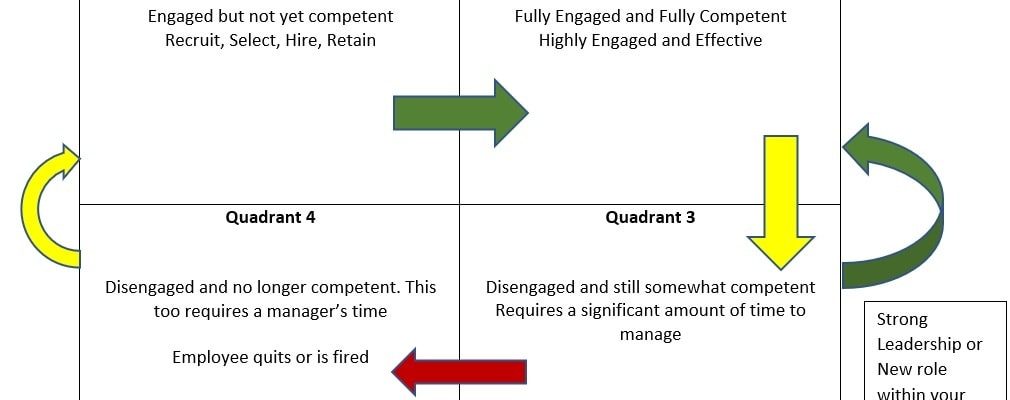
Think back to when you started your job, you were likely excited and eager to learn. So how do your employees become disengaged? The chart below illustrates a typical process for having engaged or unengaged employees:
Quadrants
In Quadrant 1 employees are hired and brought into the organization. Regardless of the job, most employees are highly engaged and chomping at the bit to get started. They are not particularly competent at this stage but are learning and their competency and value to the organization grow each day. Employees stay in Quadrant 1 for 3-12 months depending on the complexity of the job.
In Quadrant 2 employees are highly engaged and have learned enough to be fully competent and of high value to the organization. If the job is a good fit for the motivational needs of the employee, they may stay in Quadrant 2 for quite a while and this is obviously where we want all our employees to be and stay if possible. Unfortunately, we know most employees are not fully engaged so many moved to Quadrant 3.
In Quadrant 3 employees become disengaged and over time begin to lose their competence. If they stay in Quadrant 3 long enough, they may move to Quadrant 4. The employee can become re-engaged either through strong leadership or through a new project or role opportunities within the company, moving back to Quadrant 2.
If employees move to Quadrant 4, they can become so disengaged they lose competency. If an employee stays in Quadrant 4 for very long, they will either leave on their own or be fired at which point the employer starts the cycle over, hiring a new employee.
What causes loss of employee engagement? Is it:
Lack of effective leadership
No shared vision
Weak or toxic organizational culture
Poor communication
The job does not meet the motivational needs of the employee
All of the above
The answer varies from one organization to the next but most often the answer is some level of “All of the above.”
Turnover is just the cost of doing business, right? But what is the cost? Earlier we shared how engagement impacts performance metrics over time. Based on the employee engagement process model let’s explore the real $ cost of low engagement.
Sample Cost To ABC Widget Company
Total number of employees
100
X Percentage in Quadrant 3 (per Gallup research)
67%
Estimated number of employees in Quadrant 3
67
X Average Monthly Compensation per employee in Quadrant 3
$4,000.00
Estimated Average monthly compensation for Employees in Quadrant 3
$268,000.00
X Cost of lost effectiveness (100-67%)
33%
Estimated Monthly Cost of employees in Quadrant 3
$88,440.00
Estimated Annual cost of lost productivity of employees in Quadrant 3
$1,061,280.00
This is just a model and you may say that number is wrong and unfortunately, you would be right. This example only considers the hard cost of each disengaged employee in Quadrant 3. That’s bad enough but these disengaged individuals don’t just sit there quietly. They play a game called “Ain’t it awful”, recruiting others to their side. They do this in the break room, over a beer after work, or even at company events. You know it’s true because you’ve seen it and maybe at some point in your career played the game yourself.
How To Avoid The True Cost Of The Wrong Hire
It doesn’t have to be this way. Even under the best circumstances, you will have disengaged employees, but you can dramatically reduce their numbers and improve your bottom line in doing so. Here are a few things you should consider:
Use assessments in your hiring process. Scientifically valid assessments like those Jamesson Solutions offers are the only way to get an objective view of how the person will show up to work behaviorally and if the job fits the motivational needs of the person. You are not doing yourself or the applicant any favors by putting them in a job that does not fit them.
Have a clear mission and vision for your company and make sure everyone in the organization knows them, what they mean, and what their role is in making the mission and vision happen
Assess your current organizational culture and whether that culture is conducive to enacting your company’s mission and vision. If not, actively work to make the needed changes to your culture.
Most are not born leaders but rather grow to become leaders over time, through learning on the job, through mentorship, and through dedicated, focused leadership development. It is as critical to your organization for you to have a solid leadership pipeline as it is to have a solid sales pipeline. So, make sure you are developing your people at every level.
Specializing in workforce development, talent selection, and personality assessment and evaluation, Jamesson Solutions provides numerous proprietary tools and methodologies to find the right people to fit the right roles, provide visibility and action plans for management, and Business Simulations that allow people to learn through self-discovery and by doing.
Each Jamesson Solutions Associate brings her/his own unique experience in developing individuals and improving organizational effectiveness to each client engagement. Their interest, their passion, and their commitment are in supporting you, the client, and your organization in achieving your objectives NOW and in the future.
Encompass Solutions is a business and software consulting firm that specializes in ERP systems, EDI, and Managed Services support for Manufacturers and Distributors. Serving small and medium-sized businesses since 2001, Encompass modernizes operations and automates processes for hundreds of customers across the globe. Whether undertaking full-scale implementation, integration, and renovation of existing systems, Encompass provides a specialized approach to every client’s needs. By identifying customer requirements and addressing them with the right solutions, we ensure our clients are equipped to match the pace of the Industry.