Applied Composites Engineering (ACE) is a premier supplier of aviation and aerospace products and services. This includes creating products from concept to finish for the international commercial, corporate, and military aircraft industries.
Success Highlights
Challenges
Tie together operations end-to-end and ensure all manufacturing processes, products, and services meet stringent government and industry regulations
Solution
Epicor® ERP
Benefits
Visibility to make on-the-fly changes based on customer requirements
Review details, communicate changes, and make informed decisions in minutes
Create automated procedures ensuring all processes meet certification standards
Increased profitability by tracking the shelf life of materials and reducing the amount of inventory kept on hand
Better identify the time and activity spent on each operation
Encompass Solutions is a business and software consulting firm that specializes in ERP systems, EDI, and Managed Services support for Manufacturers and Distributors. Serving small and medium-sized businesses since 2001, Encompass modernizes operations and automates processes for hundreds of customers across the globe. Whether undertaking full-scale implementation, integration, and renovation of existing systems, Encompass provides a specialized approach to every client’s needs. By identifying customer requirements and addressing them with the right solutions, we ensure our clients are equipped to match the pace of the Industry.
Aerobiotix, Inc. develops, manufactures, and markets professional air treatment systems for the healthcare market. Since 2013, they have actively worked with administrators and facilities nationwide to evaluate air quality issues, set targets, and prescribe the appropriate solutions through careful cost/benefit analyses.
In May 2017, Aerobiotix launched their new HEPA Ultraviolet Air Recirculation System—the Illuvia 500UV—to capture five percent of the U.S. hospital system marketplace within the next two years. This objective is backed by efficacy studies showing that a single pass through the device eliminates bacteria and spore-related viruses by 99 percent.
Success Highlights
Challenges
Further company growth through the meticulous tracking of inventory, sales, purchases, and deliveries
Solution
Epicor® ERP Cloud
Benefits
Track the status and use of every machine in the production cycle at 30 separate hospitals nationwide
Improve sales tracking and performance
Easily transfer products and supplies from one location to another
Encompass Solutions is a business and software consulting firm that specializes in ERP systems, EDI, and Managed Services support for Manufacturers and Distributors. Serving small and medium-sized businesses since 2001, Encompass modernizes operations and automates processes for hundreds of customers across the globe. Whether undertaking full-scale implementation, integration, and renovation of existing systems, Encompass provides a specialized approach to every client’s needs. By identifying customer requirements and addressing them with the right solutions, we ensure our clients are equipped to match the pace of the Industry.
Founded in 1992, Metal-Tech Partners (MTP) has rapidly grown from a supplier of telecommunications products to a multi-million-dollar business providing custom manufactured and fabricated parts and services to the international telecom industry. This includes meeting exacting specifications for thousands of products ranging from racks, bays, and cabinets to pipe stands and support grids.
Success Highlights
Challenges
Lead the industry with high-quality products provided at the lowest possible costs and with the fastest turnaround times
Solution
Epicor® ERP Cloud
Benefits
Operate more efficiently by accessing production information on a daily or even hourly basis
Can track and review the time spent by every employee on projects
Eliminated paper trails so workers can focus on production
Better inventory control and prediction of shortages before supplies are depleted
Encompass Solutions is a business and software consulting firm that specializes in ERP systems, EDI, and Managed Services support for Manufacturers and Distributors. Serving small and medium-sized businesses since 2001, Encompass modernizes operations and automates processes for hundreds of customers across the globe. Whether undertaking full-scale implementation, integration, and renovation of existing systems, Encompass provides a specialized approach to every client’s needs. By identifying customer requirements and addressing them with the right solutions, we ensure our clients are equipped to match the pace of the Industry.
For nearly 100 years, Mid-West Metal Products has been a premium producer of wire-formed, sheet metal fabricated, and tubular metal products for customers ranging from leading global corporations to small emerging enterprises.
With four locations in Muncie, Indiana, including three manufacturing facilities, as well as production operations in Dalian, China, the company specializes in the custom design and manufacturing of items like enclosures, bag stands, pet crates, shelving, and displays from concept to finished product. This is performed in both a “job shop” atmosphere as well as a wholesaler/distribution environment dedicated to quality, timeliness, and competitive pricing.
Success Highlights
Challenges
Facilitate the growth of this wholesaling and industrial fabrication company by creating easy access to historical sales information, while automating shipping, processing, packing, and picking activities across five locations
Solution
Epicor® ERP
Benefits
Identified numerous production inefficiencies, which enabled Mid-West to reduce labor costs by 20 percent and increase sales by 30 percent during the first year of use
Provided a clearer picture of both profitable and non-profitable product lines
Streamlined order processing and eliminating the need for sales representatives to fax requests or constantly follow up to learn the status of orders
Encompass Solutions is a business and software consulting firm that specializes in ERP systems, EDI, and Managed Services support for Manufacturers and Distributors. Serving small and medium-sized businesses since 2001, Encompass modernizes operations and automates processes for hundreds of customers across the globe. Whether undertaking full-scale implementation, integration, and renovation of existing systems, Encompass provides a specialized approach to every client’s needs. By identifying customer requirements and addressing them with the right solutions, we ensure our clients are equipped to match the pace of the Industry.
For the past 50 years, National Coating Corporation has specialized in the custom coating and saturation of any non-metal flat or rolled substrate. This includes enhancing the everyday performance and lifespan of materials used in automotive, industrial, commercial, aerospace, alternative energy, and consumer products worldwide.
Success Highlights
Challenges
Provide in-depth insights into company operations, while identifying new cost-saving methods and opportunities to develop products for a broader range of industries
Solution
Epicor® ERP
Benefits
Quicker, simpler-to-navigate access to nearly every application company-wide
Real-time access to actionable and accurate data that can increase revenues and cut costs
All-in-one package that includes accounting, payroll, labor, and inventory information with simple, easy-to-use dashboards
Encompass Solutions is a business and software consulting firm that specializes in ERP systems, EDI, and Managed Services support for Manufacturers and Distributors. Serving small and medium-sized businesses since 2001, Encompass modernizes operations and automates processes for hundreds of customers across the globe. Whether undertaking full-scale implementation, integration, and renovation of existing systems, Encompass provides a specialized approach to every client’s needs. By identifying customer requirements and addressing them with the right solutions, we ensure our clients are equipped to match the pace of the Industry.
Proton therapy is a highly advanced, painless, and precise form of external beam radiation that has been used to treat 100,000 cancer patients worldwide. An exceptional option for childhood cancers, it has also become ideal for treating solid tumors of the prostate, brain, eye, head, and neck, inoperable small cell lung cancer, as well as liver and certain types of breast and gastrointestinal cancers.
Optivus Proton Therapy, Inc. (Optivus) was launched in 1993 by the center’s original engineering team led by Jon W. Slater and entrusted with the entire facility’s technical enhancements and ongoing maintenance. Founded on the principles of continuous excellence, Optivus has developed and implemented hundreds of design and new technology improvements over the past two decades according to the facility’s precise clinical specifications.
Success Highlights
Challenges
In addition to manufacturing, Optivus is a project-driven organization, with significant requirements for tracking hundreds of thousands of labor charges and managing a bill of materials with thousands of parts
Solution
Epicor® ERP
Benefits
Better understand job costs through the generation of detailed records integrating manufacturing and engineering with payroll and accounting
Identify the exact location and status of parts stored across four separate warehouses
Create purchase orders with detailed line items attributed directly to project steps
Readily reconcile accounting differences between purchasing, receiving, and billing
Encompass Solutions is a business and software consulting firm that specializes in ERP systems, EDI, and Managed Services support for Manufacturers and Distributors. Serving small and medium-sized businesses since 2001, Encompass modernizes operations and automates processes for hundreds of customers across the globe. Whether undertaking full-scale implementation, integration, and renovation of existing systems, Encompass provides a specialized approach to every client’s needs. By identifying customer requirements and addressing them with the right solutions, we ensure our clients are equipped to match the pace of the Industry.
Founded in 1970, Maxweld and Braze is the wholesale division of the Weldamax Group. It began as a wholesale supplier of safety wear for the welding industry. But gradually expanded to include a full range of welding equipment and consumables backed by warranties, a local service center, and customer training.
High production costs in the USA and Europe meant new suppliers had to be found in the East. However, this brought further challenges in managing procurement, stock, and production, whilst ensuring optimum customer service.
Success Highlights
Challenges
Required standardized data management throughout the Weldamax group
Old systems were not integrated and lacked transparency
Needed more control over inventory
The inability to forecast sales and manage to purchase accurately resulted in incorrect inventory purchasing and holding
Fluctuating Rand v. US Dollar exchange rate
Solution
Epicor ERP
Benefits
Streamlines operations by integrating internal processes
Ensures all areas of the business are transparent
Helps to establish processes and systems within the group
Encompass Solutions is a business and software consulting firm that specializes in ERP systems, EDI, and Managed Services support for Manufacturers and Distributors. Serving small and medium-sized businesses since 2001, Encompass modernizes operations and automates processes for hundreds of customers across the globe. Whether undertaking full-scale implementation, integration, and renovation of existing systems, Encompass provides a specialized approach to every client’s needs. By identifying customer requirements and addressing them with the right solutions, we ensure our clients are equipped to match the pace of the Industry.
Encompass Solutions is a business and software consulting firm that specializes in ERP systems, EDI, and Managed Services support for Manufacturers and Distributors. Serving small and medium-sized businesses since 2001, Encompass modernizes operations and automates processes for hundreds of customers across the globe. Whether undertaking full-scale implementation, integration, and renovation of existing systems, Encompass provides a specialized approach to every client’s needs. By identifying customer requirements and addressing them with the right solutions, we ensure our clients are equipped to match the pace of the Industry.
Collaborative robots (cobots) are gaining traction in modern manufacturing facilities. Prices have steadily fallen into the realm of affordable for most small and medium-sized manufacturers. By offloading the repetitive portions of a human counterpart’s workload, the cobot increases overall output, accuracy, and safety.
With COVID-19 forcing businesses to reevaluate collaboration in the workplace, cobots are entering conversations at an increasing rate. Where two humans may not be able to share a common space, a human and a cobot can do so safely without sacrificing productivity.
Cobots Are Built For – Wait For It – Collaboration
When we examine robotics and automation in the age of Industry 4.0, we can identify many familiar, though more archaic, forms of robotics in the manufacturing facility. Unfortunately, many of these examples pose quite a hazard to their human coworkers. Robot cell design has traditionally put human safety at the forefront and locked these machines in cages or behind walls.
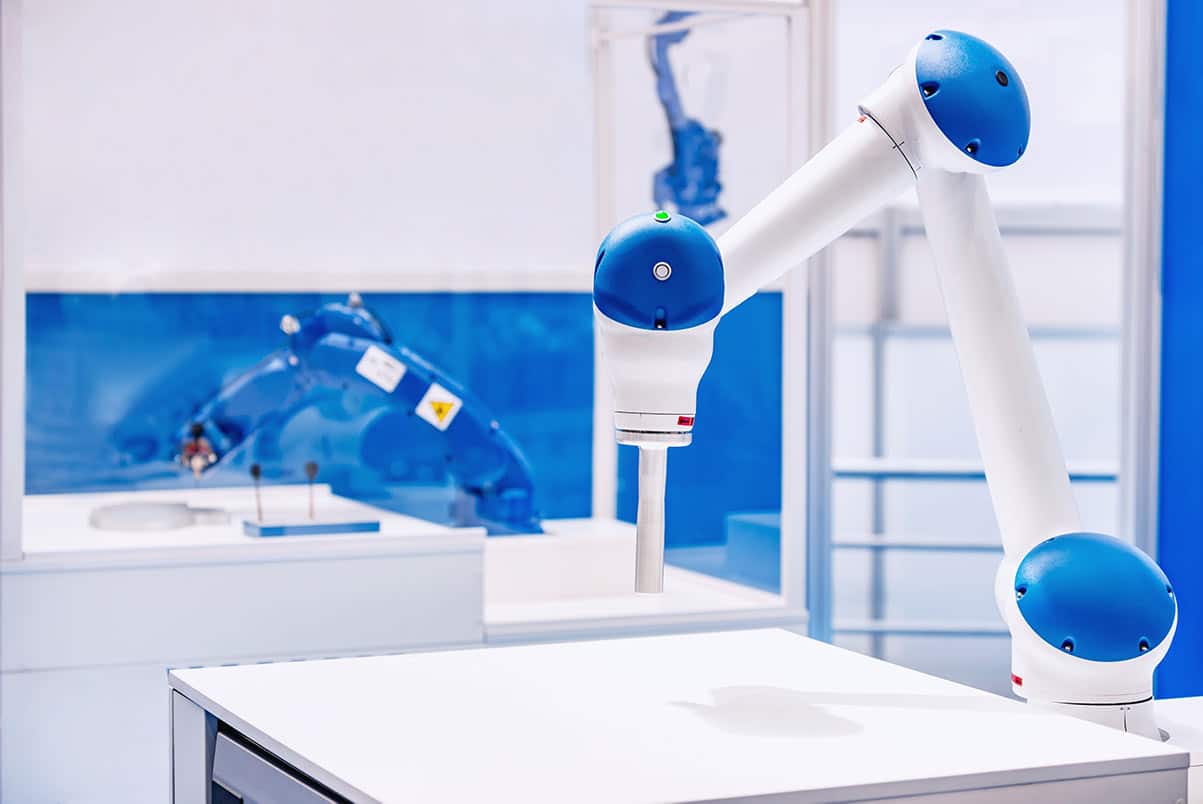
Cobots break free of those bonds and work right alongside people. By design, they are considerate of our fragility. Internal and external sensors ensure they speed up and slow down operations based on proximity to humans.
This is just one example of how collaborative robots are making their adoption more palatable in the factory.
With a starting price tag on most models circling $25,000, cobots are more affordable than they have ever been.
As adoption increases and innovation in human-cobot collaboration proliferates, we can expect to see even more exciting technologies and use cases emerge as Industry 5.0 approaches.
Collaborative Robots Make Smart Manufacturing Accessible
Not only can we program cobots to perform any series of dull, dangerous, and dirty tasks ad nausea, but we can also ensure they adopt new methods of performing work easily.
This is in stark contrast to hard or fixed automation examples in industries like aerospace and automotive manufacturing.
Those robots, generally referred to as articulated robots, are built with one purpose in mind and are rigid in their programming. Changing tooling and behavior takes significant effort. Too often resulting in lost production time. These robots even risk becoming obsolete as production changes over time.
On the other hand, collaborative robots can be reprogrammed and equipped with novel end-of-arm tooling to complete an array of complex tasks. Whether the job requires drilling, stamping, welding, gripping, or just about any other method of manipulation, chances are there is a cobot solution out there already or currently being developed.
The experience of programming cobots is becoming more intuitive every day. Examples like drag&bot and block come to mind, with simple drag-and-drop coding snippets that can program a robot to perform manufacturing tasks. as the coding environment becomes more accessible to workers who traditionally had a hands-on interaction with jobs, the result is new ways of achieving efficiency. This is in stark contrast to a computer science-oriented way of thinking about manufacturing scenarios.
Not only this, but career machinists can put their valuable knowledge to work in new ways that spark creativity, growth, and fulfillment in their careers.
Where Cobots Fit Into The Manufacturing Facility
Collaborative robots in manufacturing can take the mundane and stressful in stride. Excelling at dull, dirty, and dangerous tasks is what they do best.
Consider cobots scaled-down versions of other familiar robots already utilized in manufacturing facilities around the world.
Bench-top models resemble miniature articulated robots, at 3 to 4 feet in length. They are agile, lightweight, and customizable to an array of tasks. These same robots can also be mounted to mobile platforms. This can expand the cobot’s range of operation, assuming many different assembly tasks with the quick changeover from station to station.
Mobile cobot examples are also gaining momentum ferrying materials and components to staging areas so that staff doesn’t waste time walking from their bench to picking locations in your facility. Manufacturing and distribution centers gain incredible productivity when these useful robots can carry weights no human possibly could between storage and staging areas. The result is more employee engagement regarding the tasks at hand, fewer opportunities for accidents, and less time wasted walking the floor.
Mobile robots also make managing inventory much easier on your operations. They can complete non-stop audits of inventory, suggest amended sorting based on the flow of goods, and other efficiency opportunities based on the data flowing from their sensors into your ERP system. Businesses can then bring planning and scheduling to greater levels of efficiency, driving supply chain management like never before.
Beyond the physical examples, there are digital examples of cobots to consider, too.
Chatbots answer visitor inquiries on your website and report back to your CRM with visitor profile data.
Robotic Process Automation (RPA)
Robotic process automation (RPA) routines fall into this category, too. They handle repetitive data entry and admin tasks at an exponentially faster rate than humans. Not only does this example enable immense cost savings for large operations, but smaller businesses can remain competitive by handling more tasks with fewer costs sunk into non-revenue generating activities.
Both examples automate repetitive tasks that free your staff to take on more creative and value-added work.
All these collaborative robots fit into your facility in some way or another and feed the information they gather into enterprise systems.
These data transactions inform every level of your business, enabling you to make more intelligent decisions on the fly.
The Elephant In The Room – Fear Of Replacement
Ever since robots made their debut on production floors, humans have feared being replaced. Robots don’t complain, they don’t get tired, and they don’t get paid.
Despite these perks for companies, perhaps the biggest drawback when it comes to robots is that they don’t think for themselves.
They do not innovate; they do not come up with more efficient ways of doing things and they certainly are not creative. In this sense, they are about as dumb as the sum of their parts without a human giving the orders in the form of a program.
Before Covid-19, talent was hard to come by, especially for skilled trades in manufacturing. Cobots were one way to ease the burden these companies faced in a “sellers” market for talent. According to one 2018 Deloitte study, as many as 2.4 million U.S. Manufacturing jobs were expected to remain unfilled through 2028. This translated into an economic impact of $2.5 trillion.
The argument can be made that many skilled workers complete repetitive tasks daily. These tasks are the target of cobot solutions. These tasks wear on the hungry mind or eat at the fragile structures of the human body, the result is nagging injury and unfulfilled potential.
When cobots shoulder the burden of these tasks, their human counterparts can develop personally and professionally.
Take the Paradigm Electronics cobot example into consideration. The introduction of collaborative robots into the workplace didn’t lead to job loss. Quite the opposite. Those staff who were machinists up-skilled to robot programmers. Those traditionally static jobs fell by the wayside to be scooped up by cobots. The resulting dynamic was not a job loss for humans, by a redefinition of their professional roles and responsibilities.
Collaborative Robot Proliferation
The rise of cobots has shown to bring more benefits than drawbacks.
Industries continue to adopt the technology and human workers see the benefits in their adoption.
Even start-ups can reap the benefits of a workforce that doesn’t slow down and can always remain nimble to the changing landscape of business.
Whether it be on the manufacturing floor, the vineyard, or the back of the house at a restaurant, cobots are fast becoming a part of our daily lives.
Every day the price of cobots is driven down by fierce competition among robot manufacturers.
Innovations in sensing technologies and machine vision further increase efficiencies.
Currently, the cobot market is expected to exceed $11 billion by 2030. According to ABI research, the greater cobot ecosystem, which includes software, tooling, and customization, is expected to grow to $24 billion by the same time.
The above picture reveals a bright future for manufacturers and workers as this exciting technology develops.
Encompass Solutions is a business and software consulting firm that specializes in ERP systems, EDI, and Managed Services support for Manufacturers and Distributors. Serving small and medium-sized businesses since 2001, Encompass modernizes operations and automates processes for hundreds of customers across the globe. Whether undertaking full-scale implementation, integration, and renovation of existing systems, Encompass provides a specialized approach to every client’s needs. By identifying customer requirements and addressing them with the right solutions, we ensure our clients are equipped to match the pace of the Industry.
Businesses of every size contend with keeping the availability of materials, components, products in sync with their rate of production and customer demand. Finding the balance between these factors is, at a high level, the core concept of inventory management.
Why Inventory Management Important
As a business digs deeper into the specifics of inventory management, it will refine its goals. This includes all the additional details that make the process more efficient. Suffice it to say, good inventory management goes beyond the weight, dimensions, quantity, and location of items.
At a foundational level, your business will need a system of categorization to manage inventory. This also requires a means of interacting with this system when adding, removing, and identifying items.
Your system may require software and interactive technologies. These technologies can include computers, barcoding hardware, and scanners.
Knowing what you have in inventory and where is only one part of the equation. Forecasting demand to inform a business of when to replenish stock or when to buy more materials to manufacture those products is just as essential.
By ensuring that warehouse space is used efficiently and in sync with the rate of sales and replenishment, the cost associated with goods held in inventory is kept to a minimum.
In a broader sense, Inventory management is the component of your business’ supply chain that keeps material flowing into and out of your facility.
This is kept by production processes and customer demand.
Inventory Management Principles
Suppliers may experience fluctuations in the ability to fulfill POs and global events may shake up availabilities across the board. However, you can keep your own house in order with inventory management best practices.
For example, keeping a detailed record of products as they enter and leave your warehouse provides visibility to your business needs. This ensures you can deliver on customers’ and supply chain partners’ requirements at any given time.
Businesses of every size use inventory management principles to manage their flow of goods. However, there is no defined set of guidelines that all businesses can look to for the answers.
The best inventory management strategies will change from business to business, but generally accepted best practices can be applied in almost every case.
Identifying the right set of guidelines for your mode of operation will ensure you can deliver the right goods in the right quantities to your customers at the right place and time.
The Difference Between Inventory Management And Inventory Control
While these terms may seem the same at face value, they are generally not considered interchangeable.
A strong inventory management system ensures a business can source, store, and sell materials or finished goods in such a way that yields a consistent and dependable profit for the business overall. Good inventory management is a sustainable practice.
Inventory management follows a structure of thought as a business principle. It is an overarching set of concepts that address a larger business model.
Inventory Control is housed, pun-intended, within the larger concept of inventory management. Inventory control is focused on maintaining visibility and understanding of the materials and their flow. Namely, where and how much inventory can be found on-hand and readily accessed in a retail location, stockroom, or warehouse.
Why Inventory Management Is Important
Global supply chains are complex and in a state of constant ebb and flow.
Manufacturing processes that utilize raw materials and components are also changing continually according to customer demand, specification, and regulatory requirements.
In short, what is available today may not be available tomorrow. However, there are usually indicators of when a supply shortage may be looming or new regulations will be coming into effect.
Keeping up with these constant changes is more than simply difficult, it’s outright unnerving and even chaotic at times. Being stuck with an abundance of stock that can’t be used, spoils, or becomes obsolete can cost a considerable amount of capital, running a business well into the red. This is where the balancing act of inventory management becomes so critical.
The costs of carrying goods can be considerable. For this reason, many organizations seek to refine and optimize their methods for ensuring they have just enough material on hand to deliver on anticipated production levels or sales.
Streamlining inventory management will keep inventory levels low, which keeps costs sunk into stock on hand to a minimum. Furthermore, lower stock levels will ensure less space is required to match material requirements to production levels. With less space required, facilities can be kept to a more manageable size and minimize warehouse leasing costs.
How You Can Implement Best Practices
Fortunately, for many decades, businesses have been refining how they bring stability to the unpredictable world of global supply chains, manufacturing processes, and inventory management.
As part of those efforts, two major philosophies of inventory management have emerged as the most widely accepted and utilized: Just-In-Time (JIT) and Material Requirements Planning (MRP). Both instances have their benefits and drawbacks. We go into more detail in dedicated articles on JIT and MRP inventory management strategies.
Technology And Software
Beyond JIT and MRP inventory management, there are several technologies and software that make the process of managing inventory easier for businesses, staff, supply chains, and customers.
ERP software is one such technology that delivers all the critical data needed to inform demand forecasting and purchasing, whether a business is based in manufacturing or wholesale and distribution.
Inventory management data housed within the ERP system is accessed and reported digitally, while also easily sharable for key stakeholders and managers to use in their decision-making processes.
Encompass Solutions is a business and software consulting firm that specializes in ERP systems, EDI, and Managed Services support for Manufacturers. Serving small and medium-sized businesses since 2001, Encompass modernizes operations and automates processes for hundreds of customers across the globe. Whether undertaking full-scale implementation, integration, and renovation of existing systems, Encompass provides a specialized approach to every client’s needs. By identifying customer requirements and addressing them with the right solutions, we ensure our clients are equipped to match the pace of the Industry.