Today, businesses are trying to make important decisions accurately and efficiently — and to do that, you need access to the right information. But, keeping up with all of the available data can be exhausting – from sales figures and inventory data to financial management information. Do you know how your business is performing?
EDA Dashboards and Scorecards Webinar
Dashboards and scorecards give valuable insights into your business and allow your teams to uncover new opportunities and improve efficiencies. Join our webinar, Dashboards & scorecards: How is your business performing discover how you can turn your raw data into actionable insights to open up new opportunities, reduce costs and streamline processes with Epicor Data Analytics.
In this webinar, you’ll learn how to:
tailor dashboards to your business needs
summarize an entire database in a single interface
create an overarching view of your business that can be accessed anytime, anywhere.
When:
September 10, 2020
1 PM ET
During this webinar, you’ll see EDA dashboards and scorecards firsthand and learn how you can become a trailblazer in self-service, reporting, dashboards, and analysis. We look forward to seeing you there.
About Epicor Data Analytics
Epicor Data Analytics (EDA), powered by Phocas, is an easy-to-use cloud service with powerful tools to help you reduce costs, identify new opportunities, and speed decision-making.
Stay up-to-date with the daily changes in your business
Eliminate time-consuming and error-prone manual reporting processes
Visualize data across all of your business systems from production to sales
Encompass Solutions is a business and software consulting firm that specializes in ERP systems, EDI, and Managed Services support for Manufacturers and Distributors. Serving small and medium-sized businesses since 2001, Encompass modernizes operations and automates processes for hundreds of customers across the globe. Whether undertaking full-scale implementation, integration, and renovation of existing systems, Encompass provides a specialized approach to every client’s needs. By identifying customer requirements and addressing them with the right solutions, we ensure our clients are equipped to match the pace of the Industry.
ERP for start-ups may seem like a bit of an oxymoron. The nature of ERP is to connect several departments in a unified information system. This allows you to leverage crucial data to make informed decisions that drive the success of your business. When most people hear those three little letters, they tend to think of large-scale enterprises, multi-national conglomerates, or global entities. This couldn’t be further from the truth.
Small And Medium-Sized Businesses Include Start-Ups
The modern enterprise isn’t a fortune 500 company. It isn’t even a Fortune 5,000 company.
In the US There are roughly 17 million businesses with fewer than 500 employees. This number represents 99.7% of all US businesses and almost half of total private sector employment.
With that in mind, it would make sense the market for ERP that speaks to small and medium-sized enterprises is ripe for development. In the last 40 years, it has done just that with tremendous effect.
Among businesses surveyed in a 2017 Deloitte report commissioned by Google, the top 20% of the most digitally advanced companies:
Earned 2 times as much revenue per employee
Experienced revenue growth over the previous year that was nearly 4 times as high
Were almost 3 times as likely to be creating jobs over the previous year
Had an average employment growth rate that was more than 6 times as high
We’re also 3 times as likely to have exported over the previous year
Those stats can’t be ignored. However, what were the digital advancements these successful companies used to gain their edge in the market? Here’s how the levels of digital transformation of business are represented among those surveyed:
High – Advanced website, mobile or e-commerce capability, engagement on multiple social media platforms, online marketing channels
Advanced – Advanced data analytics and applications for business management and customer interactions
It’s clear a business using advanced digital tools to help their business will perform better than those businesses using only basic or intermediate tools. But what does advanced mean?
In this case, advanced digital tools include:
Data analytics are used to examine the characteristics of customers, and to inform business decisions such as online marketing strategies or products offered.
The ability for customers to make bookings and purchases through online channels, such as enabling payments through the business’ website or using third-party e-commerce platforms.
Digital technologies and tools are utilized internally to improve business processes or worker productivity (e.g. cloud-based software, video conferencing, corporate social networks).
Epicor ERP For Start-Ups Facilitate Sales Excellence
Let’s start with the first benefit of ERP for start-ups. It’s no secret that sales are top of mind of a start-up.
Whether you are in it for the long haul or just long enough to get an offer, proving viability through sales is key in attracting investors and securing longevity.
Epicor ERP CRM and Sales Management tools drive intelligent marketing and provide insightful data about what products are and are not moving. Add to this the ability to collaborate with internal teams as well as customers externally through one unified system and you have a recipe for success.
With Epicor Sales Management tools Improve the efficiency and effectiveness of your sales team. By giving your sales teams the ability to manage their opportunities and automate administrative tasks, you free up their time to focus on building lasting, profitable relationships. It also enables your sales team to:
Produce accurate estimates
Streamline your order-to-cash cycle
Fulfill perfect orders and ensure high customer satisfaction
Components of the sales management module include:
Estimate and Quote Management – Easily generate and track all customer or prospect requests for quotation (RFQs)—from the time of receipt until an order is placed. Create estimates and get quotes out more quickly with more accurate pricing and lead times with a wide range of powerful tools.
Generate accurate and timely estimates and quotes
Import data from a variety of customer and system sources
Check inventory availability during quote entry
Manage the sales cycle with dynamic task lists that ensure the right people are working on the quote at the right time
Automatically cross reference customer part numbers to your part numbers during the quoting process
Order Management – Order Management drives the Epicor system. From the time an order is entered, its progress is tracked through final shipment—producing perfect order fulfillment on demand for maximum customer satisfaction.
With the Order Job Wizard, generate appropriate jobs for new orders in a single step
Check customer credit status online at quote entry, order entry, and shipment entry
Using blanket orders, establish multiple releases for each sales order line and pull parts directly from inventory
Link sales orders, jobs, purchase orders, field service calls, cases, tasks, milestones, and budget information to manage projects
EDI/Demand Management – Entrust EDI/Demand Management secures your competitive edge by incorporating electronic data interchange (EDI) with the demand schedule.
Get full flexibility and control for setting up customer contracts and handling their schedules in the Epicor ERP system
Reduce lead time and effort for planning and procurement
With Demand Management, set up contracts per customer with such agreed-upon parameters as pricing, initial demand schedule, and contract end date
Point of Sale – Epicor Point of Sale (POS) extends the power of your Epicor ERP to a customer-facing sales environment—regardless if you need a single POS station or if you’re a multinational chain.
Feature-rich system that empowers store personnel to deliver an enhanced customer experience
Comprehensive functionality includes electronic gift cards, gift receipting, customized receipt per transaction type, coupon redemption/issuance, layaways, special orders, suspend and resume, item marking for various functions, additional input fields, multicurrency, start/end of day functions, cash management, and more.
Epicor Commerce Connect – B2B and B2C eCommerce is the new norm. Epicor Commerce Connect (ECC) provides your buyers and sales channels with a simple online shopping experience that encourages repeat purchases and sets your brand apart.
Launch an attractive, simple-to-use eCommerce site with your branding in less time
Manage only one product database with tight integration into Epicor ERP
Simplify channel support by letting your partners make payments on accounts, access pricelists, and place quick re-orders
Epicor Customer Connect – Today’s customers want new access to information. Epicor Customer Connect helps you improve customer loyalty and online commerce.
Special promotions and pricelists
Enable your customers to make repeat purchases
Startup Growth And Innovation With Advanced Digital Tools At An Affordable Price
Epicor technology is powered by industry-leading innovation and expertise. The software empowers businesses of every size and is modular to fit the needs of start-ups, no matter their stage of growth. Epicor solutions feature seamless integration with thousands of existing software applications, web-enabled platforms, and fully configurable interfaces and reporting systems.
Utilize the components of Epicor ERP for your start-up needs here and now. Add more functionality as you scale, customize the framework to fit your unique business components, and take as much control of your technology as you like with on-premise, cloud, and hybrid deployment options. Mobile solutions can further be utilized to access the system from Windows, iOS, and Android devices.
Epicor ERP for start-ups is designed to be both accessible and affordable for small businesses and start-ups. Financing, subscription models, and even tax write-offs are available for Epicor ERP software purchases.
Encompass Solutions is a business and software consulting firm that specializes in ERP systems, EDI, and Managed Services support for Manufacturers and Distributors. Serving small and medium-sized businesses since 2001, Encompass modernizes operations and automates processes for hundreds of customers across the globe. Whether undertaking full-scale implementation, integration, and renovation of existing systems, Encompass provides a specialized approach to every client’s needs. By identifying customer requirements and addressing them with the right solutions, we ensure our clients are equipped to match the pace of the Industry.
Epicor Data Analytics (EDA), powered by Phocas, is an easy-to-use cloud service with powerful tools to help you reduce costs, identify new opportunities, and speed decision-making.
Stay up-to-date with the daily changes in your business
Eliminate time-consuming and error-prone manual reporting processes
Visualize data across all of your business systems from production to sales
Each of the currently available Epicor ERP content packages for EDA provides starter dashboards and deep integration into a specific set of Epicor ERP data. You have the freedom to build onto these content packs with any additional fields from Epicor ERP and augment from any other data sources, such as Salesforce and ADP.
Epicor Data Analytics for Sales (sales, orders, quotes)
Quickly discover business trends by visualizing the sales data in your Epicor system. Get deeper insight into sales results by account, location, geography, order, and more.
Answers questions like:
What are my average sales and gross margin by invoice?
Who was buying, but is not buying now?
Where are we succeeding geographically?
Gain full visibility into:
Net sales
Quantity shipped
Quantity ordered
Material cost
Fixed burden
Variable burden
Labor cost
Other cost
Gross margin
Epicor Data Analytics for Materials (inventory, purchasing, and shipping)
Improve the productivity of what is likely your largest fixed asset—your inventory—by making sure you invest in the right inventory mix. EDA can help you see your inventory data more clearly.
Answers questions like:
What is our current inventory value today?
What are our potential inventory shortfalls?
What is on order in my open POs?
Where are my shipments?
Gain full visibility into:
Quantity on hand
Inventory value
Cost
Allocated
Backordered
On PO
In transit
Quantity ordered
Epicor Data Analytics for Financials (AR/AP and general ledger)
Improve overall visibility into your business by drilling down into categorized accounts and transactions within your income statement and balance sheet.
Answers questions like:
What are this year’s actuals versus last year’s actuals by account?
How long is money held up in accounts receivable?
What payments are receivable and what invoices are due?
Did we take advantage of discount terms and how much did we save?
Gain full visibility into:
Amount paid
Terms taken
Allowed
Bad debt amount
Amount receivable
Owing
Items invoiced
Invoices paid
Memos
Terms taken
Transactions for income statement and balance sheet
Epicor Data Analytics for Production (production, reporting, and quality)
With the production content pack for Epicor ERP and iScala, make certain that quality products are produced for the right customer at the right time—for the right price and profit margin.
Answers questions like:
What is my resource earned hours?
Do I have differences in production rates between shifts?
How do I improve the overall effectiveness of my resources?
What is the most frequent cause for product rejections?
Encompass Solutions is a business and software consulting firm that specializes in ERP systems, EDI, and Managed Services support for Manufacturers and Distributors. Serving small and medium-sized businesses since 2001, Encompass modernizes operations and automates processes for hundreds of customers across the globe. Whether undertaking full-scale implementation, integration, and renovation of existing systems, Encompass provides a specialized approach to every client’s needs. By identifying customer requirements and addressing them with the right solutions, we ensure our clients are equipped to match the pace of the Industry.
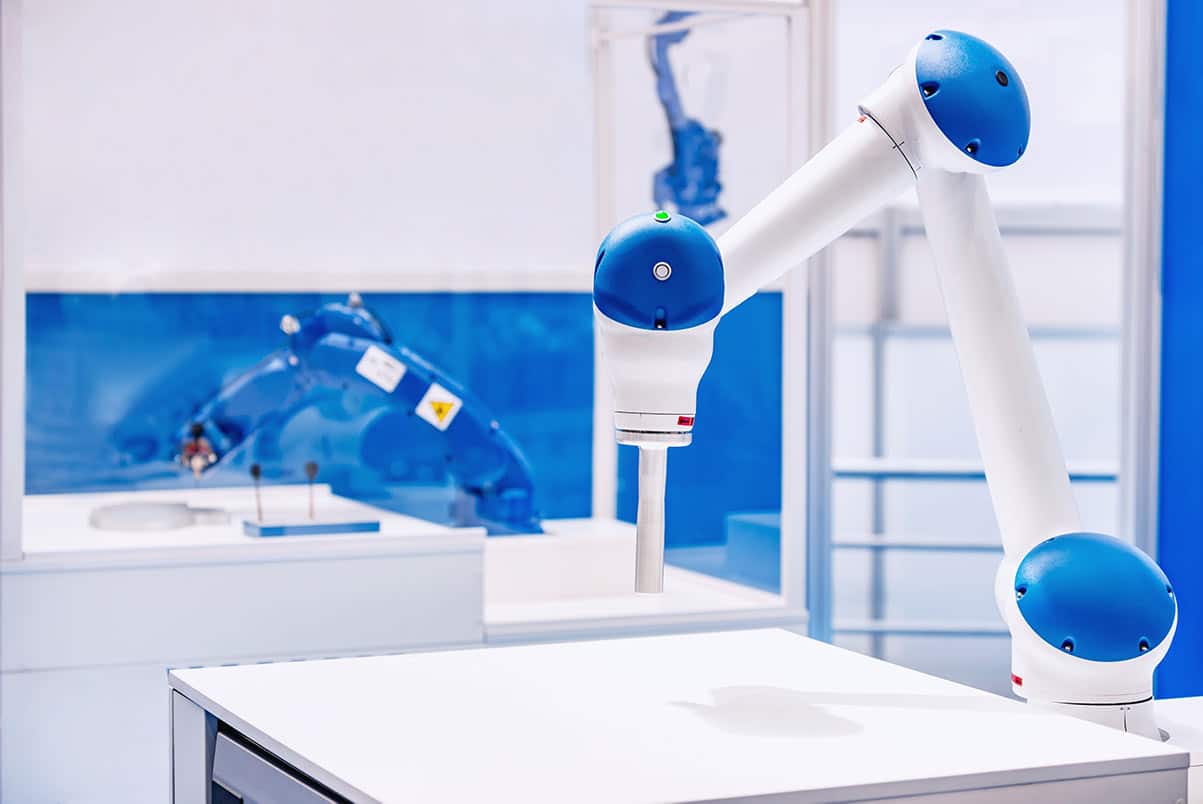
Collaborative robots (cobots) are gaining traction in modern manufacturing facilities. Prices have steadily fallen into the realm of affordable for most small and medium-sized manufacturers. By offloading the repetitive portions of a human counterpart’s workload, the cobot increases overall output, accuracy, and safety.
With COVID-19 forcing businesses to reevaluate collaboration in the workplace, cobots are entering conversations at an increasing rate. Where two humans may not be able to share a common space, a human and a cobot can do so safely without sacrificing productivity.
Cobots Are Built For – Wait For It – Collaboration
When we examine robotics and automation in the age of Industry 4.0, we can identify many familiar, though more archaic, forms of robotics in the manufacturing facility. Unfortunately, many of these examples pose quite a hazard to their human coworkers. Robot cell design has traditionally put human safety at the forefront and locked these machines in cages or behind walls.
Cobots break free of those bonds and work right alongside people. By design, they are considerate of our fragility. Internal and external sensors ensure they speed up and slow down operations based on proximity to humans.
This is just one example of how collaborative robots are making their adoption more palatable in the factory.
With a starting price tag on most models circling $25,000, cobots are more affordable than they have ever been.
As adoption increases and innovation in human-cobot collaboration proliferates, we can expect to see even more exciting technologies and use cases emerge as Industry 5.0 approaches.
Collaborative Robots Make Smart Manufacturing Accessible
Not only can we program cobots to perform any series of dull, dangerous, and dirty tasks ad nausea, but we can also ensure they adopt new methods of performing work easily.
This is in stark contrast to hard or fixed automation examples in industries like aerospace and automotive manufacturing.
Those robots, generally referred to as articulated robots, are built with one purpose in mind and are rigid in their programming. Changing tooling and behavior takes significant effort. Too often resulting in lost production time. These robots even risk becoming obsolete as production changes over time.
On the other hand, collaborative robots can be reprogrammed and equipped with novel end-of-arm tooling to complete an array of complex tasks. Whether the job requires drilling, stamping, welding, gripping, or just about any other method of manipulation, chances are there is a cobot solution out there already or currently being developed.
The experience of programming cobots is becoming more intuitive every day. Examples like drag&bot and block come to mind, with simple drag-and-drop coding snippets that can program a robot to perform manufacturing tasks. as the coding environment becomes more accessible to workers who traditionally had a hands-on interaction with jobs, the result is new ways of achieving efficiency. This is in stark contrast to a computer science-oriented way of thinking about manufacturing scenarios.
Not only this, but career machinists can put their valuable knowledge to work in new ways that spark creativity, growth, and fulfillment in their careers.
Where Cobots Fit Into The Manufacturing Facility
Collaborative robots in manufacturing can take the mundane and stressful in stride. Excelling at dull, dirty, and dangerous tasks is what they do best.
Consider cobots scaled-down versions of other familiar robots already utilized in manufacturing facilities around the world.
Bench-top models resemble miniature articulated robots, at 3 to 4 feet in length. They are agile, lightweight, and customizable to an array of tasks. These same robots can also be mounted to mobile platforms. This can expand the cobot’s range of operation, assuming many different assembly tasks with the quick changeover from station to station.
Mobile cobot examples are also gaining momentum ferrying materials and components to staging areas so that staff doesn’t waste time walking from their bench to picking locations in your facility. Manufacturing and distribution centers gain incredible productivity when these useful robots can carry weights no human possibly could between storage and staging areas. The result is more employee engagement regarding the tasks at hand, fewer opportunities for accidents, and less time wasted walking the floor.
Mobile robots also make managing inventory much easier on your operations. They can complete non-stop audits of inventory, suggest amended sorting based on the flow of goods, and other efficiency opportunities based on the data flowing from their sensors into your ERP system. Businesses can then bring planning and scheduling to greater levels of efficiency, driving supply chain management like never before.
Beyond the physical examples, there are digital examples of cobots to consider, too.
Chatbots answer visitor inquiries on your website and report back to your CRM with visitor profile data.
Robotic Process Automation (RPA)
Robotic process automation (RPA) routines fall into this category, too. They handle repetitive data entry and admin tasks at an exponentially faster rate than humans. Not only does this example enable immense cost savings for large operations, but smaller businesses can remain competitive by handling more tasks with fewer costs sunk into non-revenue generating activities.
Both examples automate repetitive tasks that free your staff to take on more creative and value-added work.
All these collaborative robots fit into your facility in some way or another and feed the information they gather into enterprise systems.
These data transactions inform every level of your business, enabling you to make more intelligent decisions on the fly.
The Elephant In The Room – Fear Of Replacement
Ever since robots made their debut on production floors, humans have feared being replaced. Robots don’t complain, they don’t get tired, and they don’t get paid.
Despite these perks for companies, perhaps the biggest drawback when it comes to robots is that they don’t think for themselves.
They do not innovate; they do not come up with more efficient ways of doing things and they certainly are not creative. In this sense, they are about as dumb as the sum of their parts without a human giving the orders in the form of a program.
Before Covid-19, talent was hard to come by, especially for skilled trades in manufacturing. Cobots were one way to ease the burden these companies faced in a “sellers” market for talent. According to one 2018 Deloitte study, as many as 2.4 million U.S. Manufacturing jobs were expected to remain unfilled through 2028. This translated into an economic impact of $2.5 trillion.
The argument can be made that many skilled workers complete repetitive tasks daily. These tasks are the target of cobot solutions. These tasks wear on the hungry mind or eat at the fragile structures of the human body, the result is nagging injury and unfulfilled potential.
When cobots shoulder the burden of these tasks, their human counterparts can develop personally and professionally.
Take the Paradigm Electronics cobot example into consideration. The introduction of collaborative robots into the workplace didn’t lead to job loss. Quite the opposite. Those staff who were machinists up-skilled to robot programmers. Those traditionally static jobs fell by the wayside to be scooped up by cobots. The resulting dynamic was not a job loss for humans, by a redefinition of their professional roles and responsibilities.
Collaborative Robot Proliferation
The rise of cobots has shown to bring more benefits than drawbacks.
Industries continue to adopt the technology and human workers see the benefits in their adoption.
Even start-ups can reap the benefits of a workforce that doesn’t slow down and can always remain nimble to the changing landscape of business.
Whether it be on the manufacturing floor, the vineyard, or the back of the house at a restaurant, cobots are fast becoming a part of our daily lives.
Every day the price of cobots is driven down by fierce competition among robot manufacturers.
Innovations in sensing technologies and machine vision further increase efficiencies.
Currently, the cobot market is expected to exceed $11 billion by 2030. According to ABI research, the greater cobot ecosystem, which includes software, tooling, and customization, is expected to grow to $24 billion by the same time.
The above picture reveals a bright future for manufacturers and workers as this exciting technology develops.
Encompass Solutions is a business and software consulting firm that specializes in ERP systems, EDI, and Managed Services support for Manufacturers and Distributors. Serving small and medium-sized businesses since 2001, Encompass modernizes operations and automates processes for hundreds of customers across the globe. Whether undertaking full-scale implementation, integration, and renovation of existing systems, Encompass provides a specialized approach to every client’s needs. By identifying customer requirements and addressing them with the right solutions, we ensure our clients are equipped to match the pace of the Industry.
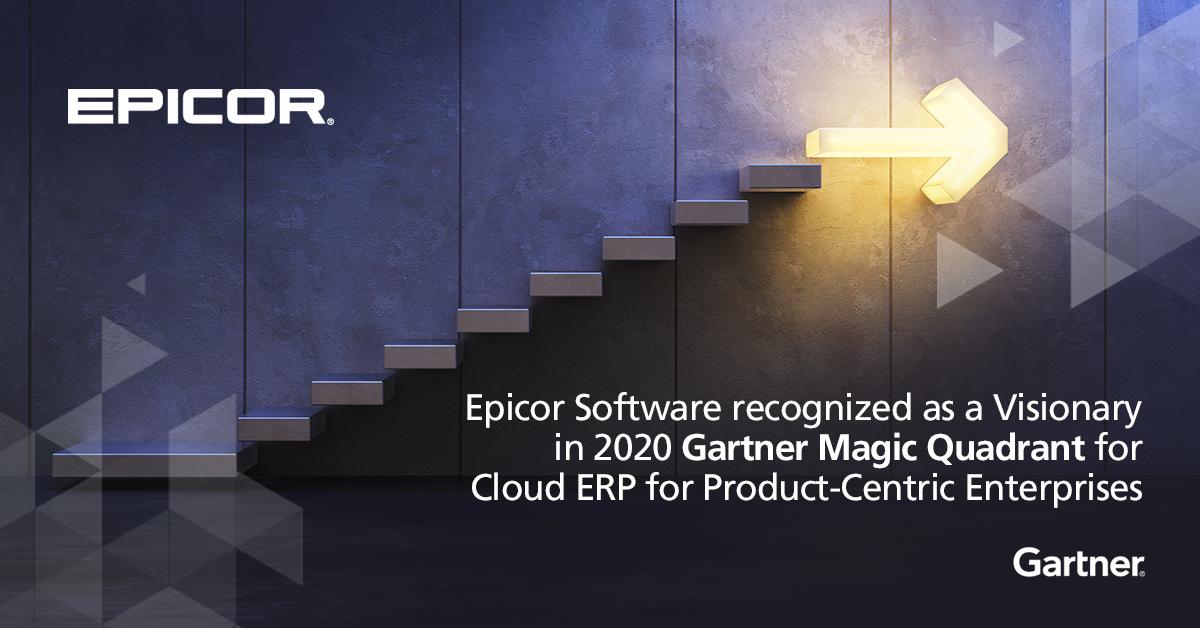
The Gartner Magic Quadrant for Cloud ERP is an annually published report that outlines the research organization’s perspective on the best software available. This year, Epicor Software again received designation as a visionary in the category of Cloud ERP for Product-Centric Enterprises.
The published report is free to download for anyone interested in learning more about Epicor Software and other Cloud ERP vendors.
You can download the Gartner Magic Quadrant for Cloud ERP for Product-Centric Enterprises report HERE.
Epicor ERP Cloud
Epicor ERP Cloud is a secure, economical, efficient, and reliable enterprise resource planning (ERP) system.
The solution provides businesses with flexibility and comprehensive support. It helps manufacturers simplify processes, optimize operations and ease IT responsibilities.
For example, Epicor Cloud ERP delivers a 99.5% or greater uptime.
Aerospace and defense manufacturer Wipaire leverages the benefits of Epicor Cloud ERP to free up resources and reduce costs.
The company enjoys real-time access to information, which delivers higher cost efficiency and better time management.
Wipaire Controller Mike Elrod commented about their choice to use Epicor ERP, “We chose to deploy in the cloud because it offered flexibility and cost savings and we no longer need to maintain in-house servers or equipment.”
Epicor ERP is built to scale alongside manufacturers as they grow and depend on better tools to deliver the results and experience their stakeholders and customers expect.
With Epicor Cloud ERP, businesses are better equipped to compete, thrive, and grow by harnessing data and implementing automation to improve productivity and profitability.
“We believe Epicor’s spot in the Visionaries quadrant proves that we are a cloud vendor of choice in the markets we serve and that our cloud ERP software is providing customers with the tools they need to succeed in today’s mid and enterprise markets,” said President Himanshu Palsule. “Our customer base is large, incredibly loyal, and actively engaged, and we will continue to foster those relationships to address and prioritize their feedback in future product updates so that our customers can push ahead of their competitors and can focus on business resiliency rather than IT administration.”
Placement in the Visionary quadrant validates Epicor’s ability to provide businesses with the best ERP solution. Read the Gartner Magic Quadrant for Cloud ERP for Product-Centric Enterprises report HERE to learn more.
Encompass Solutions is a business and software consulting firm that specializes in ERP systems, EDI, and Managed Services support for Manufacturers and Distributors. Serving small and medium-sized businesses since 2001, Encompass modernizes operations and automates processes for hundreds of customers across the globe. Whether undertaking full-scale implementation, integration, and renovation of existing systems, Encompass provides a specialized approach to every client’s needs. By identifying customer requirements and addressing them with the right solutions, we ensure our clients are equipped to match the pace of Industry.
As part of the Epicor Cloud ERP 10.2.700 Update, Epicor Cloud ERP pilot instances will upgrade to the newest release in September 2020. Read on to learn what new business value awaits and how to prepare.
What’s New In The Epicor Cloud ERP 10.2.700 Update
More details will be released as we near September 2020, but a few highlights include:
Cloud Read-only Data Access—Safely and securely view your data in a read-only environment. Epicor ERP Cloud Data Access is a new offering that allows for read-only access to your Epicor ERP instance. This new offering gives freedom of access while also safeguarding data security and system integrity. Access to the database will be on a read-only basis, but also near real-time (within seconds) to provide high value, whether leveraged by you directly or by ISV partners via APIs.
Epicor Advanced Unit of Measure—Seamlessly conduct business in a different unit of measure. A new capability, primarily aimed at the metals industry and adjacent industries, provides the ability to buy and value material in one unit of measure and transact in a different unit of measure.
Epicor Data Analytics (EDA) Financial Reporting—Budgeting, forecasting, and planning simplified. EDA Budgeting and Planning will provide an easy-to-use solution for budgeting, forecasting, and planning. With EDA Budgeting and Planning, you will be able to create financial budgets from scratch or prior year actuals and generate a budgeting workflow process, eliminating the need for Excel spreadsheets.
Epicor Kinetic—Continuing the journey to provide a modern and intuitive user experience with Epicor Kinetic. With this release, Epicor Kinetic is focused on the transformation of maintenance screens and quotes to cash process forms targeting high-impact maintenance and entry screens. New enhancements will be made to Epicor Application Studio, which allows you to tailor Kinetic forms with low/no code that won’t break during an upgrade.
How To Prepare For The The Epicor Cloud ERP 10.2.700 Update
Epicor will upgrade pilot systems one month before production systems. This will provide Epicor Cloud ERP customers with a chance to explore the updates in 10.2.700 without affecting production systems.
As a best practice, please use this time to review and make any necessary changes to your Unique Business Components (UBCs). This includes any custom reports, BAQs, BPMs, User Interface customizations, etc. Effective testing will ensure everything continues to operate as expected.
If you submit an EpicCare ticket for help with moving your UBCs from Pilot to Production, Epicor will do so for you during the upgrade weekend.
Important Dates
Friday, September 11, 2020 Deadline for Flex customers to submit an EpicCare ticket indicating their preference to defer their upgrade to one of the alternate upgrade dates
What’s New in Epicor ERP Cloud 10.2.700 upgrade webinars are scheduled for mid-September. Register for one of the sessions to learn the latest about Epicor Kinetic, AppStudio, and Identity. If you cannot attend, they will be available on demand.
Friday, September 18, 2020 – Saturday, September 19, 2020 Pilot system upgrades to 10.2.700. During this time, your pilot system will be unavailable while Epicor performs your upgrade, but don’t worry—your production system will not be affected by the new release. Once it is complete, log in to your pilot system and start exploring what’s new.
Tuesday, October 13, 2020 A pilot system update to 10.2.700.2 and UBC Opt-In Deadline. The final version that will be loaded into your Production system will be 10.2.700.2, so we’ll update your Pilot environment on this date. Also, if you want Epicor to move your UBCs from your Pilot environment to your Production environment, you must submit an EpicCare ticket to opt into the process. If you do not submit an EpicCare ticket to opt into the process, the UBCs from your Pilot environment will not be moved by Epicor to the Production environment.
Saturday, October 17, 2020 – Sunday, October 18, 2020 Production system upgrades to 10.2.700.2. Your upgrade weekend arrives! While Epicor upgrades your production system to Epicor Cloud ERP 10.2.700.2, your system will be unavailable for several hours during this time.
Note that dates are subject to change.
Flexing Your Upgrade
Subscribers to the Epicor Public Cloud Flex Option can follow the same schedule.
Alternatively, you have the option to defer your upgrade to Epicor Cloud ERP 10.2.700.
Below are the two date options for your flex upgrade.
Pilot Production
Option 1: Week of Dec 14, 2020 Jan 23-24, 2021
Option 2: Week of Jan 18, 2021 Feb 20-21, 2021
If you choose to defer, you must submit an EpicCare ticket with your selected upgrade date (Option 1 or Option 2) and we will send you a personalized confirmation with your instructions. We must receive your deferral no later than Friday, September 11, 2020. If you do not choose to defer, we’ll keep you on cadence and automatically upgrade your system in September 2020.
Note: If you choose to defer your upgrade, you will not receive any 600.x updates after the 10.2.600.11 update. We only host the upgrade webinars on September 16 and September 17, but replays are accessible at any time afterwards as documentation on EpicWeb. If you defer, you are strongly encouraged to either attend or watch the replay so you are aware of the upgrade process.
About The The Epicor Cloud ERP 10.2.700 Update
The Epicor Cloud ERP 10.2.700 update is the second of two major upgrades in 2020, as part of the regular cadence and commitment to helping your business grow through innovation.
Unlike the more frequent monthly updates that are minor yet enhance your daily experience, major releases like this bring you greater usability, performance, and strategic value in a single upgrade. That’s why we give you advance notice and the opportunity to test and explore the updates in the pilot before upgrading your production system.
Next Steps
Watch for additional information about the upcoming upgrade. You will be invited to join educational webinars on September 16 and September 17 to learn more about the Epicor Cloud ERP 10.2.700 update, how to prepare, and ways to leverage the new functionality for driving business growth. Documentation will also be made available on the Epicor customer portal EpicWeb. And as a reminder, reach out to EpicCare anytime you have a question or need application support.
Encompass Solutions is a business and software consulting firm that specializes in ERP systems, EDI, and Managed Services support for Manufacturers and Distributors. Serving small and medium-sized businesses since 2001, Encompass modernizes operations and automates processes for hundreds of customers across the globe. Whether undertaking full-scale implementation, integration, and renovation of existing systems, Encompass provides a specialized approach to every client’s needs. By identifying customer requirements and addressing them with the right solutions, we ensure our clients are equipped to match the pace of Industry.
As of June 2020, Epicor is no longer delivering enhancements for Epicor Advanced Financial Reporting (AFR), but bug fixes are still available for existing customers on maintenance, and the product is still in the Active Support stage. However, AFR is expected to move to Sustaining Support by 2021.
If your organization is looking for an alternative product by Epicor that gives more value and benefit to your business, Epicor can offer you three great financial reporting products that are fully integrated with Epicor ERP and provide the same capabilities as Epicor Advanced Financial Reporting and much more.
Epicor Financial Planner (EFP) – New edition: Financial Reports by EFP – New demo
Epicor Data Analytics (EDA) – New module: Financial Statements – New promo video
To support the migration to these products, a new, very beneficial, non-time limited migration offer is available to every Epicor ERP customer on active AFR maintenance when migrating to Epicor XL Connect or EFP.
EDA Financial Statements is also a great option at your discretion, however, for this product, the new non-time limited migration offer does not apply.
Encompass Solutions is a business and software consulting firm that specializes in ERP systems, EDI, and Managed Services support for Manufacturers and Distributors. Serving small and medium-sized businesses since 2001, Encompass modernizes operations and automates processes for hundreds of customers across the globe. Whether undertaking full-scale implementation, integration, and renovation of existing systems, Encompass provides a specialized approach to every client’s needs. By identifying customer requirements and addressing them with the right solutions, we ensure our clients are equipped to match the pace of the Industry.
An Encompass customer in the Industrial Heating industry recently fell victim to an opportunistic ransomware attack that had encrypted all internal system files, as well as their Epicor application files. As a result, work was unable to continue, bringing operations to a standstill. Encompass’ Managed Services (MS) were enlisted to help get things back up and running. The company requested this case study on their ransomware recovery project be posted anonymously.
Ransomware Recovery Project Background
The company’s network fell victim to a severe ransomware attack. Unfortunately, it affected all internal systems, including backups. The attack took down the company’s systems completely in a matter of hours, forcing the company to rebuild from scratch. Fortunately, the company was able to save its Epicor Database.
The Plan
Initially, there was no internal plan in place at this company to address the initial attack or the fallout from such an event. The results from the attack were a focused effort to get systems up and running as fast as possible as well as restore a state of operational functionality.
Objectives for the engagement with Encompass Solutions’ Managed Services team were to recover system use, rebuild what was lost, and establish backups.
A plan to instate standard operating procedures that would minimize the potential for reoccurrence and maximize the efficiency of response and ransomware recovery followed.
The Execution
The company’s staff were able to provide Encompass with the necessary documentation, in the form of a blueprint of the existing Epicor environment, to rebuild the system in a more structurally sound way than the original.
Encompass’s Managed Services team worked with corporate IT staff to ensure backups and other security precautions were in place moving forward.
Overall, Encompass has just been a great asset to our organization. We have been through both a major Epicor upgrade and recovery process with them, and I am extremely impressed with everything they have done. They definitely make my job easier.
– C.R., IT Manager
The Results
Encompass’ ‘s managed services team was able to work with the parent company to reestablish a stable network and functional Epicor system in less than one week.
Next Steps
Documented SOPs were put in place to routinely establish backups and test recoverability regularly.
This company was pleased with Encompass’ level of service and expedient reaction to the situation. The two organizations will continue to work together on future Epicor projects and system maintenance.
Encompass Solutions is a business and software consulting firm that specializes in ERP systems, EDI, and Managed Services support for Manufacturers and Distributors. Serving small and medium-sized businesses since 2001, Encompass modernizes operations and automates processes for hundreds of customers across the globe. Whether undertaking full-scale implementation, integration, and renovation of existing systems, Encompass provides a specialized approach to every client’s needs. By identifying customer requirements and addressing them with the right solutions, we ensure our clients are equipped to match the pace of the Industry.
The article “How to Consider the “What-ifs” in Times of Uncertainty” by Wayne Slater was originally published on the Prophix blog in April 2020. you can read the original article, Here.
How to Consider the “What-ifs” in Times of Uncertainty
The word “uncertainty” immediately invokes feelings of anxiety and fear. This is not unusual, as it’s a natural human reaction to prefer the comfort of predictability over the vagueness of uncertainty. It’s in our nature to plan our day, week, and year on the data available to us. Businesses and finance professionals are no different. When the future is uncertain, this increases the risk to businesses and anxiety escalates around how to tackle the situation quickly.
Uncertain times are just that, uncertain. They make predicting the future much harder at the precise time you need to plan for it the most. Like people, businesses need to change with the times as well. Plans are no longer set in stone and need to be revisited more than twice or thrice in a year.
The need for active forecasting based on real data is paramount to making well-informed decisions about the future. In uncertain times, it’s all about becoming agile. Think about how the United States went from one COVID-19 case in Jan. 2020 to over 140,0001 by the end of Mar. 2020. Whether your organization operates in healthcare or hospitality, your plans need to adapt quickly because new decisions need to be made. Project management has already started moving from waterfall methodologies to agile for more frequent output. Ask yourself, has this sort of innovation happened in FP&A? It’s high-time finance teams are equipped with the right tools to “shift from generating data to producing insights2” that drive superior decisions.
Welcome to the world of CPM – Corporate Performance Management – a tool that transforms your finance department by making processes more efficient, agile, and automated, so that you can leverage your data to improve planning, reporting, security, workflows, and consolidations, all while reducing human error. Ultimately, CPM lets your organization be proactive and forward-thinking and enables finance leaders to better guide the organization during uncertain times.
Agile Scenario Planning
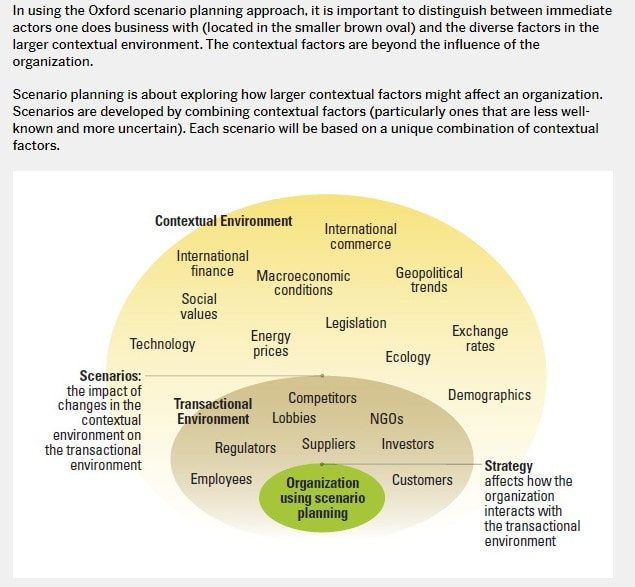
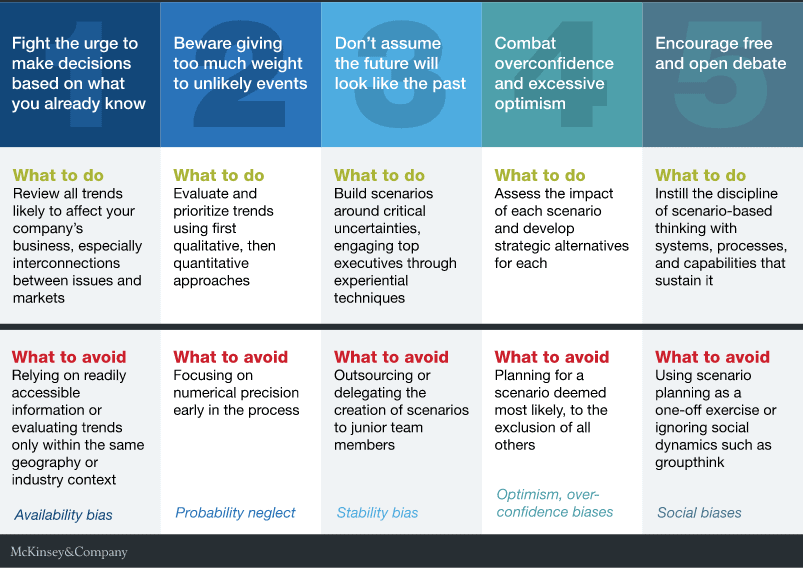
An especially important application in these uncertain times is scenario planning (see Fig.1 for contextual and transactional environmental factors involved in scenario planning). What realities is your business facing? What happens if consumer spending falls by 25%? Or if product revenue falls by 15%? Or do customers need to renegotiate payment terms? Whether sales are booming or declining, finance leaders need to go back and revisit their forecasts to assess the impact on cash flow and profitability and set correcting strategies. Having a centralized CPM tool like Prophix can make your life easier because it allows you to easily run scenarios on-the-fly.
Powerful tools let you transform your data and allow you to better model your operations, especially regarding “what-if” scenario planning. Positioning your company for success involves tough modeling to ensure business continuity.
Some industries are experiencing tremendous growth like healthcare, pharmaceuticals, and groceries. Concurrently, some are being hit hard financially such as hospitality, aviation, and retail. Cash flow planning becomes critical during uncertain times. With a robust CPM tool, you can easily model changes to your plans and move forward. It’s all about enabling you to plan smartly.
Your finance department probably spends long nights doing month-end and operational tasks. If they’re already spending 80% of their time on transactional tasks, it can be hard to shift focus to complex planning. Is your team equipped and ready to model endless scenarios in price adjustments, changes in capital spending, and fluctuating labor needs? Now, try to imagine a world where you already had a plan and solution in place to successfully steer you out of uncertainty…
So, how you do you plan for uncertainty (see Fig. 2 for some tips on scenario planning)? Well, it depends on many factors, but it starts with having a tool that can effectively and centrally manage your data so that all your users can view and interpret the same information.
To prepare for uncertainty, you need to set the baseline financial plan and the appropriate objectives/strategic goals. Next, prepare for different outcomes by involving more people in your planning process and considering best- and worst-case scenarios. CPM software lets you do this seamlessly through workflow project management capabilities.
Once your data is centralized, it’s easy to assess your performance against planned objectives. As you understand your variances, you can measure performance, visualize the future, and adapt accordingly with agility. Once everyone agrees, you can automate report distribution, buying you more time for value creation and generating insights.
As you can see, scenario planning is closely linked with both budgeting and forecasting. Things change, uncertainty arises, and plans evolve. In finance, scenarios act as guiding frameworks about events that may or may not take place in the future.
As finance leaders, we must proactively plan for the unknown and incorporate it into our forecasts. We must assess more frequently whether we are meeting our objectives, and if these objectives need to be changed. Scenario planning helps mitigate variances by focusing on the realities of the business. It helps finance leaders manage resources and improve decision-making by considering opportunities and risks.
Recap
In summary, the strategy is all about envisioning and implementing ideas and goals that let you compete and win in the marketplace. Don’t let old habits of the past slow down your organization and its predisposition to change. CPM tools like Prophix provide you with the technological solutions that help innovate the Office of Finance in a rapidly evolving environment to give you a competitive edge in a world of big data and increasing complexity.
Join the live discussion with Q&A to learn what CFOs around the globe can do to respond to changing conditions and ensure business continuity while improving planning and minimizing risk.
Prophix develops innovative software that automates critical financial processes such as budgeting, planning, consolidation, and reporting — improving a company’s profitability and minimizing its risks. Thousands of forward-looking organizations in more than 90 countries use software from Prophix to gain increased visibility and insight into their business performance.
Encompass Solutions is a business and software consulting firm that specializes in ERP systems, EDI, and Managed Services support for Manufacturers and Distributors. Serving small and medium-sized businesses since 2001, Encompass modernizes operations and automates processes for hundreds of customers across the globe. Whether undertaking full-scale implementation, integration, and renovation of existing systems, Encompass provides a specialized approach to every client’s needs. By identifying customer requirements and addressing them with the right solutions, we ensure our clients are equipped to match the pace of the Industry.
The article “It’s 2020 — Should Business Owners Fear The Cloud?” was written by Epicor Software Corp. CEO Steve Murphy and published by Forbes on March 2, 2020. You can read the original article here.
The cloud. It’s a small word that packs a big punch. Defining what a cloud is can confuse some while implementing it raises concerns for others.
We should consider three key factors as we continue into a new decade and business owners ask if they should fear the cloud: privacy, interoperability, and cost.
But first, what is the cloud, and why are businesses migrating to this solution?
Essentially, the cloud is a delivery method for your software. It’s a network of servers that are linked together and operate as a single system. The cloud can perform a variety of functions (e.g., storing data, running applications, delivering content, etc.), and you can access it online. There are both public and private cloud options. The biggest difference with the cloud is what it doesn’t require. You don’t need any hardware or networking gear on-site – all you need is a tablet or a phone to run the software.
One of the major reasons I believe cloud adoption continues to grow is the flexibility and productivity enhancements it offers. As the CEO of a company that offers cloud platforms, I’ve found that these features are particularly attractive for business owners looking to build resiliency in the face of unpredictable trade wars and other geopolitical changes. Business owners often look to business management software to provide stability. According to Goldman Sach’s 2020 review (via CNBC), 23% of IT workloads are now in public clouds.
So, should business owners fear the cloud when it comes to privacy, interoperability, and cost?
Should I fear privacy in the cloud?
There is no denying privacy is a major concern when it comes to data. Data breaches continue to increase, as does the projected production of data. To keep pace, both software solutions and IT departments will have to up their game.
First, I’ll share the bad news. According to Hiscox’s 2019 Cyber Readiness Report, most businesses are unprepared for cyber threats. In fact, in the U.S., 73% of businesses are “novices” at cyber readiness.
The good news, however, is that the public cloud has proven safer than on-premise data center environments. Specifically, Gartner found that “to date, there have been very few security breaches in the public cloud” and that “through 2020, public cloud Infrastructure as a Service (IaaS) workloads will suffer at least 60% fewer security incidents than those in traditional data centers.”
If you decide to move to the cloud due to these safety findings, you should still be mindful of cloud vulnerabilities. Take stock of what kinds of sensitive information you are putting in the cloud, and ensure you understand how the cloud provider will protect that data. The time needed to safely migrate systems and data can be lengthy, but it shouldn’t be rushed at the expense of security infrastructure. Select a provider who prioritizes security during the migration process and who has a solid reputation for getting the configuration right, and communicate with your team so that they understand the migration timeline and can manage their expectations.
Regardless of your software solution, privacy issues will continue to be a concern. One of the most important things business leaders can do is ensure they have a crisis management protocol in place if and when a breach should occur.
Should I fear cloud interoperability challenges?
I have great news on this front. There have been major strides toward interoperability. Multiple systems can exchange and use information easier than ever before. This is due to a variety of reasons: Many application programming interfaces (APIs) continue to get better, standards continue to improve, and, notably, I see tech giants such as Google, Amazon, and Microsoft Azure frequently expand the universe of applications that can easily be put in their clouds. I believe their efforts have significantly moved the needle.
While interoperability isn’t perfect, there’s a lot of upward momentum. I expect that to progress.
Should I fear the cost of the cloud?
If you’re a business owner and you aren’t sure cloud makes sense for you from a cost perspective, ask yourself if you have a good grip on how much it costs to have your own data center in your business. Do you already have the IT skills in-house to run your system? If so, the cloud may not make sense.
However, many business owners are surprised to find that their IT operations cost them a lot more than they think and that implementing cloud solutions can save them both time and money when it comes to issues such as automatic upgrades (which keep your company current and competitive), labor and maintenance costs, or increases in workforce productivity, to name a few.
Just remember that the decision between on-premise and cloud will be unique for each business. When you’re evaluating your IT operations cost, ask yourself how scalable you need your solution to be in the future. How adept is your IT department at staying up to date with evolving technology? Will you need additional data storage, and do you have the physical space to accommodate an expansion of your on-premise data center? Do you need access to data on the go? If a natural disaster hits your business, how will you back up your data?
What it comes down to is the total current cost of your on-premise data center versus a cloud solution. For business leaders who are still on the fence about expenses, make sure you evaluate your options regularly. Cloud providers will have to continue to be cost-competitive, which could work in your favor.
Bottom line: Don’t fear the cloud. It could be a safer option than on-premise data. Its interoperability continues to improve. It can be highly effective at increasing productivity. It can save you money long-term. And the cloud will likely continue to improve over time. The year 2020 may be the one for you to move forward with implementation.
Encompass Solutions is a business and software consulting firm that specializes in ERP systems, EDI, and Managed Services support for Manufacturers and Distributors. Serving small and medium-sized businesses since 2001, Encompass modernizes operations and automates processes for hundreds of customers across the globe. Whether undertaking full-scale implementation, integration, and renovation of existing systems, Encompass provides a specialized approach to every client’s needs. By identifying customer requirements and addressing them with the right solutions, we ensure our clients are equipped to match the pace of the Industry.