With a popular line of wood pellet grills and barbecue accessories, Traeger Grills knew it needed to get its manufacturing analytics to continue its impressive growth.

Big box retailers, specialty dealers, and cooking events had helped dramatically increase awareness of Traeger products among key customer groups, from backyard barbecue enthusiasts to world-renowned chefs. But the company sensed potential challenges ahead as its monthly product requests had reached the thousands.


About Encompass Solutions

Encompass Solutions is a business and software consulting firm that specializes in ERP systems, EDI, and Managed Services support for Manufacturers. Serving small and medium-sized businesses since 2001, Encompass modernizes operations and automates processes for hundreds of customers across the globe. Whether undertaking full-scale implementation, integration, or renovation of existing systems, Encompass provides a specialized approach to every client’s needs. By identifying customer requirements and addressing them with the right solutions, we ensure our clients are equipped to match the pace of the Industry.


For manufacturers, simplifying your business process and streamlining your organization is a constant concern. Whether you’re just starting or are actively growing, making improvements to challenges like supply chain visibility, production, and product delivery can put you on a path to greater success.


About Encompass Solutions

Encompass Solutions is a business and software consulting firm that specializes in ERP systems, EDI, and Managed Services support for Manufacturers. Serving small and medium-sized businesses since 2001, Encompass modernizes operations and automates processes for hundreds of customers across the globe. Whether undertaking full-scale implementation, integration, or renovation of existing systems, Encompass provides a specialized approach to every client’s needs. By identifying customer requirements and addressing them with the right solutions, we ensure our clients are equipped to match the pace of the Industry.


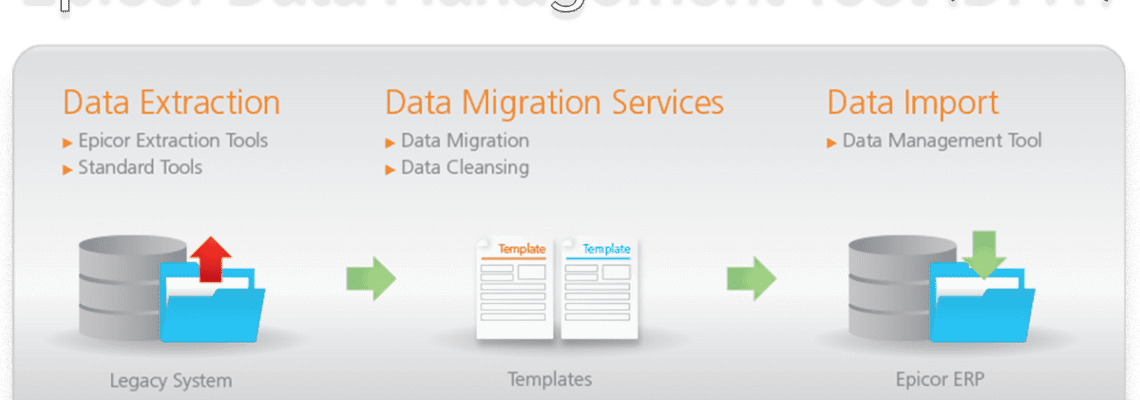
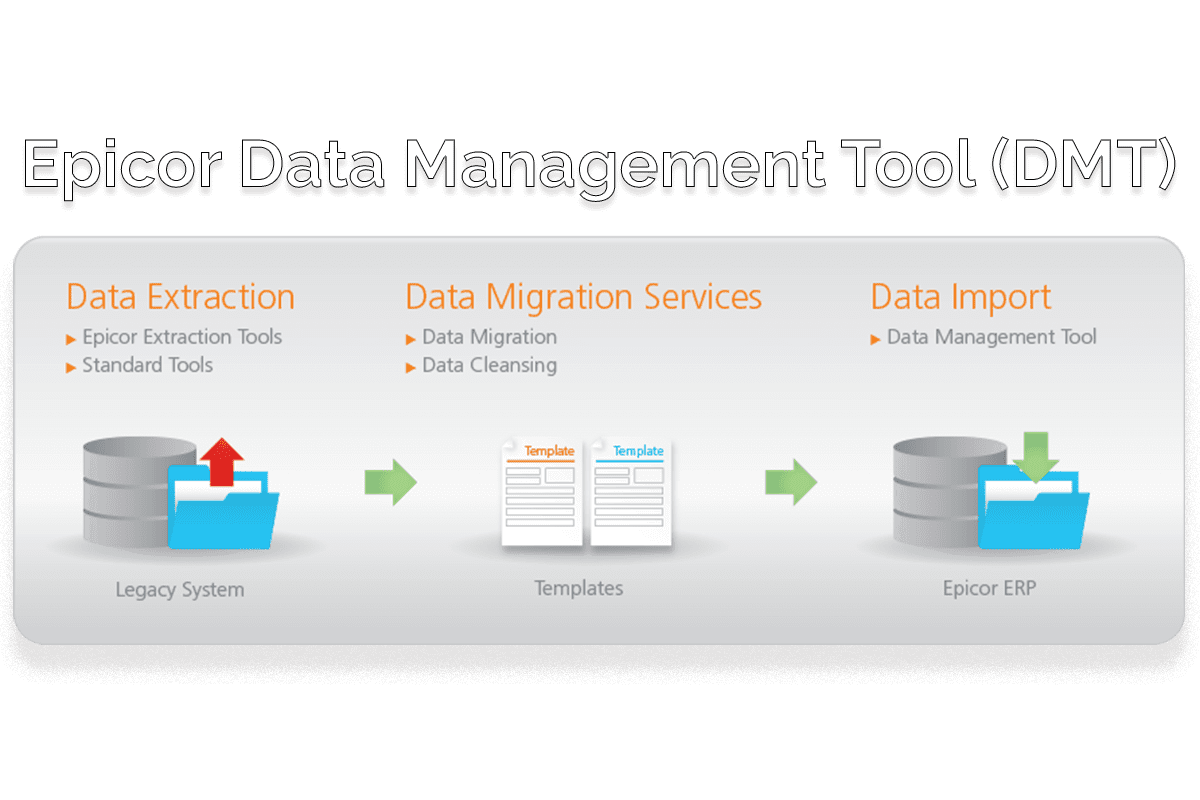
The Epicor Data Management Tool (DMT) is an application that many Epicor ERP clients use to import information into their Epicor systems and to make mass updates. Many clients already know how to use the tool through the standard UI interface. The command line interface allows for interacting with the DMT without the need for user intervention.

The Benefit of Accessing Epicor Data Management Tool via Command Line

By allowing us to interface directly with DMT, this allows for us developers/consultants to quickly import information into Epicor. Such information that can be imported for both new and updating include:

  • Parts
  • Material Issue
  • Return Material
  • Quantity Adjustments
  • Jobs
  • Job Receipt to Inventory
  • Many More

Under normal circumstances, we would need to utilize the standard Business Objects or APIs to make these transactions and updates within the system. This can add a lot of overhead when performing a large number of transactions at a time. Pushing these through the DMT usually allows for us to process a greater number of transactions more quickly, with only the need to write the CSV file and kick off the application.

Getting started with Epicor Data Management Tool (DMT) via Command Line

Epicor provides a good amount of information regarding the DMT and the command line interface. Here is some documentation on it, so long as you have an EpicWeb account. you can find those resources, here.

The above resource provides all of the options that can be used with the DMT.exe and some basic examples. Beyond that, I would recommend anybody who would want to use this to use the DMT to create the templates for what they would want to import. By default, it automatically selects the required fields, so it’s just a matter of adding in the fields that need to be updated/inserted.

Kicking off the DMT via a BPM is how I had originally done this for an Encompass client in Life Sciences manufacturing and I imagine that this would probably be the most universal way for it to be used. With that said, using the DMT in this way is not viable for Cloud clients as the DMT isn’t available for execution from the server side of things.

Cloud clients can still utilize the DMT, even with the command line, but it would need to be through a different methodology, such as a script file or through a local application that has access to the DMT install.

For more information on utilizing Epicor Data Management Tool via Command Line, reach out to Encompass using the link below.

About Encompass Solutions

Encompass Solutions is a business and software consulting firm that specializes in ERP systems, EDI, and Managed Services support for Manufacturers. Serving small and medium-sized businesses since 2001, Encompass modernizes operations and automates processes for hundreds of customers across the globe. Whether undertaking full-scale implementation, integration, or renovation of existing systems, Encompass provides a specialized approach to every client’s needs. By identifying customer requirements and addressing them with the right solutions, we ensure our clients are equipped to match the pace of the Industry.


Everyone is talking about the cloud, especially manufacturers who are evaluating a cloud ERP solution for their business. However, if you don’t quite follow what they’re saying, it comes down to this—using the cloud is using data and systems through the Internet.

How You Already Interact With Cloud Technology

While The Cloud may seem abstract, you likely already interact with and use cloud technologies every day.

  • Do you update a Facebook profile?
  • Do you check your bank balance from your phone?
  • Do you stream movies or music?
  • What about playing games online?

If you answered yes to any of these questions, you are using cloud technology.

Cloud technology has permeated our everyday lives. Now ask yourself, is it as simple for businesses to leverage cloud technology? The answer is yes.

Businesses leveraging cloud technology improve operations in several ways. Examples include improving your cash flow, increasing business capabilities, and simplifying processes for their workforce. All these benefits are realized through the use of an access-from-anywhere platform that is more reliable than traditional ERP deployments that place hardware on-premises.

How Cloud Makes Innovating Easier

By enabling cloud technology at every level of an organization, businesses remove the anxiety associated with security, backups, and verification of backups. Offsite storage becomes a thing of the past and maintenance of hardware and software can be done away with completely. Troubleshooting and upgrades can all be handled with a fraction of the effort.
Perhaps most importantly, connectivity is more reliable in the cloud. This means teams can remain connected and productive anywhere and anytime they need.

Manufacturers questioning whether now is the time to move to the cloud, the answer is a resounding yes. Cybersecurity, IT projects, maintenance activities and more can be removed from the equation with a cloud ERP solution. This leaves your businesses to take care of the business, and make time for customers, employees, and partners.

Simplicity And Dependability of a Cloud ERP Solution

On-premise ERP deployments give businesses a sense of confidence that their data is safely stored just down the hall. While that peace of mind and control is reassuring in theory, in practical terms it can be quite a drain on your IT staff. Maintaining both hardware and software is a headache most IT departments would gladly do without. Cloud enables businesses to shed the tether of physical systems in favor of a more agile and simple solution. With a cloud ERP solution, your teams can focus on running your business more efficiently and taking better care of your customers’ experience.

Cloud ERP solutions operate under the safety of redundancy. Cloud technologies store data securely in multiple data centers locally, regionally, and even globally. This dependability is designed to help businesses maintain system uptime and access no matter what adverse conditions may befall a specific region. These data centers are managed by industry professionals whose sole focus is keeping systems up and running at optimal levels. This frees up resources and capital for your business to focus on growth and improving user experiences across departments. As a result, collaboration among internal teams gets better, the complexity of your information technology resources is reduced, and overall business performance improves.

“The rise of the collaborative workforce and workspace is underway. Increasingly, tech-savvy mobile users are ready for collaborative workspaces with deep integrations to the software they use daily. Collaboration is a key element that helps create the future of work.”

– Worldwide Team Collaborative Applications Forecast, 2019–2023: Collaboration Growth Impacts the Future of Work, IDC, Doc #US44662619, August 2019.

If your business is in the progress of growing or you want to grow, adopting a cloud ERP solution could be an easy way to increase capacity and output without taking on additional software, hardware, or IT personnel. A cloud ERP solution can be scaled up or down with ease, as well.

Savings found in the Cloud

Cloud ERP Solutions are a cost-savings component of business that reduces overhead.

What’s overhead? simply put, overhead is what doesn’t make you money. This includes things like accounting, insurance, and rent.

Antiquated approaches to IT can be a huge source of spending for businesses with maintenance, update tasks, and utility bills, not to mention the extra space servers take up. When working in the cloud, the costs of doing business are driven down. Here’s how.

Reduced Cost of Ownership

Cloud computing removes upfront hardware costs, and the pay-as-you-go subscription model eliminates large initial layouts for software. Easy setup and cash flow-friendly monthly payments make it even easier to see why cloud deployments are so popular—especially when you add the fact that Epicor cloud business software deployments typically cost 25–40% less* than on-premises deployments.

Competitive Advantage

Technology allows your employees to turn on a dime. The cloud provides access to data at a user’s fingertips, ensuring that no matter your company’s size you can compete with enterprise-class technology. The time and money cloud computing free up for your business translates into a lean, nimble, and competitive advantage.

Employee Productivity and Loyalty

With cloud ERP solutions, you can run your business from anywhere there’s an internet connection. Give your employees the ability to produce wherever they happen to be. This enables a better work-life balance that translates to greater loyalty and output. With improved employee loyalty and buy-in, talent turns over less often, this further improves your savings in retaining talent versus having to train new employees more often.

Minimize Downtime With a Cloud ERP Solution

Downtime can cost a company dearly. Cloud ERP solutions can ensure your apps are up and running when you need them most. Cloud-based SaaS applications are proven to minimize downtime, reduce the costs that go along with it, and keep your people productive. Epicor ERP has a service level agreement of 99.5% uptime but performs well beyond that promise with a historical uptime of 99.98%.

Safety, Stability, And Access

Backups are an integral part of any IT department. However, when your backups are stored on-site, you are vulnerable to all manner of internal and external compromises. This can include natural disasters, fire, rogue employees, malicious actors, and the list goes on. any one of these mentioned exposures could cost you irreplaceable data.

The Cloud is the only truly safe place for your backups because they are housed where natural disasters, fires, and all those other potential pitfalls can’t touch them. True backup—the safe keeping of a redundant set of data—is best left to the cloud. It’s the safest, most affordable, and most efficient way to make sure that if you lose everything, all is not lost.

When it comes to stability, cloud systems are simply more stable, better monitored, and more secure than any on-premises system. Unless you have an impenetrable data center protected by intrusion detection, fire suppression, advanced power grids, backup generators, environmental monitoring, and six separate HVAC units inspected every day—all connected by multiple T3 pipelines from multiple vendors and all in a distant geographic location—you’re not as safe as you think.

Accessibility, as in who you want to have access to your systems and who you want to keep out, is a big deal in IT. Add to that lost devices and you’ve compounded the problem. Lost laptops are a billion-dollar business problem. However, the greater problem is the loss and possible theft of the sensitive data stored on those laptops. When your data is stored in the cloud, you can access it no matter what, no matter where. Not only this, but you can lock out anyone when it comes to using that device and you can remotely wipe data from lost laptops at any time.

Now, are you ready to explore the benefits of a Cloud ERP solution for your business?


So, you just purchased a shiny new ERP, and are looking to roll out EDI. You want to get started right away on your EDI project, right? We should be able to set up data and test all transactions out of the box, right? WRONG!

EDI Project Best Practices

EDI is a customized, systemic process, that much like your data, rolls through the quote to cash cycle in a coordinated sequence. Each EDI document requires data from an upstream process, and you must always complete, and validate, the upstream processes first.  A common mistake we see on many EDI projects is an expectation that EDI is plug and play, and that we can implement all documents simultaneously.  EDI is not plugged and play, for the same reason that ERP implementations are not plugged and play.

EDI trading partners are notorious for sending through erroneous or uniquely specific data. Our customers all have different shipping and packaging scenarios. Many customers have different expectations on how EDI data is to be handled. The answer to a successful EDI implementation is to work on each document until it is correct, until moving to the next one, and ensure that the ERP system has been configured and validated for packaging and shipping processes before starting to work on outbound transactions. EDI implementations always lag the ERP implementation by some weeks, and always last the duration of the design and validation stage of the implementation project.

Below are some typical EDI transactions, that must be managed, and processed sequentially.

Inbound Purchase Orders (850i), Demand Forecasts (830i), etc.

Many times, Trading Partners will send data that does not have a native home in ERP. Our EDI team must carefully inspect all the inbound PO documents from all your trading partners, and understand each file, which will be unique, whether there is a native home in Epicor, and if not, we create one for it and make it visible in the ERP through customization. This can take time, and for some trading partners, extensive customer part cross references must be built, so that Epicor ERP can understand what it is in fact that this customer is ordering.

Outbound Sales Acknowledgement (855o)

It is common to need to include custom trading partner data in an 855 outbound. Until all of the inbound maps have been translated, and the data housed in Epicor, we can not start testing 855o.   This is normally not a difficult transaction, but until we have every inbound document defined and a custom schema in place to accommodate your trading partners, we can not design the outbound format for this document for testing.

Outbound Packing Slip (856o)

Most customers expect us to be able to start this right away. Some customers have even demanded that we start this right away. The trouble is that everyone ships differently, and some people have multiple levels of packaging, at various points in their production process, which change how we build the dataset for the 850o. Another common mistake our customers make is asking for the packing labels before the ASN is designed.

The shipping and packaging process must ALWAYS be designed first, and approved, before we start building 856o data and labels. Typically the label would be the last thing we build, as we process through all the 850i for all trading partners, demonstrate all packaging scenarios for each, and then finally, armed with model data, we can construct the outbound ASN dataset and labels. This is especially important when you have multiple versions of labels for different trading partners, or if you have Master Pallets, Mixed Pallets, etc. All EDI projects I have seen go over budget, or that have been frustrated, have been those where the company insists on having working outbound ASNs before the shipping process is validated.

Outbound Invoices (810)

Typically the easiest of all, but these can not be started until a validated ASN document has been produced. As such, we save these until the end of the project, to ensure all the data necessary on the invoice, whether from custom inbound data from the 850o, or custom packaging data from the 856o, are available. Shipments in the system are required to invoice, so there needs to be a solid, unchanging process to generate multiple shipments for the inbound orders, such that they can be invoiced.  This data is typically not available until the last quarter of the implementation.

Listening to your expert EDI implementation consultant, and understanding that EDI will slightly lag the work being done in ERP and that the work will stretch the duration of the project, are key to a successful EDI implementation. Following our process and methodology and will minimize frustrations if expectations were that EDI would be ready on day one, and reduce or eliminate rework for any EDI transactions forced through before the system is validated.

If you are having a difficult implementation and would like to talk to Encompass about how to put things back on track, we would be happy to conduct a mid-ERP implementation review. If you are about to start an EDI implementation, understanding the above before starting, and ensuring that the project manager and steering committee understand the timeline, will be critical to meeting expectations, and ultimately having a successful, error-free cutover.

About Encompass Solutions

Encompass Solutions is a business and software consulting firm that specializes in ERP systems, EDI, and Managed Services support for Manufacturers. Serving small and medium-sized businesses since 2001, Encompass modernizes operations and automates processes for hundreds of customers across the globe. Whether undertaking full-scale implementation, integration, or renovation of existing systems, Encompass provides a specialized approach to every client’s needs. By identifying customer requirements and addressing them with the right solutions, we ensure our clients are equipped to match the pace of the Industry.


To run a successful operation, every manufacturing organization needs a modern enterprise resource planning (ERP) system to boost efficiencies and drive down costs. However, with so many options available, it can be difficult to make the right choice. If you’re wondering whether a generic or industry-specific solution is the best fit for your business—or if you’re wondering how to even start the ERP selection process—you’re not alone.

In this white paper, you’ll discover ways to simplify your ERP selection process, and you’ll learn the differences between industry-specific and generic ERP solutions.


About Encompass Solutions

Encompass Solutions is a business and software consulting firm that specializes in ERP systems, EDI, and Managed Services support for Manufacturers and Distributors. Serving small and medium-sized businesses since 2001, Encompass modernizes operations and automates processes for hundreds of customers across the globe. Whether undertaking full-scale implementation, integration, or renovation of existing systems, Encompass provides a specialized approach to every client’s needs. By identifying customer requirements and addressing them with the right solutions, we ensure our clients are equipped to match the pace of the Industry.


Deciding to invest in ERP software for your business is a huge milestone and signals your business is moving in the right direction for growth. Financing ERP software is one option you may want to consider if sticker shock has left you hesitant to proceed with purchasing a system for implementation.

Fortunately, it is not all that difficult to finance ERP. By leveraging these options, you can continue running your business as usual without committing a big chunk of your budget at once.

Another attractive option for businesses considering the purchase of an ERP system is the option to leverage a software tax deduction through IRS Section 179.

Contact Encompass Solutions today to learn more about your ERP financing options.

Why You Should Consider Financing ERP Software

If you’re already evaluating an ERP system and the price tag has put the brakes on your project, fear not. You don’t have to commit all that capital to an ERP software purchase all at once.

At this stage in the buying process, you likely understand how beneficial an ERP system can be for a growing business. Everything from accepting and processing orders to managing inventory and shipping to financial reporting can be completed in one, unified ERP system. Whether you purchase your ERP software as an out-of-the-box solution or customize it to your specific needs, the price may be high.

Fortunately, financing options are available to you that can make that purchase a far more manageable process.

Here are some things to consider in favor of financing your ERP implementation project:

  • Preserving capital through a financing option will allow you to start your implementation project immediately, leaving your precious capital available for use in other areas of your business.
  • Taking advantage of flexible payment options means you can structure the terms of your payment to fit your unique needs and business objectives.
  • Leasing ERP software is easy, simple, and intuitive. You can finance your ERP purchase as easily as you finance a home, car, or other common purchase.
  • Reduce long-term debt exposure through financing your ERP system to maintain a better Balance Sheet. With less debt, you will have access to more capital to further improve your business processes or expand operations.

Your ERP Software Financing Options

Manufacturers may be surprised to find that they have an array of options to consider when financing ERP software purchases. Loans and grants are just two of the most common options available.

Government programs allow manufacturers to apply for and be awarded grants and low-interest loans to put towards ERP software projects. A business needs to satisfy only a few criteria before it can be considered for such government-sponsored financing programs. You can find a sampling of such funding and grant programs at the manufacturing.gov website.

Alternatively, a company can work with an ERP implementation partner to scope out their project and approach private lenders who specialize in ERP financing.

Whichever option you choose to pursue, Encompass Solutions is experienced in financing ERP for manufacturers and can help you, from start to finish.

We’re Here to Help

Encompass Solutions works directly with companies that specialize in financing ERP software purchases. With our help and these strategic partnerships, you can manage your buying process more easily. That leaves you more energy to focus on things like implementation and training your employees on how to use ERP for the greatest benefit.

By working with us and our financing partners, you can break up payments into manageable sums spread out over time. This results in a powerful ERP system for your business and a low monthly payment that is easy to manage.

Our partners can help you finance ERP software and projects, including:

  • Software licenses – Perpetual and subscriptions.
  • Services such as implementation, project management, consulting, and training.
  • Prepaid, Multi-year SaaS agreements
  • Hosted Applications
  • Customized Website Development Costs

With financing terms available for between 24 and 60 months, you can reap the benefits of ERP now and worry about settling the bill later.

Consider working with Encompass and our partners on your next ERP project to leverage such benefits as:

  • Budget-friendly monthly payments with no large up-front costs
  • Conserve cash with 100% financing
  • Match cash outlay with benefits of the solution
  • Aggressive fixed rates
  • Credit approvals up to $250,000 without financial statements
  • Preservation of existing credit facilities

Want a better idea of how your financial plan will be structured? Use this intuitive ERP financing calculator to get answers to your ERP financing questions today.


If you have not read the writing on the wall, cloud-based technologies and digital transformation initiatives are quickly becoming the focus for enterprises around the world. Providing more security, reliability, and mobility, cloud technologies simply provide too many benefits to ignore. However, their adoption is not always easy. As with any significant change at the organizational level, cloud ERP implementation challenges can stack up quickly. Here are the top 5 challenges in cloud ERP implementation and how you can address them before they impact your success.

Cloud ERP Implementation Challenges

While there are far more than five challenges that cloud ERP implementation may present to an organization, these are what we have found to be the most common. Several of these challenges are compounded by the increased reliance on remote workforces and the inability to meet in person due to environmental factors.

1. Change Management

While the age-old adage is nothing is certain but death and taxes, in business the only constant changes. For most people who are comfortably entrenched in the predictability of a routine, change can be a “four-letter word”. In most cases, change will be unsurprisingly met with resistance.

Change management will be one of your biggest hurdles in moving towards a complete cloud ERP solution from a system that was either previously on-prem or a hybrid deployment model of on-prem and cloud-based.

The easiest way to address the inherent resistance to change is to illustrate where things will improve. This is done not just by saying things will be new and modern. Show where those improvements will take place, and the cost savings and gains in productivity that system users and the company can expect to reap.

2. Focus

The last several months have pretty much done away with the divide between work life and personal life for a significant portion of the global workforce. Transitioning to remote work from home has presented unique challenges for enterprises of every size.

The result has been a muddying of work hours, family obligations, self-care, and a host of other responsibilities in one venue, without end.

The ability to focus on implementation can be a challenge in the best conditions. In a completely remote environment, where distractions are abundant, maintaining focus will be a challenge that presents itself consistently.

To overcome distraction and maintain focus, set aside specific windows of time for core project components. Businesses need to be open to scheduling compromises with employees and their families when the lines blur between work and home. By compromising on specific project hours, there is a higher probability of remaining focused on the progress of your implementation project. The remaining work time can be more fluid as the separation of workday duties and household obligations continue to muddy.

3. Security

One of your project initiatives may be an effort to move towards heightened system security. This is a great feature of Cloud ERP. However, during the implementation phase, you may not have advanced security in place to maintain your sensitive data. This security becomes even more difficult to maintain between remote resources, like staff and their workstations.

Make it a point to understand the risks upfront. You can take on the challenge alone, hire a consultant, or work in tandem with your implementation partner to find the right protocol for your case. A simple step, like password-protecting Wi-Fi connections, not allowing users other than staff to utilize remote workstations is a necessary first layer of security.

Firewalls and network security software should follow. If you do not provide the hardware your staff will be working from while remote, you may want to consider doing so. A small investment in this area can result in big savings when you consider the alternative.

Lastly, have a plan in place, both documented and practiced, with your staff. Make sure they understand the risks and the results of a security breach and demonstrate the protocol they are going to follow moving forward.

4. Access, Permissions, and Productivity

Yeah, I know that’s three things but each build on the former to deliver a complete effort. So, in the interest of time and space, they’ve been combined.

Not everyone on your cloud ERP implementation project will need access to all components of your system. Working with IT to designate the proper permissions will be critical in ensuring that staff remain on task and don’t have an opportunity to ruin transitioning data, either by malice or mistake.

Provisioning web and mobile access may fit into this implementation scenario, too. If your staff has spotty connections based on their location, consider bolstering their coverage through their provider to ensure your project isn’t impeded by poor connectivity. This is usually as simple as flipping a switch on the provider’s end. This way, you won’t lose precious time in the event cloud cover conceals the satellite internet connection of your data analyst in rural Illinois.

5. Knowledge

When leaping on-prem and, in many cases, outdated data management systems, tribal knowledge, and training will be integral as you move forward.

By relying on your most knowledgeable IT professionals and department heads to deliver their expertise during the cloud ERP implementation process, you have your top minds tackling your biggest challenge yet. However, there will be scenarios for which even they are not prepared. This is where training can be one of your biggest assets. Whether training is provided by your vendor or consultant of choice, or you have chosen to produce your training plan, enabling your project staff with defined direction and knowledge will ensure their success.

Lack of familiarity with a new environment is sure to produce plenty of anxiety and opportunities for missteps. Proper planning can help to mitigate these pitfalls. Having an experienced and knowledgeable guide through the process can eliminate them. That is because every implementation is different, and every company is different. With the experience of an implementation professional, there is a wider breadth of experience to draw from in the event an obstacle presents itself.

There will inevitably be some unexpected challenges for even the most experienced vendors, VARs, and consultants to guide you through. However, doing your research and taking the time to get familiar with the nuances of a cloud ERP implementation will impart the confidence and understanding any business needs to go through the project on their own.

About Encompass Solutions

Encompass Solutions is a business and software consulting firm that specializes in ERP systems, EDI, and Managed Services. Serving small and medium-sized businesses since 2001, Encompass modernizes operations and automates processes for hundreds of customers across the globe. Whether undertaking full-scale implementation, integration, and renovation of existing systems, Encompass provides a specialized approach to every client’s needs. By identifying customer requirements and addressing them with the right solutions, we ensure our clients are equipped to match the pace of the Industry.


Encompass Solutions delivers an array of useful services to support your business beyond ERP implementation. Whether you need IT support for your on-prem or cloud-deployed ERP system, EDI management, or system patch management services, we are fully equipped to deliver on your needs. Make use of these managed services promotions to ensure your business has the support necessary to enjoy continued success.

Keep in mind, These offers apply to any of the Managed Services coverage levels outlined HERE.

Managed Services Promotions

Whether assisting with infrastructure support, reporting customization, Epicor patch management, or EDI-managed services, we are proud to add value to our customers.

New Managed Services customers committing contracts can take advantage of considerable savings on waived fees and free services.

6-Month Commitment: onboarding fee waived (up to a $2,000 value)

12-Month Commitment: onboarding fee waived and an additional 1-month service included (up to a $4000 value)

Offer Terms and Conditions

  • To remain eligible for discounts, commitments must be signed by October 30th, 2020
  • Terms are based on your organization’s Managed Services Proposal
  • If a 12-month agreement is broken, the user owes the remainder of the contract and waived onboarding fee
  • If a 6-month agreement is broken, the user owes the remainder of the contract and waived onboarding fee
  • Contract termination based on service subject to review and approval
  • As an introductory offer, contract promotions are available to new Managed Services customers only.

For any questions or to request customer referrals on our Managed Services offerings, please contact us to set up a meeting.

About Encompass Solutions

Encompass Solutions is a business and software consulting firm that specializes in ERP systems, EDI, and Managed Services support for Manufacturers and Distributors. Serving small and medium-sized businesses since 2001, Encompass modernizes operations and automates processes for hundreds of customers across the globe. Whether undertaking full-scale implementation, integration, and renovation of existing systems, Encompass provides a specialized approach to every client’s needs. By identifying customer requirements and addressing them with the right solutions, we ensure our clients are equipped to match the pace of the Industry.


Given the uncertainty of today’s business climate, owners and managers have a lot of questions about everything from sales and operations to logistics and inventory. The answers to these questions will help determine the next steps, whether it’s to pursue new products or markets, drop underperforming branches, or reduce raw goods in the face of industry slowdowns. All of these are real scenarios, and making gut decisions feel or based on traditions is likely to result in disappointments, or worse, losses. Data analytics has never been more important to help organizations find answers to their critical business questions and help owners and executives understand how their businesses are truly performing.

Data Analytics From The Source

For most companies, there are multiple sources of data, as well as untapped data silos where undervalued information may reside. Keeping pace with this growing data, as well as ensuring key pieces of information are considered for decision-making, can be exhausting. Many ERP systems, as important as they are to business processes, were not created for intuitive data access and analysis. In addition, if Excel spreadsheets are the foundation of your reporting, then true data analysis can be challenging as you are limited to the static numbers that you can see, and not perhaps the beauty of the details beneath the surface. This is why understanding business performance, and truly digging into the details to find answers to shape strategic decision-making, is challenging.

But this is why Epicor Data Analytics (EDA) is so valuable to businesses. EDA was built from the ground up to provide access to intuitive data analytics for users of all skill levels. Data is critical to everyone’s role, so limiting access and analysis to specialists, or managers and higher, limits what team members can do within their roles and responsibilities.

Perhaps the strength of EDA and data analytics is the ability to turn raw information into easy-to-understand dashboards and scorecards. Modern data analytics systems such as EDA enable users to quickly and easily connect diverse data sources into a single source of truth and conduct ad hoc analysis. The software does most of the heavy lifting, presenting results in an interactive dashboard that can be shared with other team members, customers, and decision-makers.

Measuring Business Success

Converting the data into a visual presentation such as a chart, graph, or table, eliminates much of the guesswork, providing clear indicators of challenges and opportunities. In addition, with a simple click, users can drill down, down, or use advanced dashboard filters, to view the underlying transactions or take the analysis even further to different angles or more levels of granularity. These fully customizable dashboards and scorecards help companies to combine all of their information into a single location so that the entire business is referring to and analyzing the same information.

Armed with access to a single source of truth, easy-to-use data analytics, easy-to-understand and interactive dashboards and scorecards, team members across the organization can be empowered with the ability to make important, data-driven decisions. This level of information strengthens the ownership that everyone in the company has in their role and area of responsibility. Perhaps more importantly, it makes tracking performance across individuals and departments, and as a whole, easier and more powerful, as owners and executives can monitor the business from all levels, providing a much more comprehensive picture of performance.

Dashboards and Scorecards Webinar

To learn more about EDA, the importance of data analytics, and how to use dashboards and scorecards to track business performance, watch the recorded webinar:

About Encompass Solutions

Encompass Solutions is a business and software consulting firm that specializes in ERP systems, EDI, and Managed Services support for Manufacturers and Distributors. Serving small and medium-sized businesses since 2001, Encompass modernizes operations and automates processes for hundreds of customers across the globe. Whether undertaking full-scale implementation, integration, and renovation of existing systems, Encompass provides a specialized approach to every client’s needs. By identifying customer requirements and addressing them with the right solutions, we ensure our clients are equipped to match the pace of the Industry.

1 10 11 12 13 14 26